English


SETI Institute
The SETI Institute is a non-profit research organization whose mission is to explore, understand…
Reads at Grades 6–8 Listens at Grades 4–8
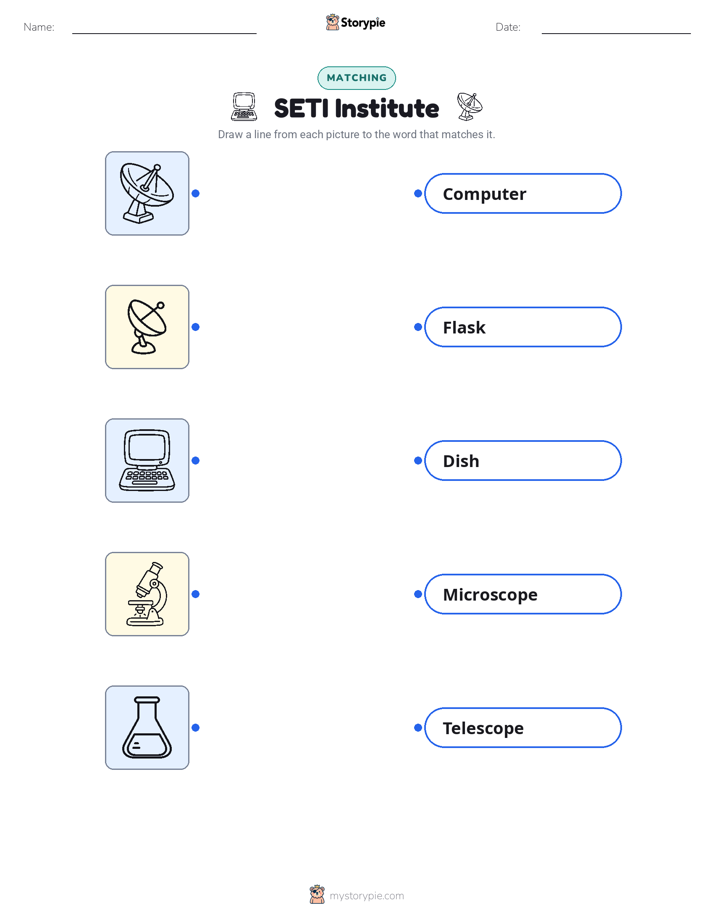
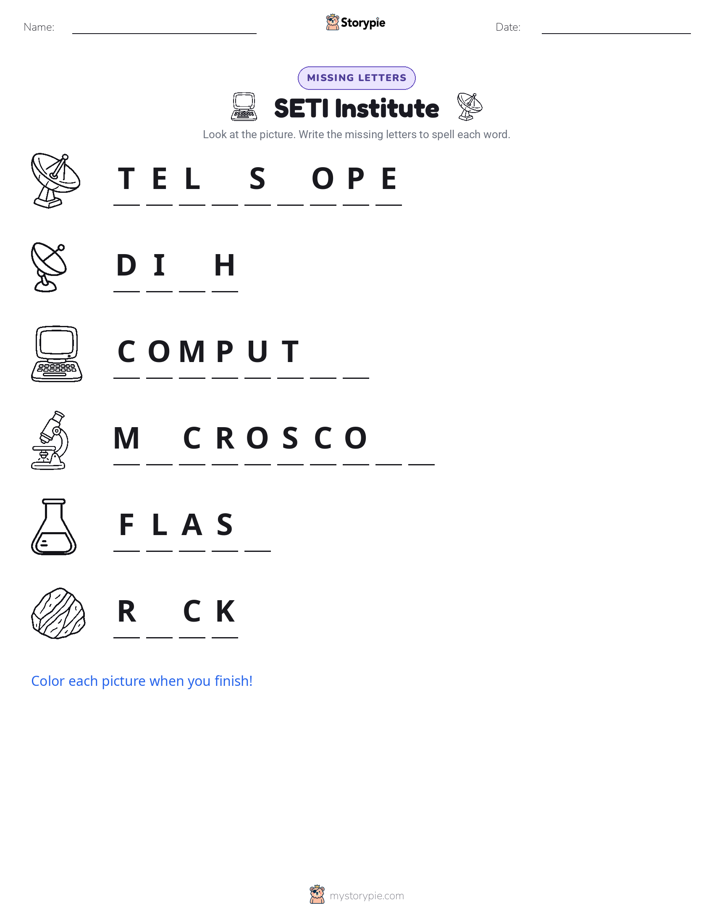
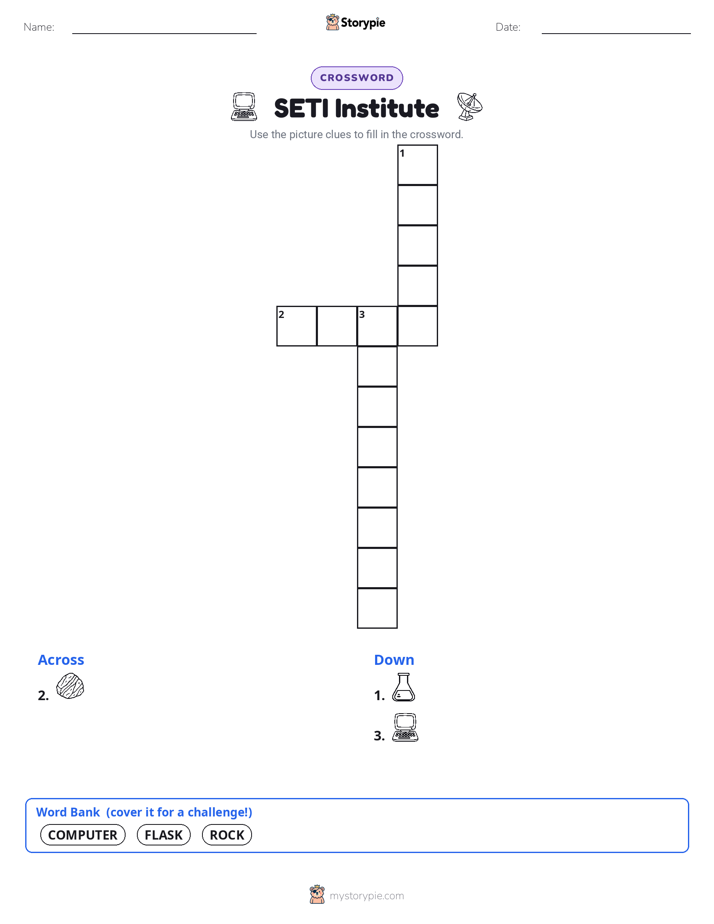
Print & create
Answer keys·No prep·Free with an account
28 worksheets · answer keys · full story · quiz · Ages 10-12 · CEFR B2
Plus adds 116,000+ more stories in 27 languages, audio for every one, and printables for all of them.
Just want SETI Institute?
Hello. We are the SETI Institute. Our full name stands for the Search for Extraterrestrial Intelligence, and our work is dedicated to one of the most profound questions humanity has ever asked: are we alone in the universe? As a non-profit scientific research organization, our central mission is to explore, understand, and explain the origin and nature of life. We use the tools of science to investigate the possibility that life exists beyond Earth. This question has inspired people for centuries, long before we had the technology to begin searching for an answer. Our job is to turn that ancient wonder into a modern scientific quest.
Our story as a formal organization began on November 20th, 1984. Before that time, the search for signals from space was conducted by individual scientists or as parts of larger projects, but there was no single institution dedicated to this specific goal. Our founding was driven by scientists, including Jill Tarter, who believed this important work needed a permanent home where research could be sustained for the long term. We were also supported by pioneers in the field, like the famous astronomer Carl Sagan, who helped share the importance of this search with the world. We established our base in California's Silicon Valley. This location was no accident; being in a global center for technology and innovation put us right where the new ideas and advanced tools we would need for our work were being developed.
From our earliest days, a major part of our work has been listening to the cosmos. We use enormous radio telescopes, which act like giant ears pointed at the sky, to capture faint radio waves traveling across the vast distances of space. We are not just listening for any sound; we are searching for a very specific kind of signal. The universe is full of natural radio noise from stars, galaxies, and pulsars. We search for signals that stand out from this background noise—signals that appear to have been created by technology. An artificial signal might have a structure, a pattern, or a narrow frequency that nature doesn't typically produce. Finding such a signal could be a potential sign of intelligent life somewhere else.
The Search for Life: A Story of the SETI Institute
Hello. We are the SETI Institute. Our full name stands for the Search for Extraterrestrial Intelligence, and our work is dedicated to one of the most profound questions humanity has ever asked: are we alone in the universe? As a non-profit scientific research organization, our central mission is to explore, understand, and explain the origin and nature of life. We use the tools of science to investigate the possibility that life exists beyond Earth. This question has inspired people for centuries, long before we had the technology to begin searching for an answer. Our job is to turn that ancient wonder into a modern scientific quest.
Our story as a formal organization began on November 20th, 1984. Before that time, the search for signals from space was conducted by individual scientists or as parts of larger projects, but there was no single institution dedicated to this specific goal. Our founding was driven by scientists, including Jill Tarter, who believed this important work needed a permanent home where research could be sustained for the long term. We were also supported by pioneers in the field, like the famous astronomer Carl Sagan, who helped share the importance of this search with the world. We established our base in California's Silicon Valley. This location was no accident; being in a global center for technology and innovation put us right where the new ideas and advanced tools we would need for our work were being developed.
From our earliest days, a major part of our work has been listening to the cosmos. We use enormous radio telescopes, which act like giant ears pointed at the sky, to capture faint radio waves traveling across the vast distances of space. We are not just listening for any sound; we are searching for a very specific kind of signal. The universe is full of natural radio noise from stars, galaxies, and pulsars. We search for signals that stand out from this background noise—signals that appear to have been created by technology. An artificial signal might have a structure, a pattern, or a narrow frequency that nature doesn't typically produce. Finding such a signal could be a potential sign of intelligent life somewhere else.
One of our first major efforts to conduct this type of search was called Project Phoenix. For this project, we carefully scanned about 800 stars that are relatively close to our own sun. It was a systematic and focused search, but it also highlighted the immense challenge we face. The biggest difficulty is the sheer scale of the universe. There are not just hundreds or thousands of stars, but billions of them in our galaxy alone. We don't know which direction to point our telescopes, what frequency to listen on, or what a potential signal would even sound like. It is like searching for a single, specific grain of sand on all the beaches of the world.
To help us overcome this incredible challenge, we knew we needed a new and more powerful tool designed specifically for our search. That is why we partnered with the University of California, Berkeley, to design and build a revolutionary instrument: the Allen Telescope Array, or ATA. Located at the Hat Creek Radio Observatory in the mountains of northern California, the ATA looks different from many other radio telescopes. Instead of having one single, giant dish, it is made up of many smaller dishes, all linked together by powerful computers. This unique design gives us a huge advantage. It allows us to scan very large areas of the sky at once, and it lets us listen on many different frequencies at the same time. The ATA is a powerful tool that dramatically speeds up our search and increases our chances of one day finding a signal.
However, our work is about more than just listening for signals from distant stars. Our scientists are key contributors to a fascinating field called astrobiology. Astrobiology is the study of life in the universe—its origins, its evolution, and its future. To understand where life might exist beyond Earth, we must first understand the incredible resilience of life on our own planet. Our astrobiologists travel to some of the most extreme environments imaginable right here on Earth. They study microorganisms that thrive in the boiling water of volcanic vents deep in the ocean or in extremely dry deserts where there is almost no water. By learning how life can survive and even flourish in these harsh conditions, we get a better idea of how life might exist on other worlds that seem hostile to us, like the cold, thin atmosphere of Mars or the ice-covered moons of Jupiter. This research helps us know what kinds of signs of life, or biosignatures, to look for when we send probes and rovers to explore other planets and moons in our solar system.
Today, our mission continues on all of these fronts. We are constantly searching the skies with the Allen Telescope Array and using other powerful telescopes around the world to expand our reach into the cosmos. As space missions like the Kepler Space Telescope and the James Webb Space Telescope discover thousands of new exoplanets—planets orbiting other stars—our work has gained a new focus. We analyze the data from these missions to help identify the most promising places to search for life, such as planets that are at the right distance from their star to have liquid water. At the same time, we believe it is vital to share our journey of discovery with everyone. Education and public outreach are a big part of our mission. We work to share our science with students and the public to inspire the next generation of explorers, scientists, and thinkers who will continue this extraordinary search for answers among the stars.
Wow facts
About
The SETI Institute is a non-profit research organization whose mission is to explore, understand, and explain the origin and nature of life and intelligence in the universe.
Take a Quiz
Question 1 of 5
What is the primary mission of the SETI Institute?
Explore next






Want to do even more?
Go beyond exploring. Unlock tools that turn every story into real learning.

Storypie Plus for families
Full stories, quizzes, and printables. Nights and car rides, sorted.
- Unlimited audio stories
- Create Mode: your child stars in the story
- Offline downloads
- Printable worksheets & coloring pages

Why Storypie for Schools
Students engaged. Prep in seconds. Evenings back to you.
- Worksheets & Quizzes
- Classroom Management
- Formative Assessment
- Custom Curriculum & Lesson Plans
- 27 Languages

Why Storypie for Homeschool
Curriculum done. They'll ask for more. Hours back in your day.
- Worksheet Generator
- First-Person Audio Stories
- Built-in Comprehension Quizzes
- Custom Curriculum & Lesson Plans
- Print & Go Activities