English

Smithsonian Institution
The Smithsonian Institution is the world's largest museum, education, and research complex…
Reads at Grades 6–8 Listens at Grades 4–8
Print & create
Answer keys·No prep·Free with an account
28 worksheets · answer keys · full story · quiz · Ages 10-12 · CEFR B2
Plus adds 164,000+ more stories in 27 languages, audio for every one, and printables for all of them.
Just want Smithsonian Institution?
We are the Smithsonian Institution, and our story begins not in America, but across the ocean with a generous and surprising gift. Our founder was a British scientist named James Smithson. He was a man of great curiosity, but one of the most remarkable facts about him is that he never once set foot in the United States. Despite this, when he passed away, he left his entire fortune to the country. His request was specific and powerful: he wanted his wealth to be used to create an establishment in Washington, D.C., for the “increase and diffusion of knowledge.”
This unusual gift from a stranger sparked a great deal of discussion. For years, the U.S. Congress debated what to do. What did it mean to increase and diffuse knowledge? How should such an organization be structured? It was a new and exciting idea for a young nation. Finally, after careful consideration, Congress officially accepted the gift. On August 10th, 1846, an act was signed into law, and we, the Smithsonian Institution, were formally established. From that day forward, our purpose has been to fulfill James Smithson's vision of gathering knowledge and sharing it with people everywhere.
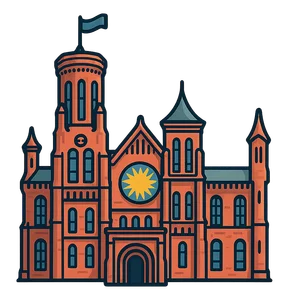
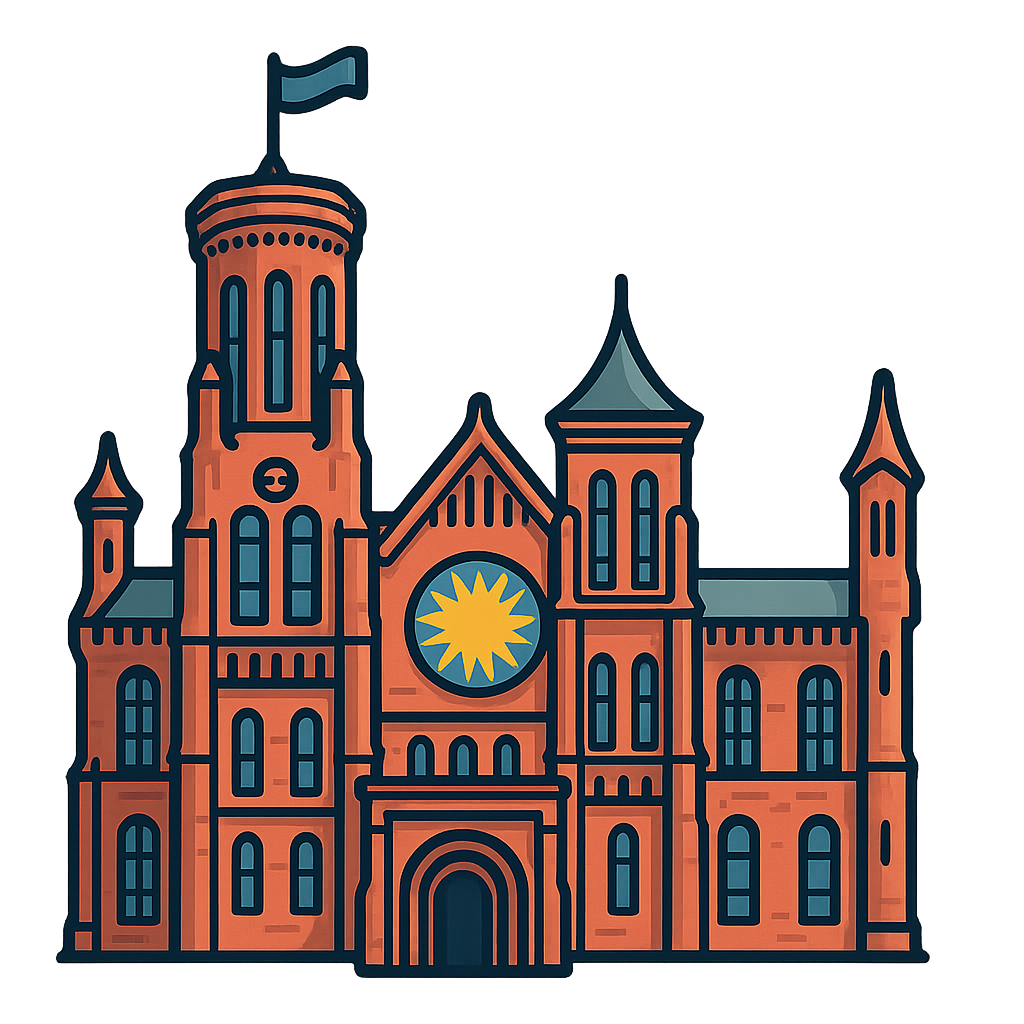
Our first physical home was a beautiful building made of red sandstone, which soon became a landmark in Washington, D.C. Today, it is known as the Smithsonian Castle and serves as our visitor center and headquarters. Our first leader, or Secretary, was a respected scientist named Joseph Henry. He helped shape our early mission, emphasizing the importance of original research. He believed that our primary duty was not just to collect items, but to support new scientific discoveries and then share that new understanding with the public. This dual focus on research and education became a core part of our identity.
The Smithsonian Institution: A Gift for Everyone
We are the Smithsonian Institution, and our story begins not in America, but across the ocean with a generous and surprising gift. Our founder was a British scientist named James Smithson. He was a man of great curiosity, but one of the most remarkable facts about him is that he never once set foot in the United States. Despite this, when he passed away, he left his entire fortune to the country. His request was specific and powerful: he wanted his wealth to be used to create an establishment in Washington, D.C., for the “increase and diffusion of knowledge.”
This unusual gift from a stranger sparked a great deal of discussion. For years, the U.S. Congress debated what to do. What did it mean to increase and diffuse knowledge? How should such an organization be structured? It was a new and exciting idea for a young nation. Finally, after careful consideration, Congress officially accepted the gift. On August 10th, 1846, an act was signed into law, and we, the Smithsonian Institution, were formally established. From that day forward, our purpose has been to fulfill James Smithson's vision of gathering knowledge and sharing it with people everywhere.
Our first physical home was a beautiful building made of red sandstone, which soon became a landmark in Washington, D.C. Today, it is known as the Smithsonian Castle and serves as our visitor center and headquarters. Our first leader, or Secretary, was a respected scientist named Joseph Henry. He helped shape our early mission, emphasizing the importance of original research. He believed that our primary duty was not just to collect items, but to support new scientific discoveries and then share that new understanding with the public. This dual focus on research and education became a core part of our identity.
Under Henry’s guidance, we began to build our collection. We supported scientific expeditions that traveled across the American West and around the world, gathering specimens of plants, animals, and minerals. We also started to acquire important historical artifacts that told the story of the United States. As our collection grew from thousands to millions of objects, we earned a popular nickname: “the nation’s attic.” This name captured the idea that we were the caretakers of a vast and wonderfully diverse assortment of American treasures, from the everyday to the extraordinary, all preserved for future generations.
Over the next century, it became clear that a single building, even one as grand as our Castle, could not hold our growing collection or represent the expanding fields of knowledge. We began to grow into a family of museums. Instead of one institution trying to cover everything, we established separate museums, each with a special focus. The National Museum of Natural History was created to house our immense collection of specimens from the natural world. Later, the National Air and Space Museum opened to celebrate the history of flight and space exploration. Our growth wasn't limited to Washington, D.C., or even to the United States. Our mission to increase knowledge led us to establish research centers across the globe.
Our scientific work now spans the planet and beyond. At our Smithsonian Tropical Research Institute in Panama, scientists study the incredible biodiversity of tropical rainforests to better understand these vital ecosystems. Far from the jungle, our Smithsonian Astrophysical Observatory uses powerful telescopes to peer into deep space, studying distant stars, galaxies, and the very origins of the universe. These research outposts, and many others like them, allow us to continue making the new discoveries that our first leader, Joseph Henry, considered so important to our mission.
Today, we continue to carry out James Smithson’s founding mission, but we also recognize that the work of sharing knowledge is never truly finished. In recent decades, we have made a dedicated effort to tell a more complete and inclusive story of America—one that represents the diverse experiences of all its people. This commitment led to the opening of important new museums, such as the National Museum of the American Indian, which honors the history and living cultures of Native peoples, and the National Museum of African American History and Culture, which explores the richness and complexity of the African American experience.
Our family has grown to include 19 museums, the National Zoological Park, and a global network of research centers. We protect the nation’s heritage, from presidential portraits and the original Star-Spangled Banner to dinosaur skeletons and the Apollo command module. We strive to make this shared heritage accessible to everyone, whether they visit us in person or connect with us online. Our work is a living conversation between the past, present, and future, all made possible by a surprising gift from a scientist who believed in the power of knowledge to change the world.
Wow facts
About
The Smithsonian Institution is the world's largest museum, education, and research complex, established in 1846 with a bequest from British scientist James Smithson to found an establishment 'for the increase and diffusion of knowledge.'
Take a Quiz
Question 1 of 5
What was the direct result of James Smithson's gift to the United States?
Explore next





Want to do even more?
Go beyond exploring. Unlock tools that turn every story into real learning.

Storypie Plus for families
Full stories, quizzes, and printables. Nights and car rides, sorted.
- Unlimited audio stories
- Create Mode: your child stars in the story
- Offline downloads
- Printable worksheets & coloring pages

Why Storypie for Schools
Students engaged. Prep in seconds. Evenings back to you.
- Worksheets & Quizzes
- Classroom Management
- Formative Assessment
- Custom Curriculum & Lesson Plans
- 27 Languages

Why Storypie for Homeschool
Curriculum done. They'll ask for more. Hours back in your day.
- Worksheet Generator
- First-Person Audio Stories
- Built-in Comprehension Quizzes
- Custom Curriculum & Lesson Plans
- Print & Go Activities