English

World Meteorological Organization
The World Meteorological Organization (WMO) is a specialized agency of the United Nations responsible for…
Reads at Grades 3–5 Listens at Grades 1–5
Print & create
Answer keys·No prep·Free with an account
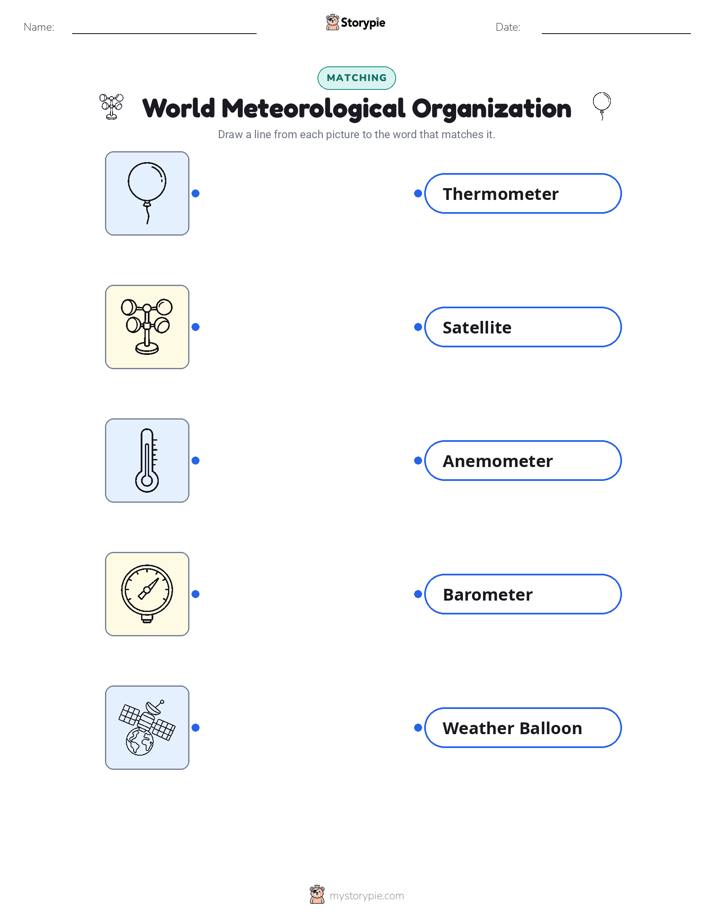
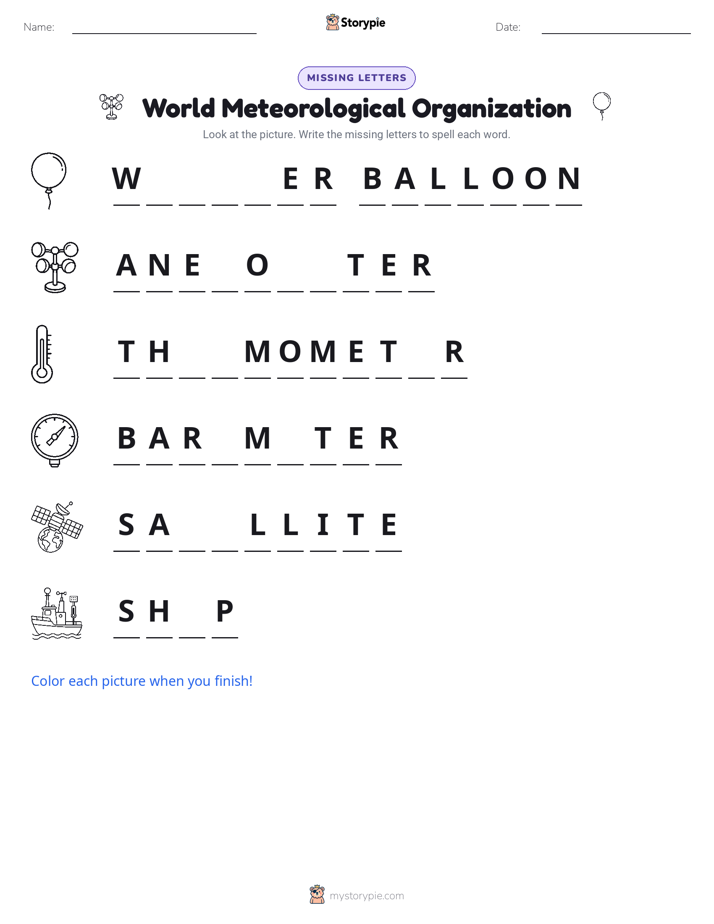
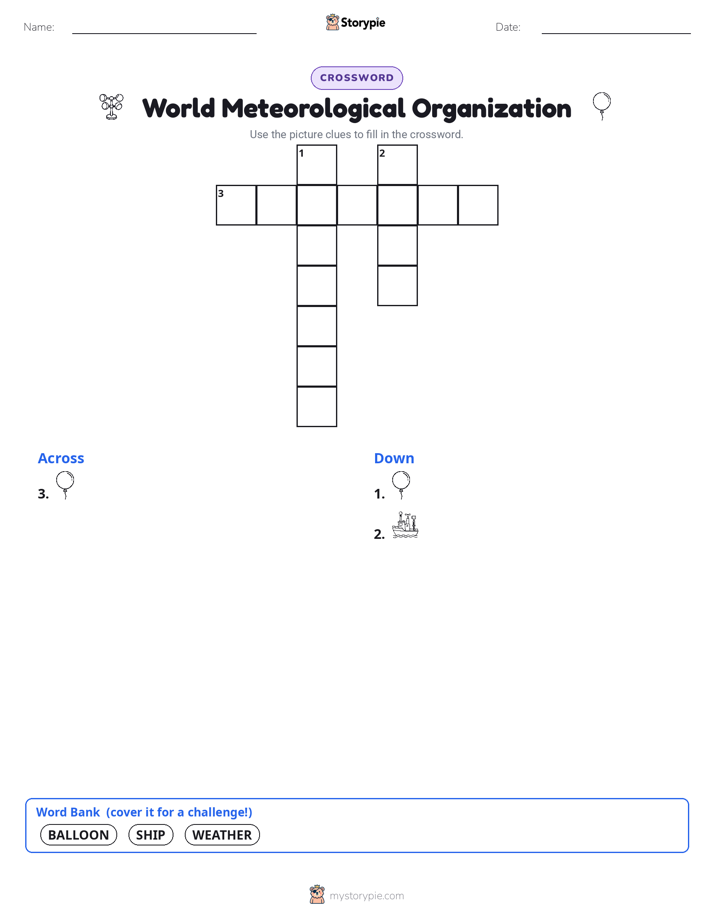
28 worksheets · answer keys · full story · quiz · Ages 8-10 · CEFR B1
Plus adds 116,000+ more stories in 27 languages, audio for every one, and printables for all of them.
Just want World Meteorological Organization?
Hello! We are the World Meteorological Organization, and you might hear people call us by our initials, WMO. We are a special part of a larger group of nations called the United Nations. Think of us as a global team of helpers. Our mission is to bring countries from all over the world together to study some of the most powerful forces on our planet: Earth’s weather, its long-term climate, and its precious water resources. By working as one, we can gather and share important information that helps keep people everywhere safe, prepared, and well-informed about the world around them.
Our main goal has always been to make weather forecasting more accurate and to help everyone better understand our planet's complex climate. We were officially established on March 23rd, 1950. Before we were formed, another international group was already doing similar work, and we were created to continue and expand that important mission. From the very beginning, we knew that to understand global weather, we needed a global team. No single country can see the whole picture on its own, so our purpose is to make sure everyone can work together as partners.
One of the first challenges we tackled was making sure that scientists everywhere were speaking the same language when it came to weather data. Imagine if one country measured temperature in one way, and another country used a completely different method. It would be impossible to compare their information! To solve this, we helped create a single set of international standards, or rules, for how to measure things like temperature, rainfall, and wind speed. Because of these shared rules, a measurement taken in one part of the world can be accurately compared with a measurement taken thousands of miles away. This allows us to build a reliable and complete picture of Earth’s weather.
We Are the World Meteorological Organization
Hello! We are the World Meteorological Organization, and you might hear people call us by our initials, WMO. We are a special part of a larger group of nations called the United Nations. Think of us as a global team of helpers. Our mission is to bring countries from all over the world together to study some of the most powerful forces on our planet: Earth’s weather, its long-term climate, and its precious water resources. By working as one, we can gather and share important information that helps keep people everywhere safe, prepared, and well-informed about the world around them.
Our main goal has always been to make weather forecasting more accurate and to help everyone better understand our planet's complex climate. We were officially established on March 23rd, 1950. Before we were formed, another international group was already doing similar work, and we were created to continue and expand that important mission. From the very beginning, we knew that to understand global weather, we needed a global team. No single country can see the whole picture on its own, so our purpose is to make sure everyone can work together as partners.
One of the first challenges we tackled was making sure that scientists everywhere were speaking the same language when it came to weather data. Imagine if one country measured temperature in one way, and another country used a completely different method. It would be impossible to compare their information! To solve this, we helped create a single set of international standards, or rules, for how to measure things like temperature, rainfall, and wind speed. Because of these shared rules, a measurement taken in one part of the world can be accurately compared with a measurement taken thousands of miles away. This allows us to build a reliable and complete picture of Earth’s weather.
We also created a system that you have probably heard about on the news: a way of naming big, powerful storms like hurricanes. Before we had an organized system, tracking storms was confusing. Different places might call the same storm by different names, making it hard to follow its path. By giving each major storm a clear, official name from an alphabetical list, we made it much easier for scientists, governments, and the public to know exactly which storm they were talking about. This simple but effective idea helps everyone track a storm’s movement and gives communities valuable time to prepare for its arrival, saving lives and property.
To see the weather all over the world, we run a huge program called the World Weather Watch. This system is constantly collecting information about our planet. It uses powerful tools like satellites orbiting high above the Earth, which look down on the clouds and oceans. It also relies on thousands of weather stations on land and buoys floating in the sea. Together, these instruments gather enormous amounts of data about what is happening in the atmosphere and the oceans, day and night. This constant stream of information is the foundation for all modern weather forecasting.
One of the most important principles of the World Weather Watch is that the information it gathers is for everyone. We believe that weather and climate data should be shared freely and openly with all of our member countries. This cooperation ensures that every nation, no matter its size or wealth, has access to the best available scientific information. This allows meteorologists in every country to create their own forecasts and warn their citizens about what to expect. It is a powerful example of how working together helps the entire world.
Beyond daily weather, we also play a key role in studying and understanding climate change. The weather is what happens on any given day, but the climate is the pattern of weather over many years. In the 1980s, scientists were becoming more certain that the Earth’s climate was changing. To help governments understand this serious issue, we co-founded a special group in 1988 called the Intergovernmental Panel on Climate Change, or IPCC. Its job is to provide leaders with the most reliable and up-to-date scientific reports about our planet's changing climate.
Today, we continue our mission from our headquarters in Geneva, Switzerland, with 193 member states and territories working alongside us. Our focus has become even more critical as our planet faces new challenges. We are working hard to help countries create and improve early warning systems. These systems are designed to give people as much notice as possible about dangerous weather events, such as destructive floods, severe droughts, and intense heatwaves. As the Earth's climate continues to change, our work of bringing the world together through science is more essential than ever to help communities stay safe and adapt to the future.
Wow facts
About
The World Meteorological Organization (WMO) is a specialized agency of the United Nations responsible for promoting international cooperation on atmospheric science, climatology, hydrology, and geophysics.
Take a Quiz
Question 1 of 5
On what date were we officially established?
Explore next





Want to do even more?
Go beyond exploring. Unlock tools that turn every story into real learning.

Storypie Plus for families
Full stories, quizzes, and printables. Nights and car rides, sorted.
- Unlimited audio stories
- Create Mode: your child stars in the story
- Offline downloads
- Printable worksheets & coloring pages

Why Storypie for Schools
Students engaged. Prep in seconds. Evenings back to you.
- Worksheets & Quizzes
- Classroom Management
- Formative Assessment
- Custom Curriculum & Lesson Plans
- 27 Languages

Why Storypie for Homeschool
Curriculum done. They'll ask for more. Hours back in your day.
- Worksheet Generator
- First-Person Audio Stories
- Built-in Comprehension Quizzes
- Custom Curriculum & Lesson Plans
- Print & Go Activities