English

Arctic Tundra
A vast, treeless biome in the Arctic regions, characterized by permafrost, low-growing vegetation…
Reads at Grades 6–8 Listens at Grades 4–8
Print & create
Answer keys·No prep·Free with an account
28 worksheets · answer keys · full story · quiz · Ages 10-12 · CEFR B2
Plus adds 244,000+ more stories in 27 languages, audio for every one, and printables for all of them.
Just want Arctic Tundra?
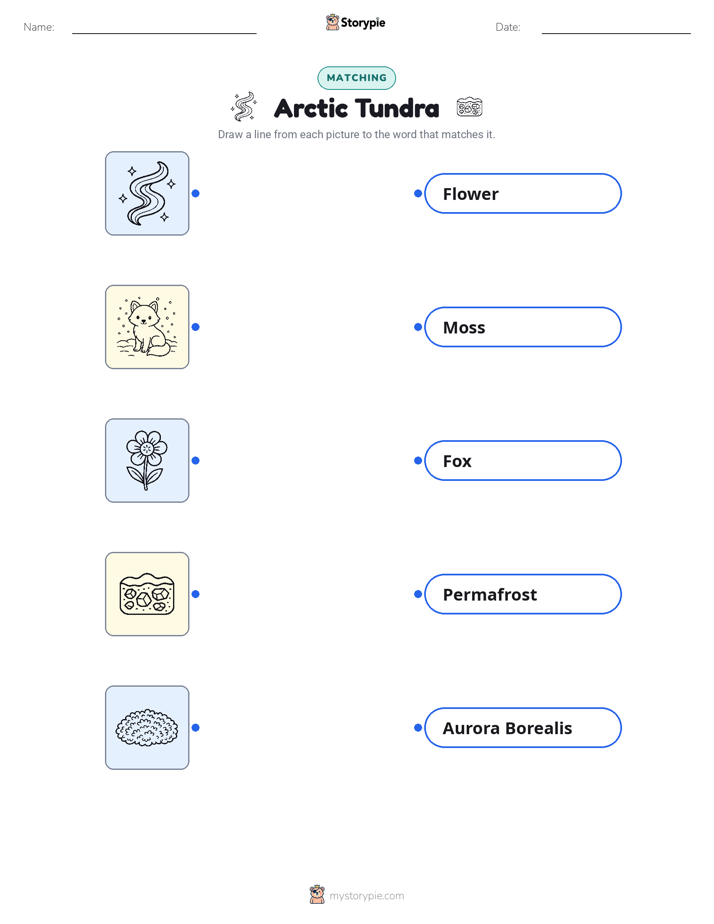
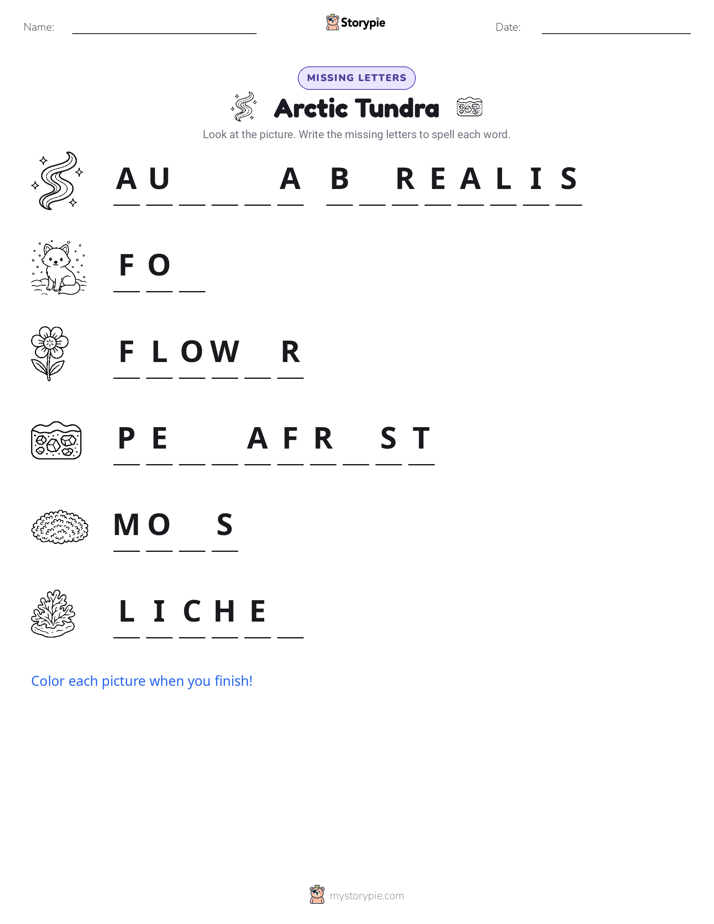
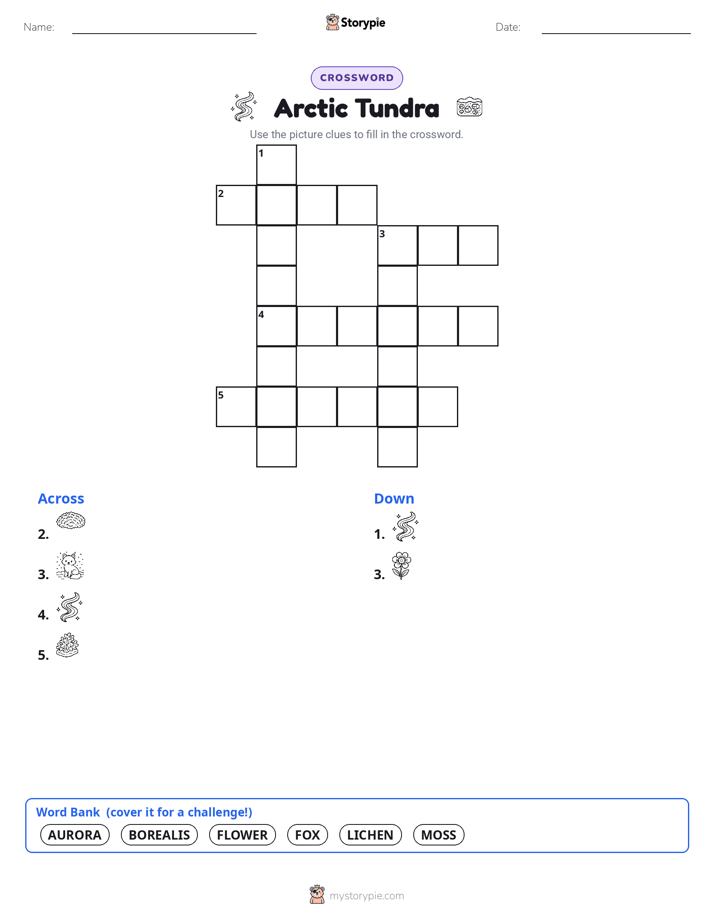
Imagine a place where the wind howls a song so ancient it seems to come from the beginning of time. In the long winter, the sun disappears for months, leaving the sky to the stars and the shimmering, dancing ribbons of green, pink, and violet light you call the aurora borealis. The silence is vast, broken only by the crackle of ice or the soft footfalls of a fox on the snow. This is my 'polar night.' But then, my world transforms. The sun returns and refuses to set, circling the horizon day and night. This is my 'midnight sun,' and during this brief, glorious summer, the ground erupts in a carpet of tiny, vibrant flowers, racing to bloom in the endless light. I am an ancient, powerful land, a frozen crown at the very top of your world. I am the Arctic Tundra.
My story begins in an age of ice. I was shaped by the colossal glaciers of the Pleistocene Epoch, immense sheets of ice that scraped and carved the land. When they finally retreated around 10,000 years ago, they left me behind. But they left a piece of themselves deep within my soil. This is my most essential feature, the secret to my existence: the permafrost. It is a layer of soil, gravel, and ice that remains frozen solid all year round, a relic of the great ice age. You could call it my frozen heart. This permanently frozen ground defines everything about me. Because water cannot drain deep into the earth, it pools on my surface in the summer, creating countless shallow lakes and marshy wetlands. The permafrost also prevents trees with deep roots from growing, which is why my landscape is wide open, dominated by small, hardy plants that can survive in the thin layer of soil that thaws each summer.
The Land of Ice and Light
Imagine a place where the wind howls a song so ancient it seems to come from the beginning of time. In the long winter, the sun disappears for months, leaving the sky to the stars and the shimmering, dancing ribbons of green, pink, and violet light you call the aurora borealis. The silence is vast, broken only by the crackle of ice or the soft footfalls of a fox on the snow. This is my 'polar night.' But then, my world transforms. The sun returns and refuses to set, circling the horizon day and night. This is my 'midnight sun,' and during this brief, glorious summer, the ground erupts in a carpet of tiny, vibrant flowers, racing to bloom in the endless light. I am an ancient, powerful land, a frozen crown at the very top of your world. I am the Arctic Tundra.
My story begins in an age of ice. I was shaped by the colossal glaciers of the Pleistocene Epoch, immense sheets of ice that scraped and carved the land. When they finally retreated around 10,000 years ago, they left me behind. But they left a piece of themselves deep within my soil. This is my most essential feature, the secret to my existence: the permafrost. It is a layer of soil, gravel, and ice that remains frozen solid all year round, a relic of the great ice age. You could call it my frozen heart. This permanently frozen ground defines everything about me. Because water cannot drain deep into the earth, it pools on my surface in the summer, creating countless shallow lakes and marshy wetlands. The permafrost also prevents trees with deep roots from growing, which is why my landscape is wide open, dominated by small, hardy plants that can survive in the thin layer of soil that thaws each summer.
Though I may seem stark and empty, I am bursting with life, full of creatures and plants that have mastered the art of survival. My plants don't grow tall; instead, they huddle close to the ground for warmth. Mosses, lichens, sedges, and dwarf shrubs form a resilient mat over my surface. In the summer, bright wildflowers like the purple saxifrage and the arctic poppy add astonishing splashes of color. And my animals are miracles of adaptation. The majestic polar bear, with its thick coat of white fur and a layer of blubber, is perfectly suited to hunt on the sea ice at my edges. The arctic fox is a master of camouflage, its fur changing from brown in the summer to pure white in the winter. Enormous herds of caribou, or reindeer, undertake some of the longest migrations on Earth, crossing my plains in search of food. High above, the snowy owl, with its silent, ghostly flight, scans the ground for its next meal. Every living thing here exists in a delicate and intricate balance, a testament to the power of life to thrive in the most challenging conditions.
For millennia, I was a world known only to the life that called me home. Then, humans arrived. The first people came thousands of years ago, their ancestors having possibly crossed the Bering Land Bridge from Asia into North America as early as 15,000 BCE. These were the ancestors of the Indigenous peoples, like the Inuit of North America and the Sámi of northern Europe. They did not see me as a harsh wasteland, but as a home. Over countless generations, they learned my rhythms, my seasons, and my secrets. They developed incredible skills to live in harmony with my cycles, respecting the animals and the land that sustained them. Then, in the 1500s, a new kind of visitor arrived. European explorers, driven by a desire for trade and discovery, came in tall ships. Men like Martin Frobisher, who made expeditions here in the 1570s, were searching for a fabled Northwest Passage to Asia. They saw me not as a home, but as a formidable challenge to be conquered, an obstacle on their map.
Today, my role in the world has become more important than ever. I am a vital natural laboratory for scientists who are trying to understand your planet's changing climate. They come to study my ice, my soil, and my delicate ecosystem, because what happens here affects the entire globe. My frozen heart, the permafrost, is beginning to thaw in some places, releasing ancient gases that have been locked away for thousands of years. This is a warning that I am giving to the world. Yet, I am also a symbol of hope and protection. Deep inside one of my mountains in Norway, humans have built something extraordinary: the Svalbard Global Seed Vault, which opened on February 26th, 2008. It is a secure fortress that holds copies of seeds from all over the world, a backup plan for humanity's food supply. In this way, I am helping to protect the future. I am a land of great history and critical importance. By listening to my story and learning from my resilience, you can learn how to better care for the beautiful, fragile planet you all share.
Wow facts
About
A vast, treeless biome in the Arctic regions, characterized by permafrost, low-growing vegetation, and a unique ecosystem adapted to extreme cold.
Take a Quiz
Question 1 of 5
What is the main idea of the section titled 'My Frozen Heart'?
Explore next




Want to do even more?
Go beyond exploring. Unlock tools that turn every story into real learning.

Storypie Plus for families
Full stories, quizzes, and printables. Nights and car rides, sorted.
- Unlimited audio stories
- Create Mode: your child stars in the story
- Offline downloads
- Printable worksheets & coloring pages

Why Storypie for Schools
Students engaged. Prep in seconds. Evenings back to you.
- Worksheets & Quizzes
- Classroom Management
- Formative Assessment
- Custom Curriculum & Lesson Plans
- 27 Languages

Why Storypie for Homeschool
Curriculum done. They'll ask for more. Hours back in your day.
- Worksheet Generator
- First-Person Audio Stories
- Built-in Comprehension Quizzes
- Custom Curriculum & Lesson Plans
- Print & Go Activities