English

Cave of Lascaux
A complex of caves in southwestern France famous for its magnificent Paleolithic cave paintings…
Reads at Grades 6–8 Listens at Grades 4–8
Print & create
Answer keys·No prep·Free with an account
28 worksheets · answer keys · full story · quiz · Ages 10-12 · CEFR B2
Plus adds 208,000+ more stories in 27 languages, audio for every one, and printables for all of them.
Just want Cave of Lascaux?
For thousands of years, I have held my breath in the dark. I am a quiet, secret space hidden deep beneath the rolling green hills and limestone cliffs of the Vézère Valley in southwestern France. The air inside me is cool and damp, carrying the scent of wet stone and ancient earth. For millennia, the only sound was the slow, rhythmic drip of water seeping through my rock skin, a clock ticking through ages of silence. My stone walls hold a spectacular secret, a gallery of powerful animals frozen in time, their bodies captured in mid-gallop, their horns ready to charge. They are a silent stampede, a ghost herd from a long-vanished world. I waited patiently in the darkness, guarding the first great masterpieces of humanity. I am the Cave of Lascaux, a time capsule from the Stone Age.
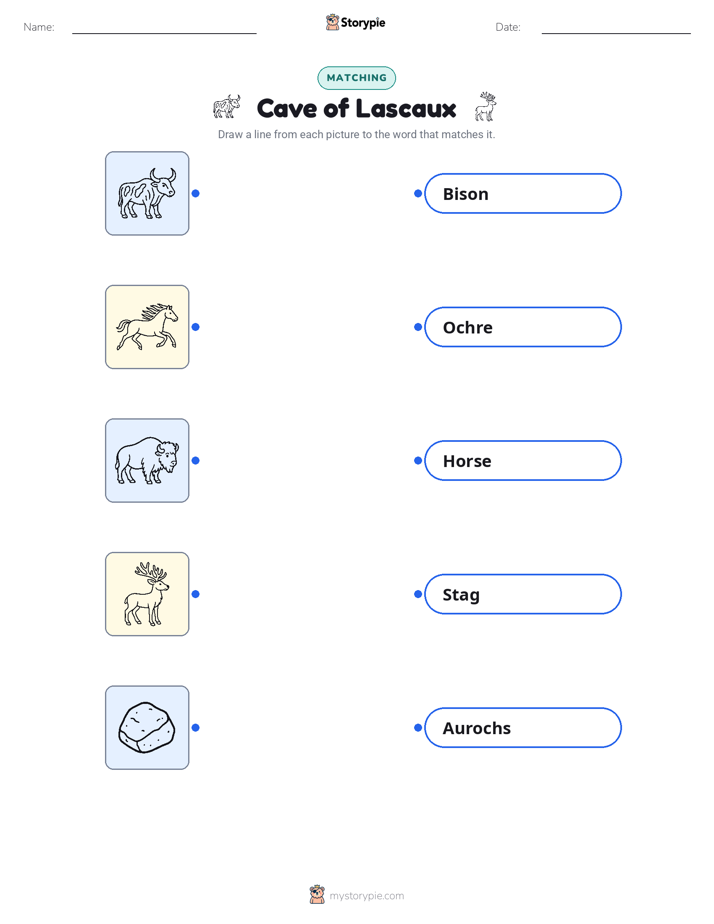
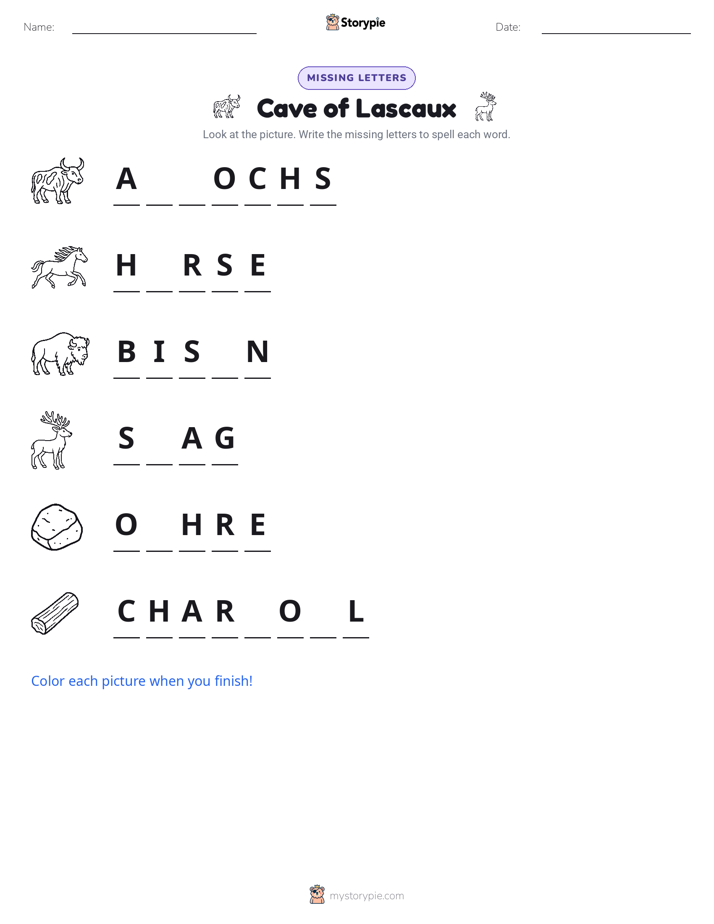
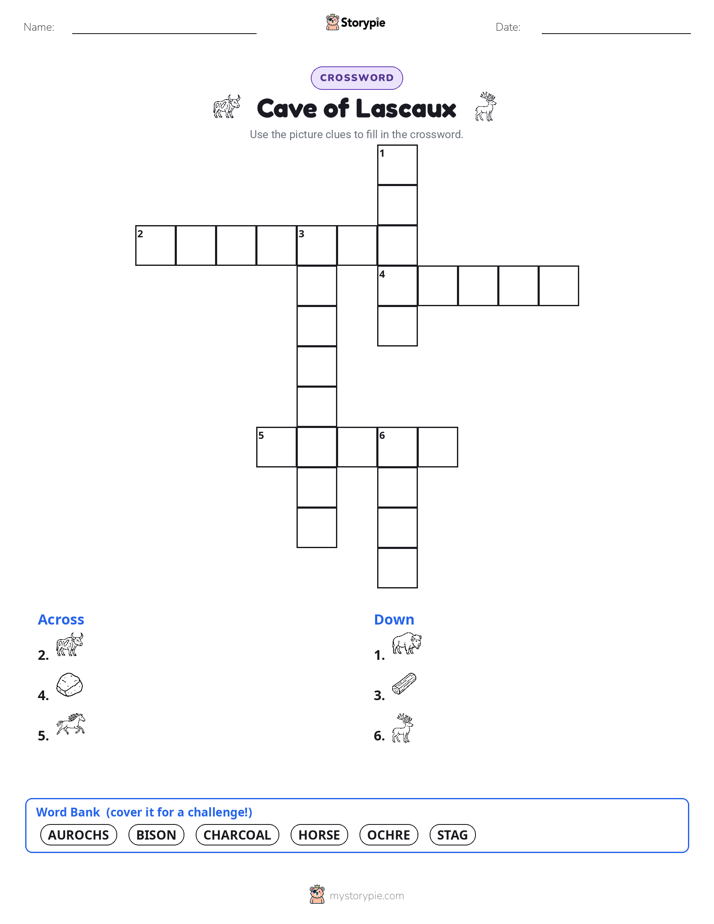
My story truly begins around 17,000 BCE, during the Upper Paleolithic period. The world outside was a harsh place of ice and wind, but inside, I offered shelter and a canvas for human imagination. My first visitors were not explorers, but artists—Cro-Magnon people who carried the spark of creativity. By the flickering, unsteady light of lamps fueled by animal fat, their shadows danced on my curving walls as they worked. They brought with them simple but effective tools. They ground red and yellow ochre, minerals found in the earth, into fine powders. For black, they used charcoal or manganese dioxide. They mixed these pigments with cave water or animal fat to create thick, lasting paint. Then, with pads of moss, their own fingers, or by blowing the powdered pigment through hollow bones, they brought my walls to life. In my most famous chamber, the Hall of the Bulls, they painted enormous aurochs—ancient wild cattle—some stretching over 17 feet long. Galloping horses, graceful stags with magnificent antlers, and solitary bison also joined the great procession. Why did they create this breathtaking art deep within the earth? Perhaps they were telling the stories of great hunts, performing rituals to ensure future success, or expressing a sacred connection to the powerful animal spirits that shared their world. No one knows for sure, and that mystery is part of my magic.
The Whispering Walls of Lascaux
For thousands of years, I have held my breath in the dark. I am a quiet, secret space hidden deep beneath the rolling green hills and limestone cliffs of the Vézère Valley in southwestern France. The air inside me is cool and damp, carrying the scent of wet stone and ancient earth. For millennia, the only sound was the slow, rhythmic drip of water seeping through my rock skin, a clock ticking through ages of silence. My stone walls hold a spectacular secret, a gallery of powerful animals frozen in time, their bodies captured in mid-gallop, their horns ready to charge. They are a silent stampede, a ghost herd from a long-vanished world. I waited patiently in the darkness, guarding the first great masterpieces of humanity. I am the Cave of Lascaux, a time capsule from the Stone Age.
My story truly begins around 17,000 BCE, during the Upper Paleolithic period. The world outside was a harsh place of ice and wind, but inside, I offered shelter and a canvas for human imagination. My first visitors were not explorers, but artists—Cro-Magnon people who carried the spark of creativity. By the flickering, unsteady light of lamps fueled by animal fat, their shadows danced on my curving walls as they worked. They brought with them simple but effective tools. They ground red and yellow ochre, minerals found in the earth, into fine powders. For black, they used charcoal or manganese dioxide. They mixed these pigments with cave water or animal fat to create thick, lasting paint. Then, with pads of moss, their own fingers, or by blowing the powdered pigment through hollow bones, they brought my walls to life. In my most famous chamber, the Hall of the Bulls, they painted enormous aurochs—ancient wild cattle—some stretching over 17 feet long. Galloping horses, graceful stags with magnificent antlers, and solitary bison also joined the great procession. Why did they create this breathtaking art deep within the earth? Perhaps they were telling the stories of great hunts, performing rituals to ensure future success, or expressing a sacred connection to the powerful animal spirits that shared their world. No one knows for sure, and that mystery is part of my magic.
A few thousand years after my artists left, a great landslide rumbled across the hillside, and my entrance collapsed. Rock and earth sealed me off from the world, plunging me into absolute darkness and silence. This event, which could have been a disaster, was my salvation. It was like closing the lid on a perfect treasure chest. Protected from the wind, rain, and changing temperatures, the fragile paintings on my walls were preserved in a stable environment for seventeen millennia. My long, silent sleep was finally broken on September 12th, 1940. A teenager named Marcel Ravidat was walking his dog, Robot, when the little dog vanished down a hole that had been exposed by a fallen pine tree. Curious, Marcel returned with three friends: Jacques Marsal, Georges Agniel, and Simon Coencas. Armed with a homemade oil lamp, they widened the opening and slid down a long, dark shaft. As they landed on my floor and raised their flickering light, they gasped. Their lamp illuminated something no human had seen for thousands of years: the powerful figures of the great bulls, the racing horses, and the swimming stags. In a moment of pure astonishment, four boys and a dog had stumbled upon one of the greatest artistic treasures in human history.
Word of my discovery spread quickly, and after the turmoil of World War II ended, I was prepared for the modern world. In 1948, I was opened to the public, and a concrete staircase was built to allow visitors to descend into my chambers. People came from all over the globe, eager to gaze upon the masterpieces of their ancient ancestors. For 15 years, I welcomed over a million visitors. But this fame came at a terrible price. I was designed to be a sealed, sterile environment. The constant stream of people brought with them heat, humidity, and, most damaging of all, the carbon dioxide from their breath. The electric lights installed for viewing warmed my delicate surfaces. An invisible invasion began. Green algae started to grow on my walls, and a veil of white calcite crystals threatened to cover the paintings. My art was beginning to fade. Scientists realized that my visitors were inadvertently destroying me. With great sadness, a difficult decision was made. On April 20th, 1963, I was closed to the public forever. It was a heartbreaking choice, but it was an act of love to ensure my survival for future generations.
My closure was not an end but a new beginning for how my story would be told. If people could not come to me, I would find a way to go to them. The challenge was immense: how to share my beauty without destroying it? The answer was a combination of science and art. In 1983, a project of incredible precision was completed nearby. It was called Lascaux II, a painstaking, exact replica of the Hall of the Bulls and the Painted Gallery. Artists and scientists used advanced techniques to recreate every bump and curve of my walls and every brushstroke of the original paintings. For the first time, people could experience my most famous chambers without harming me. This idea has since evolved. In 2016, a new, even more comprehensive project opened: Lascaux IV, The International Centre for Cave Art. This state-of-the-art museum features a complete replica of me, allowing visitors to feel the same sense of discovery the four boys did. Though my original walls now rest in protected silence, my spirit lives on. I am a powerful reminder that the need to create, to tell stories, and to share our world through art is a timeless human spark that connects us all to our earliest ancestors. It has been burning for millennia, and it still burns brightly today.
Wow facts
About
A complex of caves in southwestern France famous for its magnificent Paleolithic cave paintings, estimated to be over 17,000 years old.
Take a Quiz
Question 1 of 5
In your own words, retell the main events of the cave's rediscovery on September 12th, 1940.
Explore next






Want to do even more?
Go beyond exploring. Unlock tools that turn every story into real learning.

Storypie Plus for families
Full stories, quizzes, and printables. Nights and car rides, sorted.
- Unlimited audio stories
- Create Mode: your child stars in the story
- Offline downloads
- Printable worksheets & coloring pages

Why Storypie for Schools
Students engaged. Prep in seconds. Evenings back to you.
- Worksheets & Quizzes
- Classroom Management
- Formative Assessment
- Custom Curriculum & Lesson Plans
- 27 Languages

Why Storypie for Homeschool
Curriculum done. They'll ask for more. Hours back in your day.
- Worksheet Generator
- First-Person Audio Stories
- Built-in Comprehension Quizzes
- Custom Curriculum & Lesson Plans
- Print & Go Activities