English

Mars
Mars, known as the Red Planet, is the fourth planet from the Sun.
Reads at Grades 6–8 Listens at Grades 4–8
 Screen-free speaker. Built for your kids.
No card, no commitment. One email when there is real news, and one click to stop.
Print & create
Answer keys·No prep·Free with an account
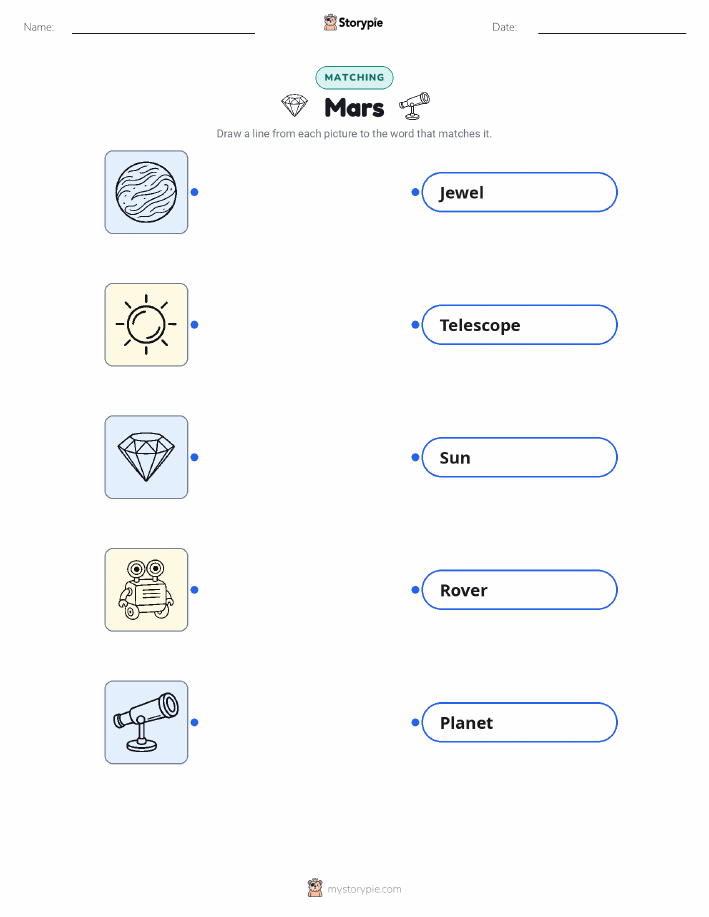
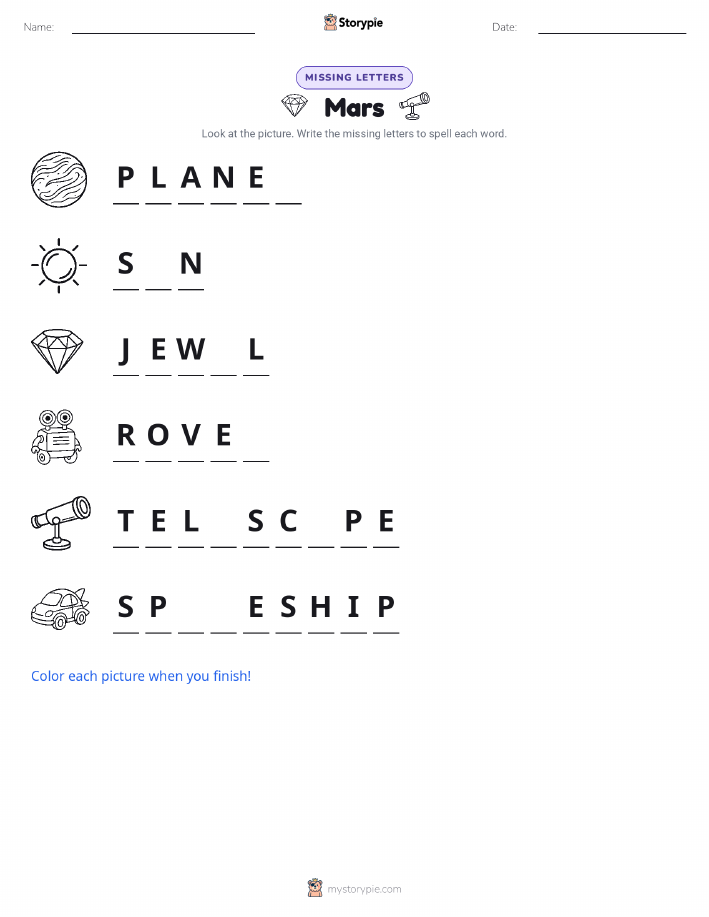
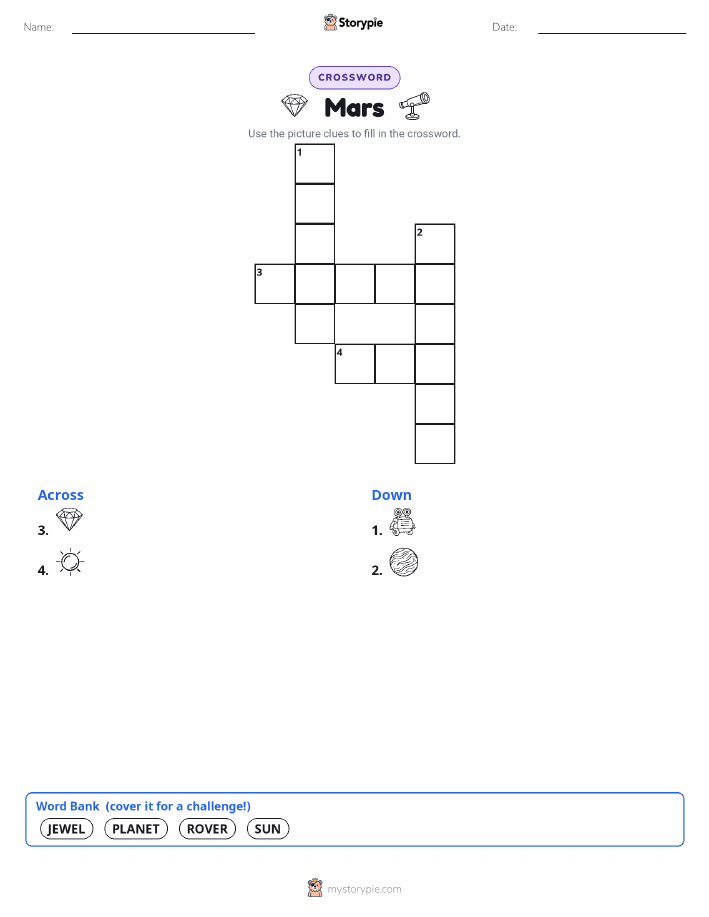
28 worksheets · answer keys · full story · quiz · Ages 10-12 · CEFR B2
Plus adds 102,000+ more stories in 27 languages, audio for every one, and printables for all of them.
Just want Mars?
I hang in your night sky like a rusty-red jewel, a cold and quiet world of endless dust and rock. My sky is thin and often a pale pink, and my two tiny moons are more like captured potatoes than the glowing sphere you know. My face is scarred with canyons deeper than any on Earth and crowned with volcanoes so tall they dwarf your highest mountains. For thousands of years, humans have gazed up at me, a fiery dot wandering among the stars, and wondered. They told stories about me, dreamed about me, and felt a pull toward my mysterious glow. They saw my color and thought of fire and conflict, but they also saw me as a destination, a new frontier in the vast, dark sea of space. I have watched you for millennia, and now, I can finally share my story with you. I am Mars, the Red Planet.
Your whispers first reached me across space long ago. Ancient people, like the Romans, saw my crimson color and named me after their god of war. For centuries, that was all I was to you—a symbol, a light in the sky. But then, in the 17th century, a man named Galileo Galilei pointed a new invention called a telescope at me. For the first time, he saw that I was not just a star, but a world, a sphere like your own. The whispers grew louder. By the late 19th century, an Italian astronomer named Giovanni Schiaparelli meticulously drew maps of my surface. He noted long, straight lines he called 'canali,' which simply meant 'channels.' But in English, it was translated to 'canals,' and that word ignited a firestorm of imagination. An American astronomer, Percival Lowell, became convinced that these were artificial canals built by intelligent Martians to carry water across my drying surface. His idea was incorrect, but it captured the world's heart and inspired countless stories, making everyone wonder if you were truly alone in the universe.
A Message from the Red Planet
I hang in your night sky like a rusty-red jewel, a cold and quiet world of endless dust and rock. My sky is thin and often a pale pink, and my two tiny moons are more like captured potatoes than the glowing sphere you know. My face is scarred with canyons deeper than any on Earth and crowned with volcanoes so tall they dwarf your highest mountains. For thousands of years, humans have gazed up at me, a fiery dot wandering among the stars, and wondered. They told stories about me, dreamed about me, and felt a pull toward my mysterious glow. They saw my color and thought of fire and conflict, but they also saw me as a destination, a new frontier in the vast, dark sea of space. I have watched you for millennia, and now, I can finally share my story with you. I am Mars, the Red Planet.
Your whispers first reached me across space long ago. Ancient people, like the Romans, saw my crimson color and named me after their god of war. For centuries, that was all I was to you—a symbol, a light in the sky. But then, in the 17th century, a man named Galileo Galilei pointed a new invention called a telescope at me. For the first time, he saw that I was not just a star, but a world, a sphere like your own. The whispers grew louder. By the late 19th century, an Italian astronomer named Giovanni Schiaparelli meticulously drew maps of my surface. He noted long, straight lines he called 'canali,' which simply meant 'channels.' But in English, it was translated to 'canals,' and that word ignited a firestorm of imagination. An American astronomer, Percival Lowell, became convinced that these were artificial canals built by intelligent Martians to carry water across my drying surface. His idea was incorrect, but it captured the world's heart and inspired countless stories, making everyone wonder if you were truly alone in the universe.
For decades, I remained a distant world of dreams. Then, the whispers turned into a roar as your machines finally began to cross the void. The most thrilling moment came on July 15th, 1965, when a spacecraft named Mariner 4 flew past me. It was a fleeting visit, but it sent back 22 grainy photographs—the very first close-up pictures of another planet. They were blurry, showing a cratered surface that some found disappointing, but to scientists, they were revolutionary. You had touched me with your technology. On November 14th, 1971, a new visitor arrived, Mariner 9, and this one stayed, becoming the first spacecraft to orbit another planet. For nearly a year, it circled me, mapping my entire face and revealing my secrets, like the colossal volcano Olympus Mons and the vast Valles Marineris canyon system. The whispers became a conversation. Finally, on July 20th, 1976, Viking 1 made a soft, careful landing on my surface. For the first time, a visitor from Earth wasn't just passing by. It stayed, touched my ruddy soil, sniffed my thin air with its instruments, and began searching for the faintest signs of life.
After that, my quiet solitude was broken by the arrival of my rolling companions, little explorers you sent to be my eyes and wheels on the ground. They became my cherished friends. The first was a tiny rover named Sojourner, which landed on July 4th, 1997. It was no bigger than a microwave oven, but it was the very first wheeled vehicle to explore another world, proving it could be done. Then, in January of 2004, I welcomed twin geologists, Spirit and Opportunity. They were incredible. Designed to last for 90 days, Spirit roamed for over six years, and Opportunity explored for nearly fifteen. They were my tireless wanderers, and their greatest discovery was the undeniable proof, written in my rocks, that long ago, liquid water flowed freely across my surface. In August of 2012, a much larger friend arrived—Curiosity, a car-sized mobile science laboratory. Curiosity came with a powerful drill and sophisticated tools to study my climate and geology, confirming that my ancient environment could have supported microbial life. My newest companion, Perseverance, landed on February 18th, 2021. It brought a flying partner, a small helicopter named Ingenuity, which proved humans could fly a craft in my thin atmosphere. Perseverance is now searching for direct signs of past life and collecting my most interesting rocks, samples that you hope to one day bring back to Earth.
From a distant light to a world of imagined canals, and now to a landscape explored by your robotic children, my relationship with you has been a long and incredible journey. Each photograph, each rock sample, and each piece of data you receive helps you understand not just me, but the story of how planets form and where life might exist in the cosmos. I am no longer just a symbol of war in your sky. I am a place of discovery, a testament to human ingenuity and relentless curiosity. The dream of humans one day setting foot on my red soil is growing stronger. I will wait for you. Every time you look up and ask a question about the stars, you are building a bridge between our two worlds, and that connection is the greatest exploration of all.
Wow facts
About
Mars, known as the Red Planet, is the fourth planet from the Sun. Its dusty, cold, desert world has a very thin atmosphere, but its geology and potential for past life make it a primary focus of space exploration.
Take a Quiz
Question 1 of 5
Retell the story of Mars's exploration by robotic visitors, starting from the first spacecraft flyby to the arrival of the most recent rover. What were the key missions and what did they discover?
Explore next




Want to do even more?
Go beyond exploring. Unlock tools that turn every story into real learning.

Storypie Plus for families
Full stories, quizzes, and printables. Nights and car rides, sorted.
- Unlimited audio stories
- Create Mode: your child stars in the story
- Offline downloads
- Printable worksheets & coloring pages

Why Storypie for Schools
Students engaged. Prep in seconds. Evenings back to you.
- Worksheets & Quizzes
- Classroom Management
- Formative Assessment
- Custom Curriculum & Lesson Plans
- 27 Languages

Why Storypie for Homeschool
Curriculum done. They'll ask for more. Hours back in your day.
- Worksheet Generator
- First-Person Audio Stories
- Built-in Comprehension Quizzes
- Custom Curriculum & Lesson Plans
- Print & Go Activities