English

Chimborazo
Chimborazo is a stratovolcano that has experienced eruptions as recently as the Holocene…
Reads at Grades 6–8 Listens at Grades 4–8
Print & create
Answer keys·No prep·Free with an account
28 worksheets · answer keys · full story · quiz · Ages 10-12 · CEFR B2
Plus adds 164,000+ more stories in 27 languages, audio for every one, and printables for all of them.
Just want Chimborazo?
A Giant Reaching for the Stars
I am a blanket of white ice and dark, ancient rock, so vast that I make my own weather. My head rests high above the clouds in the thin, cold air of the Andes Mountains, right on the imaginary belt that circles the Earth's middle. I watch the world turn from my home in the country of Ecuador, a silent giant crowned in glaciers. From my peak, the sky is a deep, dark blue, and at night, the stars feel so close you could almost touch them. This isn't just a feeling; it is my greatest secret. While other mountains may be taller from sea level, the Earth bulges at its equator, like a spinning top that's wider in the middle. Because I sit upon this bulge, my summit is the farthest point from the center of the Earth. This means that of all the places on our planet, I am the very closest to the sun, the moon, and the glittering constellations. I am a bridge between the terrestrial and the celestial. I am Chimborazo.
My Long, Quiet Life
My life has been long, and for many centuries, very quiet. But it was not always so. In my youth, I was a creature of fire and fury. Deep within my stony heart, the Earth's molten energy churned until I could hold it no longer. I erupted with tremendous force, shaping the landscape around me with rivers of lava and clouds of ash. My last great roar was a long, long time ago, around the year 550 CE. After that, a deep slumber fell over me. The fires within me cooled, and thick blankets of snow fell upon my slopes, compressing over thousands of years into the immense glaciers that cover me today. For centuries, the only sounds were the wind and the cracking of ice. The indigenous peoples who came to live in my shadow understood my power. They called me 'Apu,' a sacred spirit, a protector. They saw how my ice was a gift, melting into streams that gave life to their crops and villages below. They treated me with reverence, never taking more than they needed. This respect gave rise to a special tradition: the 'hieleros,' or ice merchants. For generations, these hardy men have climbed my steep slopes, carefully carving blocks of glacial ice from my sides. They wrap the ice in straw and carry it on their backs down to the markets in the towns below, providing a natural way to keep food and drinks cool long before freezers were ever imagined.
The Mountain Closest to the Stars
A Giant Reaching for the Stars
I am a blanket of white ice and dark, ancient rock, so vast that I make my own weather. My head rests high above the clouds in the thin, cold air of the Andes Mountains, right on the imaginary belt that circles the Earth's middle. I watch the world turn from my home in the country of Ecuador, a silent giant crowned in glaciers. From my peak, the sky is a deep, dark blue, and at night, the stars feel so close you could almost touch them. This isn't just a feeling; it is my greatest secret. While other mountains may be taller from sea level, the Earth bulges at its equator, like a spinning top that's wider in the middle. Because I sit upon this bulge, my summit is the farthest point from the center of the Earth. This means that of all the places on our planet, I am the very closest to the sun, the moon, and the glittering constellations. I am a bridge between the terrestrial and the celestial. I am Chimborazo.
My Long, Quiet Life
My life has been long, and for many centuries, very quiet. But it was not always so. In my youth, I was a creature of fire and fury. Deep within my stony heart, the Earth's molten energy churned until I could hold it no longer. I erupted with tremendous force, shaping the landscape around me with rivers of lava and clouds of ash. My last great roar was a long, long time ago, around the year 550 CE. After that, a deep slumber fell over me. The fires within me cooled, and thick blankets of snow fell upon my slopes, compressing over thousands of years into the immense glaciers that cover me today. For centuries, the only sounds were the wind and the cracking of ice. The indigenous peoples who came to live in my shadow understood my power. They called me 'Apu,' a sacred spirit, a protector. They saw how my ice was a gift, melting into streams that gave life to their crops and villages below. They treated me with reverence, never taking more than they needed. This respect gave rise to a special tradition: the 'hieleros,' or ice merchants. For generations, these hardy men have climbed my steep slopes, carefully carving blocks of glacial ice from my sides. They wrap the ice in straw and carry it on their backs down to the markets in the towns below, providing a natural way to keep food and drinks cool long before freezers were ever imagined.
Visitors From Afar
My long peace was eventually stirred by the arrival of new people with new ideas. During the Age of Exploration, stories of my immense size traveled across the oceans, and I became a great challenge, a puzzle to be solved by the world's most ambitious scientists and adventurers. On June 23rd, 1802, two such men arrived at my base: the brilliant Prussian naturalist Alexander von Humboldt and his companion, the French botanist Aimé Bonpland. They were not just trying to conquer my peak; they wanted to understand me. They carried heavy scientific instruments, measuring the air pressure, temperature, and the Earth's magnetic field as they climbed. They documented how the plants changed with the altitude, creating a new way of seeing nature as an interconnected web. But I am not an easy mountain to know. As they climbed higher, the air grew thin, and they began to suffer from what we now call altitude sickness. Nauseous and bleeding, they were forced to turn back just short of the summit. Though they did not reach the top, their journey was a monumental success for science. Nearly eighty years later, on January 4th, 1880, a determined English mountaineer named Edward Whymper, along with his Italian guides Louis and Jean-Antoine Carrel, finally stood where Humboldt could not. They were the first to reach my true summit. Their achievement was so incredible that many people in Europe refused to believe it was possible. To silence his critics, Whymper returned later that same year and climbed me again by a different route, proving that my peak could indeed be reached by human will and endurance.
My Place in the World Today
Today, I remain a symbol of challenge and wonder. The world has changed immensely since those early expeditions, and so has my role. In 1987, the land around me was officially protected, becoming the Chimborazo Wildlife Reserve. This sanctuary was created to save the graceful vicuña, a relative of the llama whose soft wool was once more valuable than gold. These animals had been hunted nearly to extinction, but now they roam freely on my lower slopes, a testament to the power of conservation. Mountaineers from all over the globe still come to test their limits against my ice and wind, following in the footsteps of Whymper and Humboldt. But perhaps my most important job now is to be a teacher. My beautiful glaciers, which have provided water to this region for thousands of years, are shrinking. They show the effects of a warming climate, reminding humanity of the delicate balance we must protect. I stand today not just as a mountain of rock and ice, but as a living piece of history. I am a record of scientific discovery, a sacred 'Apu' to local communities, and a reminder that our world is full of incredible beauty. When you look up at the stars, remember me, the point on Earth that reaches closest to them, and never stop reaching for your own great heights.
Wow facts
About
Chimborazo is a stratovolcano that has experienced eruptions as recently as the Holocene, located in the Andes of Ecuador. Its peak is the farthest point on the Earth's surface from the Earth's center because it is situated along the equatorial bulge.
Take a Quiz
Question 1 of 5
Retell the story of the two main expeditions that tried to climb Chimborazo, highlighting who the explorers were and what each group accomplished.
Explore next



Want to do even more?
Go beyond exploring. Unlock tools that turn every story into real learning.

Storypie Plus for families
Full stories, quizzes, and printables. Nights and car rides, sorted.
- Unlimited audio stories
- Create Mode: your child stars in the story
- Offline downloads
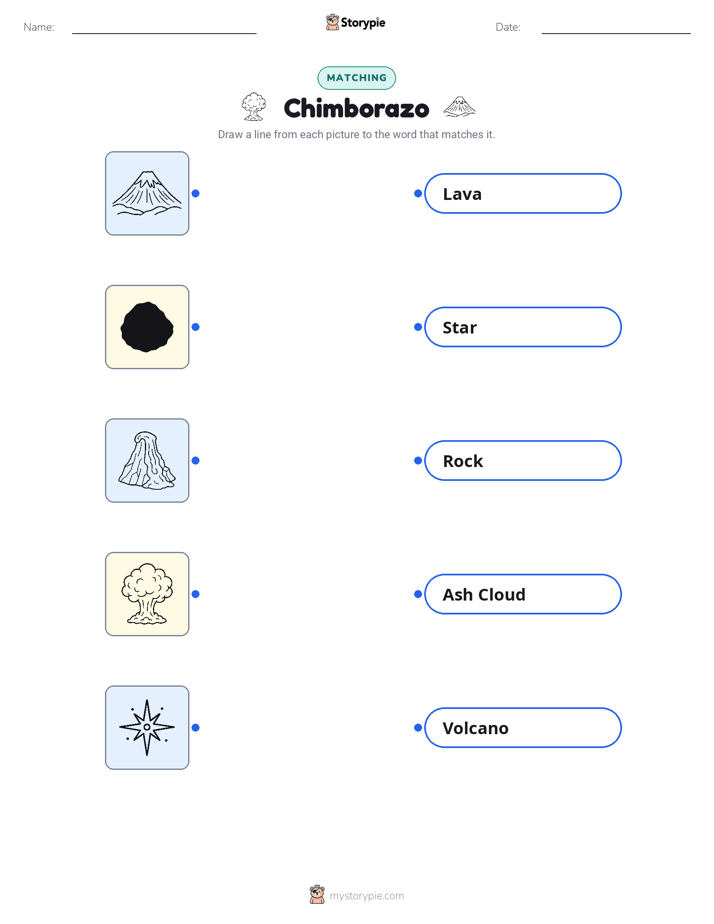
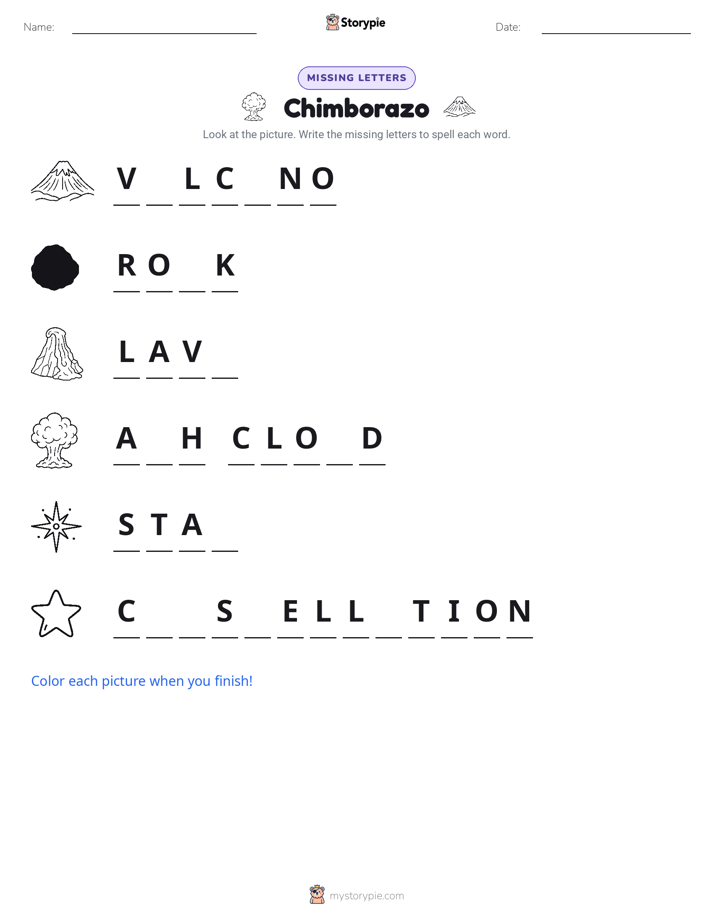
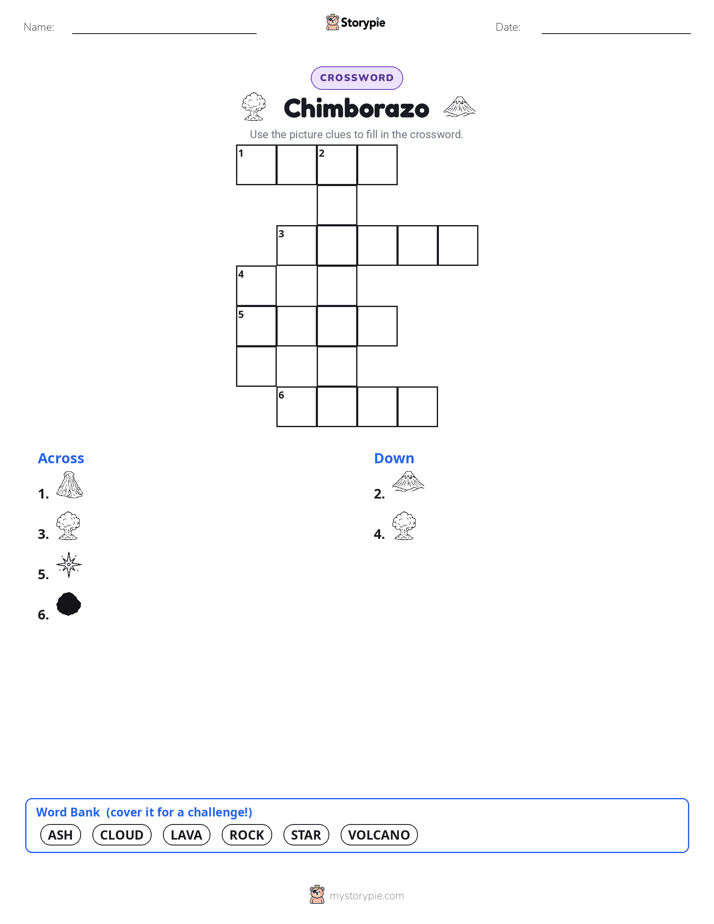
- Printable worksheets & coloring pages

Why Storypie for Schools
Students engaged. Prep in seconds. Evenings back to you.
- Worksheets & Quizzes
- Classroom Management
- Formative Assessment
- Custom Curriculum & Lesson Plans
- 27 Languages

Why Storypie for Homeschool
Curriculum done. They'll ask for more. Hours back in your day.
- Worksheet Generator
- First-Person Audio Stories
- Built-in Comprehension Quizzes
- Custom Curriculum & Lesson Plans
- Print & Go Activities