English

Chimborazo
Chimborazo is a stratovolcano that has experienced eruptions as recently as the Holocene…
Reads at Grades 3–5 Listens at Grades 1–5
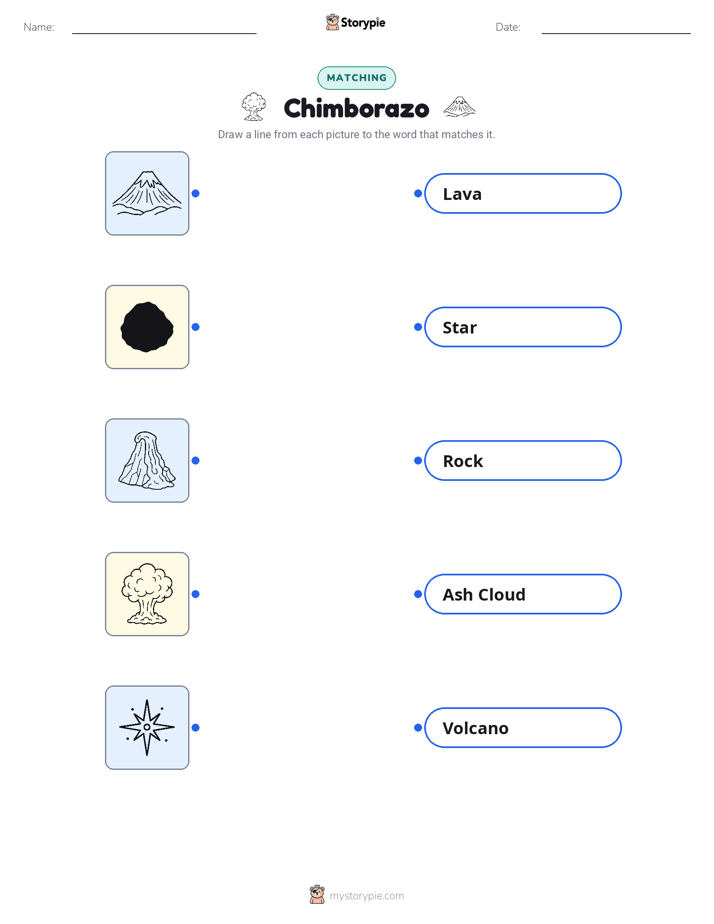
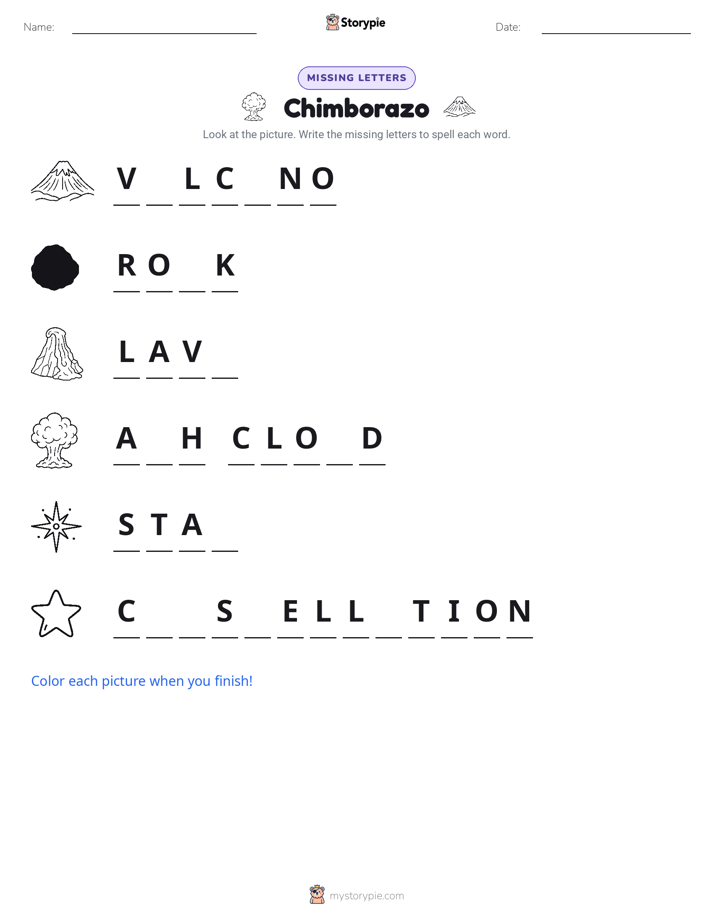
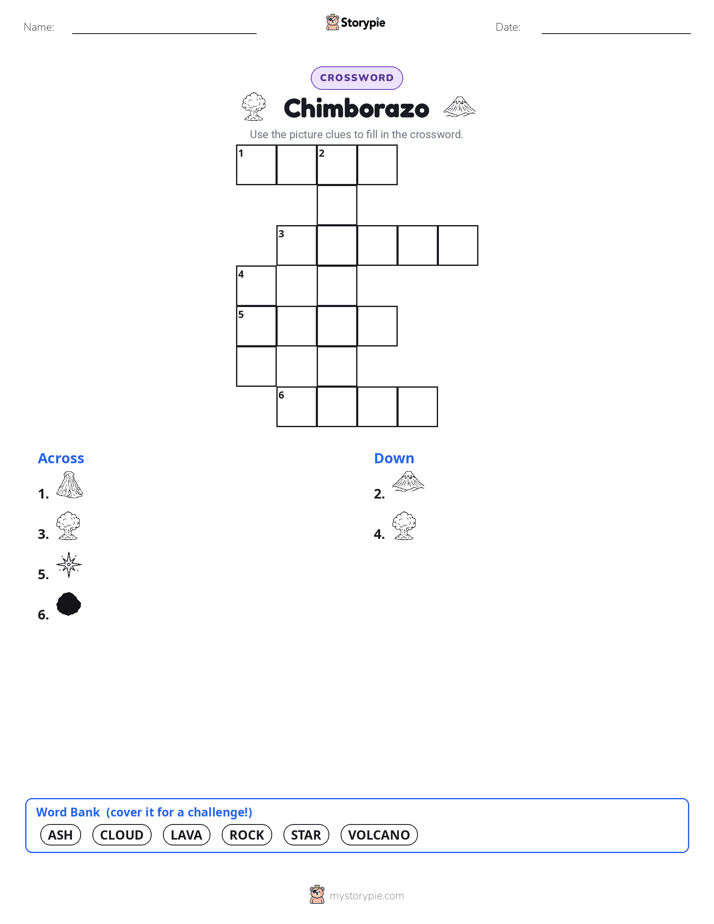
Print & create
Answer keys·No prep·Free with an account
28 worksheets · answer keys · full story · quiz · Ages 8-10 · CEFR B1
Plus adds 164,000+ more stories in 27 languages, audio for every one, and printables for all of them.
Just want Chimborazo?
In the country of Ecuador, there is a sleeping giant covered in a blanket of pure white snow. I rest right on the Earth's belly, a warm line you call the equator. Because the planet is a little bit chubby around its middle, I have a wonderful secret. Though other mountains may look taller from the ground, my peak is the farthest point from the very center of the Earth. I am closer to the sun, the moon, and the twinkling stars than any other place on this world. People from all over have come to gaze at my snowy crown. I am the great volcano, Chimborazo.
For thousands and thousands of years, I was shaped by fire from deep within the Earth and carved by slow-moving rivers of ice. My slopes became home to the Puruhá people, who have lived in my shadow for centuries. They look up at me with respect, seeing me as a sacred protector who watches over their lands. I haven't always been so quiet, though. I have a fiery past. Long ago, around the year 550 CE, I let out a mighty roar and a great puff of ash. But since that last big rumble, I have settled into a long, peaceful sleep, dreaming under my cap of ice.
One day, a very curious man came to visit me. His name was Alexander von Humboldt, and he brought his friends, Aimé Bonpland and Carlos Montúfar. On June 23rd, 1802, they decided they would try to climb to my very top. They were brave and determined, but I made the journey very hard for them. The wind bit at their faces, and as they climbed higher, the air grew thin, making it difficult for them to breathe. Their boots crunched through deep, cold snow. They climbed higher than anyone had ever climbed a mountain before, but a giant, impassable crack in the rock and ice blocked their way. They could not reach my summit. Though they turned back, their journey was a huge success. Humboldt carefully studied how the plants on my slopes changed with the altitude, creating a beautiful drawing that showed how life exists in different layers. He created a new way of seeing the world, all because he dared to explore my sides.
The Volcano Closest to the Stars
In the country of Ecuador, there is a sleeping giant covered in a blanket of pure white snow. I rest right on the Earth's belly, a warm line you call the equator. Because the planet is a little bit chubby around its middle, I have a wonderful secret. Though other mountains may look taller from the ground, my peak is the farthest point from the very center of the Earth. I am closer to the sun, the moon, and the twinkling stars than any other place on this world. People from all over have come to gaze at my snowy crown. I am the great volcano, Chimborazo.
For thousands and thousands of years, I was shaped by fire from deep within the Earth and carved by slow-moving rivers of ice. My slopes became home to the Puruhá people, who have lived in my shadow for centuries. They look up at me with respect, seeing me as a sacred protector who watches over their lands. I haven't always been so quiet, though. I have a fiery past. Long ago, around the year 550 CE, I let out a mighty roar and a great puff of ash. But since that last big rumble, I have settled into a long, peaceful sleep, dreaming under my cap of ice.
One day, a very curious man came to visit me. His name was Alexander von Humboldt, and he brought his friends, Aimé Bonpland and Carlos Montúfar. On June 23rd, 1802, they decided they would try to climb to my very top. They were brave and determined, but I made the journey very hard for them. The wind bit at their faces, and as they climbed higher, the air grew thin, making it difficult for them to breathe. Their boots crunched through deep, cold snow. They climbed higher than anyone had ever climbed a mountain before, but a giant, impassable crack in the rock and ice blocked their way. They could not reach my summit. Though they turned back, their journey was a huge success. Humboldt carefully studied how the plants on my slopes changed with the altitude, creating a beautiful drawing that showed how life exists in different layers. He created a new way of seeing the world, all because he dared to explore my sides.
After Humboldt’s famous attempt, many other adventurers came, hoping to be the first to stand on my head. For decades, they tried and failed. But then, a determined English climber named Edward Whymper arrived with his two skilled Italian guides, Louis and Jean-Antoine Carrel. They were experts at climbing on ice and snow. They faced my freezing winds and thin air with great courage. On January 4th, 1880, after a long and difficult climb, they finally did it. They stood on my highest point, the true summit. When they returned and told their story, some people back in the city didn't believe them. They said it was impossible. So, later that very same year, Whymper climbed me all over again, this time using a completely different route, just to prove that he had told the truth.
Today, I am still here, watching over Ecuador. My glaciers provide fresh water for the farms and villages nestled far below. I am a special home to amazing animals, like the graceful vicuña, a relative of the llama that thrives in my thin mountain air. I still challenge climbers and inspire scientists who come to study my ice and the unique life I support. My story shows that even when a challenge seems as big as a mountain, perseverance can lead to incredible discoveries. There is always something new to learn if you are brave enough to look up and start climbing.
Wow facts
About
Chimborazo is a stratovolcano that has experienced eruptions as recently as the Holocene, located in the Andes of Ecuador. Its peak is the farthest point on the Earth's surface from the Earth's center because it is situated along the equatorial bulge.
Take a Quiz
Question 1 of 5
In the story, Chimborazo says its peak is 'the farthest point from the very center of the Earth.' What does this mean?
Explore next




Want to do even more?
Go beyond exploring. Unlock tools that turn every story into real learning.

Storypie Plus for families
Full stories, quizzes, and printables. Nights and car rides, sorted.
- Unlimited audio stories
- Create Mode: your child stars in the story
- Offline downloads
- Printable worksheets & coloring pages

Why Storypie for Schools
Students engaged. Prep in seconds. Evenings back to you.
- Worksheets & Quizzes
- Classroom Management
- Formative Assessment
- Custom Curriculum & Lesson Plans
- 27 Languages

Why Storypie for Homeschool
Curriculum done. They'll ask for more. Hours back in your day.
- Worksheet Generator
- First-Person Audio Stories
- Built-in Comprehension Quizzes
- Custom Curriculum & Lesson Plans
- Print & Go Activities