English

Coral Reef
A Coral Reef is an underwater ecosystem built by colonies of tiny animals called coral polyps…
Reads at Grades 6–8 Listens at Grades 4–8
The Living City Beneath the Waves
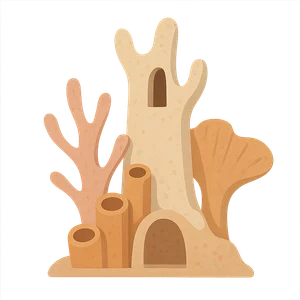
Imagine floating in warm, sunlit water, so clear you can see forever. Beams of light dance around you, illuminating a kaleidoscope of colors. Brilliant blue and yellow fish dart through towering castles and intricate gardens of stone, while gentle currents whisper secrets of the deep. It feels like a bustling city, alive with movement and energy, yet it is utterly silent except for the soft sounds of the ocean. This world, vibrant and ancient, is my home. It is a metropolis built not of steel or concrete, but of life itself. I am a Coral Reef, a living city built by the tiniest of architects.
My builders are creatures so small you might overlook them. They are called coral polyps, soft-bodied animals that work together in a massive colony. They are the master architects of my underwater world. Each polyp takes calcium from the seawater and uses it to build a hard, protective limestone skeleton around itself. When a polyp dies, its stony cup remains, and a new polyp builds its home right on top. This process, repeated over and over for thousands of years, is how I grow. My foundations are the skeletons of countless generations. Modern reefs like me began to take shape around 10,000 years ago, after the last great Ice Age ended and the sea levels rose. But my family is much older. The ancestors of my builders have been in the oceans for over 240 million years, patiently creating beautiful structures long before dinosaurs roamed the Earth.
Many people wonder about my spectacular colors, from fiery reds and oranges to deep purples and greens. The secret is not mine alone. I share my home with billions of tiny algae called zooxanthellae. They are my live-in ‘sun chefs’ and the reason for my rainbow appearance. These microscopic plants live right inside the tissues of my polyps. Using the sunlight that filters down through the water, they perform photosynthesis, turning light into food. They make so much food that they share it with the polyps, providing them with most of the energy they need to live and build. In return, the polyps give the algae a safe and sunny place to live, protected from the open ocean. This incredible partnership, a relationship called symbiosis, is the engine that powers my entire vibrant ecosystem. Without my algae friends, I would be just a white skeleton.
Because I provide so much food and shelter, I am home to an incredible number of different creatures. I am often called the ‘rainforest of the sea’ because of this amazing biodiversity. For centuries, humans knew little of my true nature. That began to change when explorers started to map the world. On June 11th, 1770, a ship called the HMS Endeavour, captained by the explorer James Cook, accidentally ran into a part of me in the Pacific Ocean, now known as the Great Barrier Reef. It was a shocking discovery for his crew. Decades later, in the 1830s, a young scientist named Charles Darwin sailed the world and was fascinated by me. He saw me in so many different shapes—fringing the edges of islands, forming great barriers offshore, and creating circular islands called atolls. He was puzzled until he developed a brilliant theory. In his 1842 book, 'The Structure and Distribution of Coral Reefs,' he was the first to correctly explain that these different forms were all stages of my growth as I built myself upward around volcanic islands that were slowly sinking into the sea.
My story continued into the modern era with explorers who could finally visit me in my own world. In the 1950s and 1960s, the famous oceanographer Jacques Cousteau co-invented the scuba gear that allowed humans to swim freely with my residents. His television shows brought my underwater world into living rooms everywhere, inspiring a new generation to care about the oceans. Today, however, my story includes new challenges. As the ocean water gets warmer, it stresses my polyps. This stress causes them to expel their colorful algae friends, and I lose my main source of food. This is called coral bleaching, and it leaves me pale and vulnerable. The first major global bleaching event occurred in 1998, shocking scientists. But my story is not over. It is now a story of resilience and hope. Scientists, conservationists, and young people are working tirelessly to protect me by fighting climate change and finding new ways to help me heal. I am a precious, living wonder that connects us all, and I hold important lessons for the future of our beautiful blue planet.
Wow facts
About
A Coral Reef is an underwater ecosystem built by colonies of tiny animals called coral polyps, creating large structures that support a vast diversity of marine life.
Take a Quiz
Question 1 of 5
Retell the story of how a coral reef forms and changes, including at least two key historical figures who studied it.
Explore next



Want to do even more?
Go beyond exploring. Unlock tools that turn every story into real learning.

Storypie Plus for families
Full stories, quizzes, and printables. Nights and car rides, sorted.
- Unlimited audio stories
- Create Mode: your child stars in the story
- Offline downloads
- Printable worksheets & coloring pages

Why Storypie for Schools
Students engaged. Prep in seconds. Evenings back to you.
- Worksheets & Quizzes
- Classroom Management
- Formative Assessment
- Custom Curriculum & Lesson Plans
- 27 Languages

Why Storypie for Homeschool
Curriculum done. They'll ask for more. Hours back in your day.
- Worksheet Generator
- First-Person Audio Stories
- Built-in Comprehension Quizzes
- Custom Curriculum & Lesson Plans
- Print & Go Activities