English

Florence
Florence, the capital of Italy's Tuscany region…
Reads at Grades 6–8 Listens at Grades 4–8
Print & create
Answer keys·No prep·Free with an account
28 worksheets · answer keys · full story · quiz · Ages 10-12 · CEFR B2
Plus adds 102,000+ more stories in 27 languages, audio for every one, and printables for all of them.
Just want Florence?
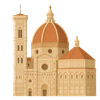
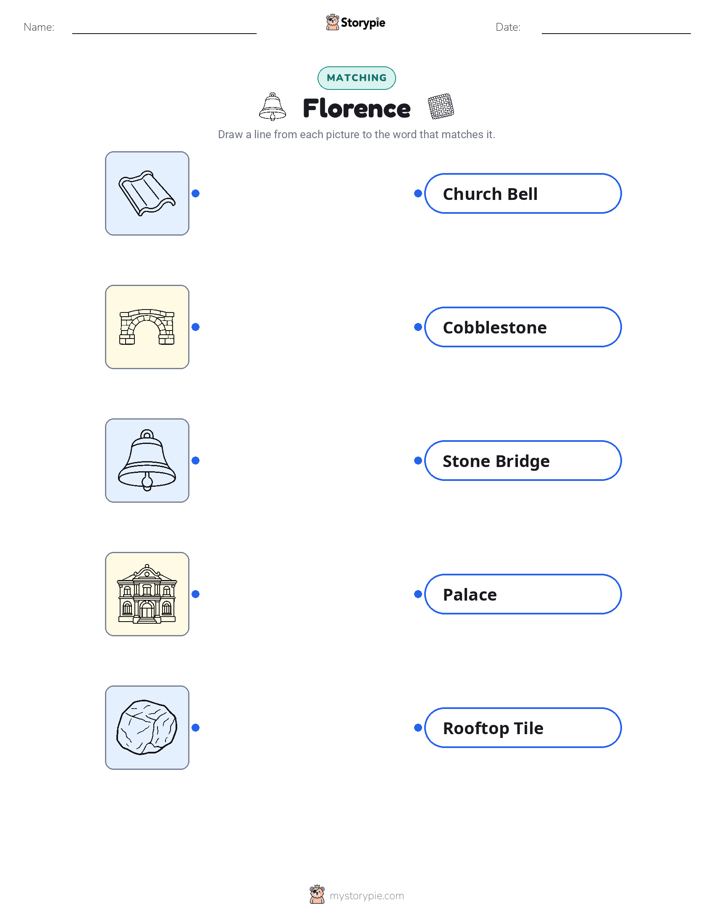
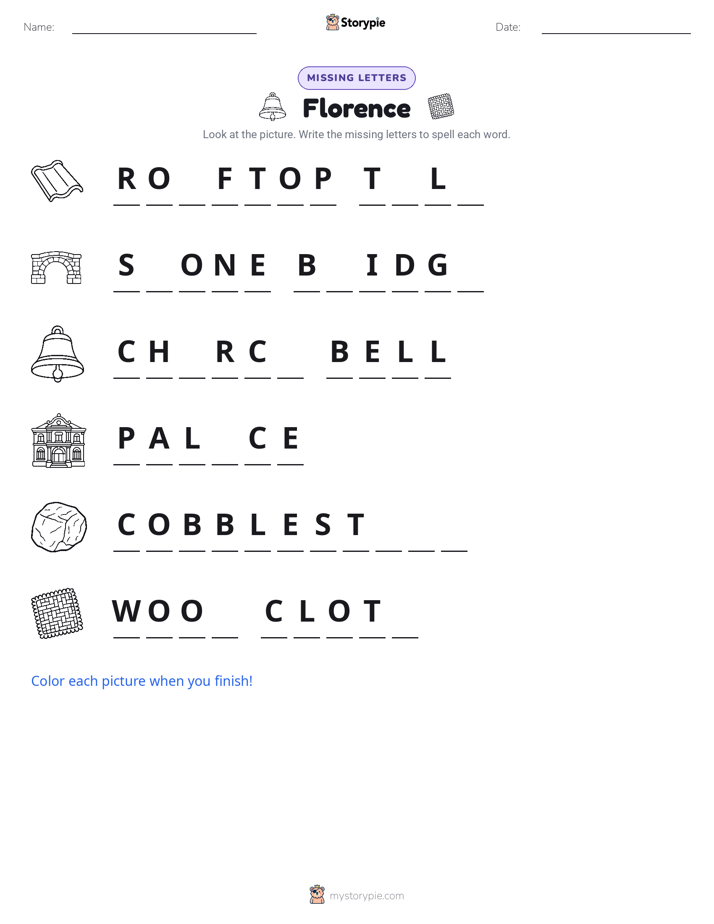
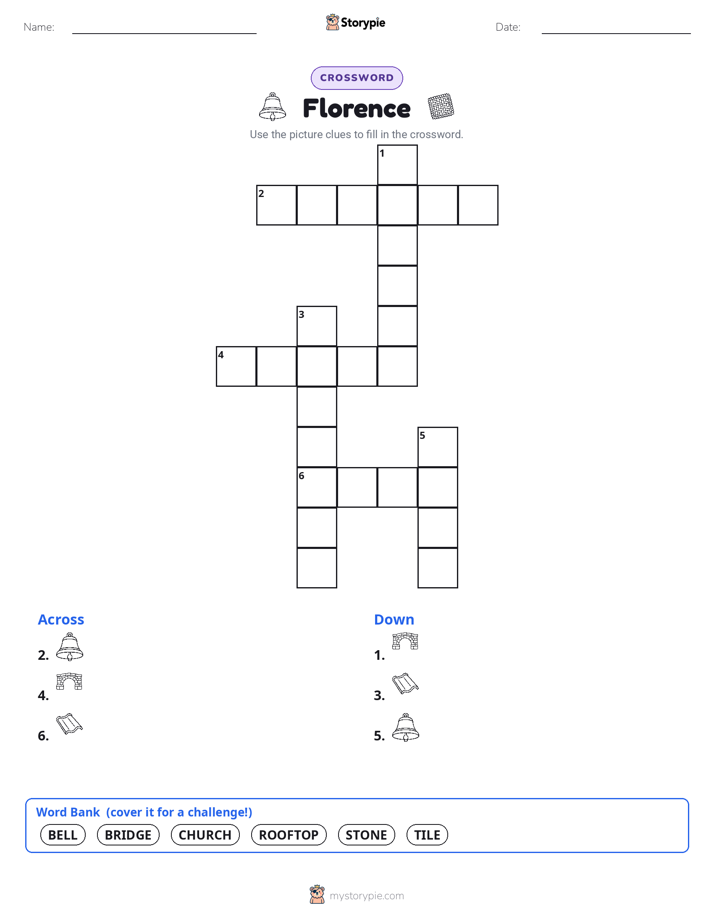
From high above, you can see all of me. My rooftops are a sea of red tiles, warmed by the Tuscan sun. A silver ribbon, the Arno River, winds its way through my heart, crossed by stone bridges that have stood for centuries. If you listen closely, you can hear the deep, resonating clang of church bells and the murmur of countless voices echoing in my narrow, cobblestone streets. Everywhere you look, there is art—in the grand statues that guard my public squares and the breathtaking paintings hidden inside my palaces. I am a city built of stone and dreams. I am Florence, or as my people have always called me, Firenze. My story began a very long time ago, when a great Roman general named Julius Caesar decided this fertile river valley was the perfect place for a settlement for his retired soldiers. That was around the year 59 BCE, and though my Roman beginnings are buried deep beneath my modern streets, the spirit of order and ambition from that time laid my very first stones.
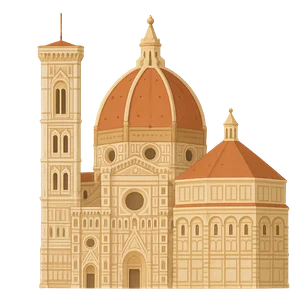
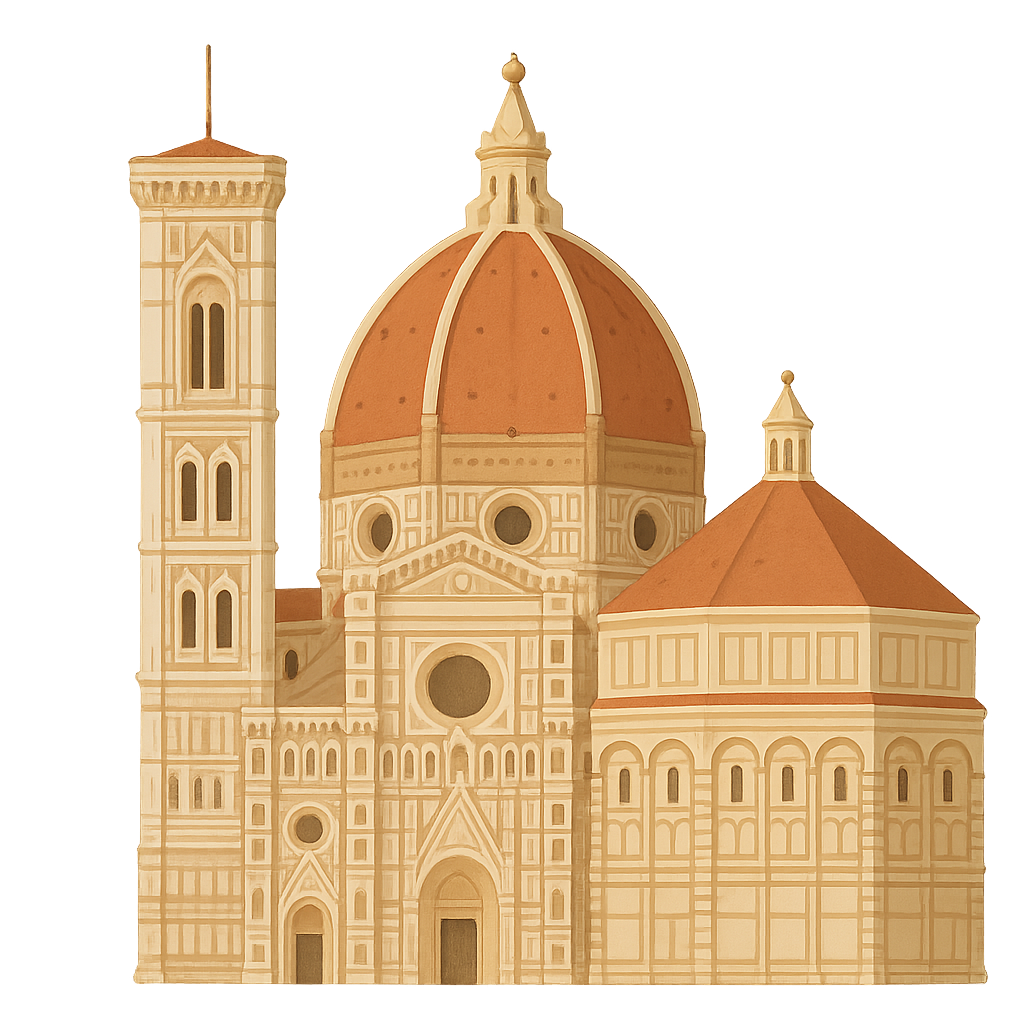
After the Roman Empire faded, I grew through the challenging but dynamic Middle Ages. I was a city of merchants and makers, and my people were fiercely independent. In the year 1115 CE, I made a bold decision. I became a self-governing republic, a city-state run by its own citizens, not by a distant king or emperor. My wealth came from the powerful guilds—associations of craftsmen and merchants. The wool makers wove the finest cloth in Europe, the silk merchants traded in luxurious fabrics, and my bankers created new ways of managing money that connected me to the entire world. This wealth made me ambitious. In 1296 CE, my leaders decided to build a cathedral so magnificent it would have no equal. They called it Santa Maria del Fiore, but everyone today knows it as the Duomo. It was a project that would take more than a century to complete. My journey was not always easy. In 1348 CE, a terrible plague known as the Black Death swept through Europe, and my streets fell silent. But the spirit of my people, their resilience and determination, allowed me to recover, to rebuild, and to dream even bigger than before.
The City of Lilies: A Story of Florence
From high above, you can see all of me. My rooftops are a sea of red tiles, warmed by the Tuscan sun. A silver ribbon, the Arno River, winds its way through my heart, crossed by stone bridges that have stood for centuries. If you listen closely, you can hear the deep, resonating clang of church bells and the murmur of countless voices echoing in my narrow, cobblestone streets. Everywhere you look, there is art—in the grand statues that guard my public squares and the breathtaking paintings hidden inside my palaces. I am a city built of stone and dreams. I am Florence, or as my people have always called me, Firenze. My story began a very long time ago, when a great Roman general named Julius Caesar decided this fertile river valley was the perfect place for a settlement for his retired soldiers. That was around the year 59 BCE, and though my Roman beginnings are buried deep beneath my modern streets, the spirit of order and ambition from that time laid my very first stones.
After the Roman Empire faded, I grew through the challenging but dynamic Middle Ages. I was a city of merchants and makers, and my people were fiercely independent. In the year 1115 CE, I made a bold decision. I became a self-governing republic, a city-state run by its own citizens, not by a distant king or emperor. My wealth came from the powerful guilds—associations of craftsmen and merchants. The wool makers wove the finest cloth in Europe, the silk merchants traded in luxurious fabrics, and my bankers created new ways of managing money that connected me to the entire world. This wealth made me ambitious. In 1296 CE, my leaders decided to build a cathedral so magnificent it would have no equal. They called it Santa Maria del Fiore, but everyone today knows it as the Duomo. It was a project that would take more than a century to complete. My journey was not always easy. In 1348 CE, a terrible plague known as the Black Death swept through Europe, and my streets fell silent. But the spirit of my people, their resilience and determination, allowed me to recover, to rebuild, and to dream even bigger than before.
That spirit of recovery blossomed into something the world had never seen before. Historians call it the Renaissance, which means 'rebirth'. It was a time when art, science, and new ideas exploded with incredible energy, and I was its cradle. Much of this was thanks to a powerful banking family, the Medici, who rose to prominence in 1434 CE. A man named Lorenzo de' Medici, who they called 'the Magnificent,' was a great patron of the arts. He and his family used their immense wealth not just for power, but to support the most brilliant minds of the age. They invited painters, sculptors, architects, and philosophers to my streets, creating a vibrant hub of creativity. But there was one great problem that stumped everyone: my Duomo. For decades, the massive hole in its roof where the dome was supposed to be remained open to the sky. No one knew how to build a dome so large without it collapsing. Then, a genius goldsmith and clockmaker named Filippo Brunelleschi came forward. Between 1420 CE and 1436 CE, he engineered a revolutionary double-shelled dome, an architectural marvel that still defines my skyline. During this golden age, true giants walked my streets. A young man named Leonardo da Vinci, born on April 15th, 1452, filled his notebooks with sketches of flying machines and painted masterpieces of haunting beauty. Another, Michelangelo, carved the magnificent statue of David from a single block of marble; it was unveiled to an astonished crowd on September 8th, 1504. Even great scientists like Galileo Galilei found a home here in the early 1600s, turning his telescope to the stars and changing our understanding of the universe.
My golden age of the Renaissance eventually passed, but my story continued. I have changed with the times, always holding onto the memory of my brilliant past. For a brief, proud period, from 1865 CE to 1871 CE, I even served as the capital of the newly unified Kingdom of Italy. But my greatest modern challenge came on November 4th, 1966. The Arno River, my constant companion, swelled with rain and burst its banks in a catastrophic flood. Mud and water surged through my streets, churches, and museums, damaging priceless books and irreplaceable works of art. The world watched in horror, but then something wonderful happened. Young people from all over the globe rushed to my side. They were called the 'Mud Angels,' and they worked tirelessly to rescue my treasures, carefully cleaning every page of a soggy manuscript and every inch of a mud-caked painting. Their help proved that I belong not just to my citizens, but to the world. Today, I am not a silent museum. I am a living, breathing city, filled with students, artists, and travelers who walk my streets, inspired by the same spirit of curiosity and beauty that sparked the Renaissance. I am a testament to human creativity and resilience, a reminder that great ideas and beautiful things have the power to connect us all across the ages.
Wow facts
About
Florence, the capital of Italy's Tuscany region, is renowned as the birthplace of the Renaissance and is home to many masterpieces of art and architecture.
Take a Quiz
Question 1 of 5
How did the Medici family influence Florence during the Renaissance?
Explore next




Want to do even more?
Go beyond exploring. Unlock tools that turn every story into real learning.

Storypie Plus for families
Full stories, quizzes, and printables. Nights and car rides, sorted.
- Unlimited audio stories
- Create Mode: your child stars in the story
- Offline downloads
- Printable worksheets & coloring pages

Why Storypie for Schools
Students engaged. Prep in seconds. Evenings back to you.
- Worksheets & Quizzes
- Classroom Management
- Formative Assessment
- Custom Curriculum & Lesson Plans
- 27 Languages

Why Storypie for Homeschool
Curriculum done. They'll ask for more. Hours back in your day.
- Worksheet Generator
- First-Person Audio Stories
- Built-in Comprehension Quizzes
- Custom Curriculum & Lesson Plans
- Print & Go Activities