English

The Sun
The Sun is the G-type main-sequence star at the center of the Solar System.
Reads at Grades 6–8 Listens at Grades 4–8
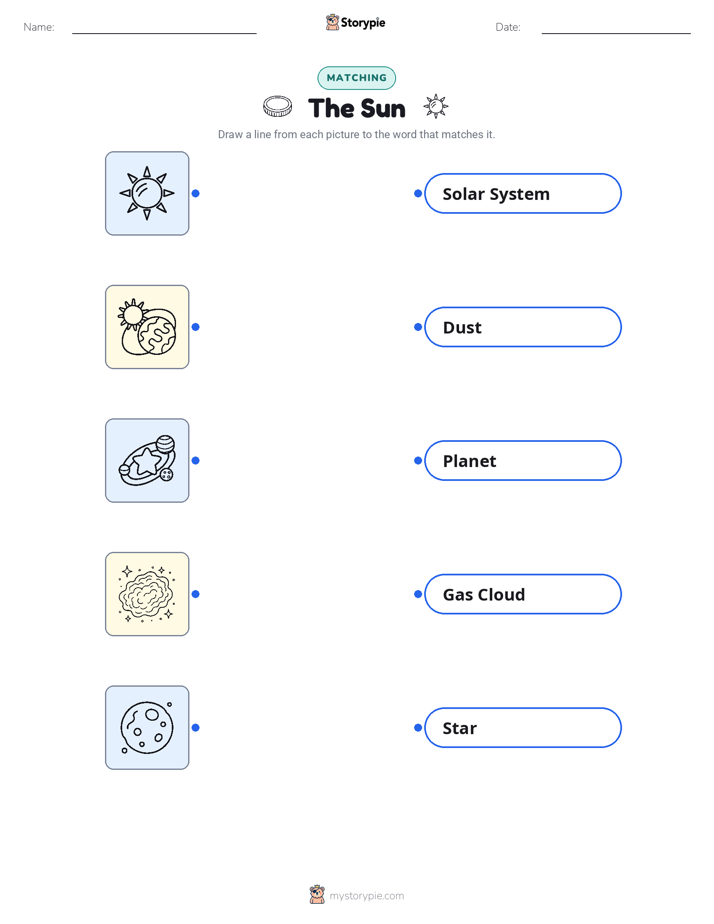
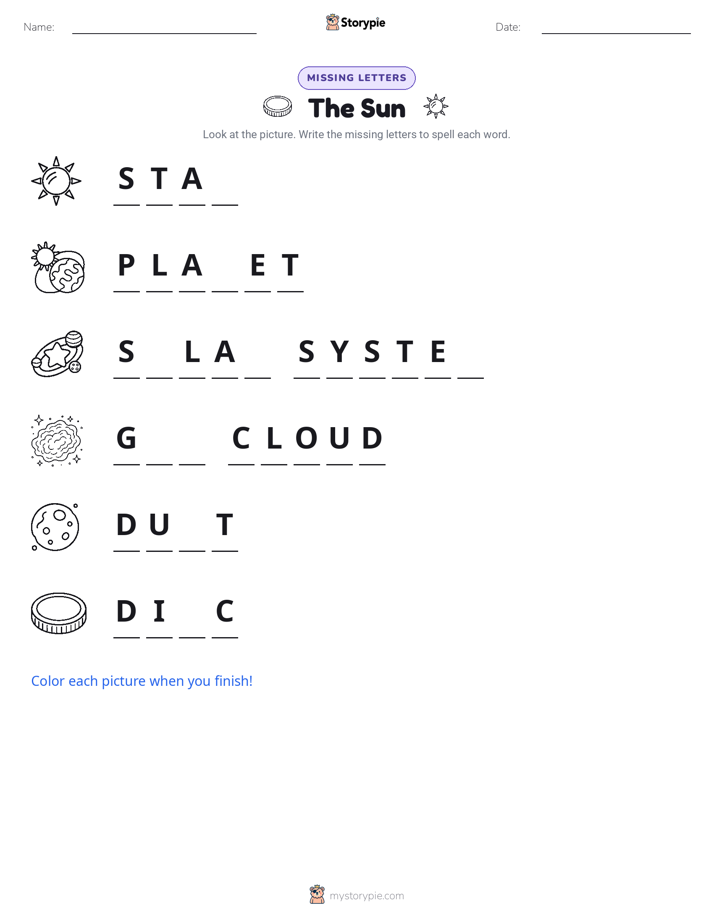
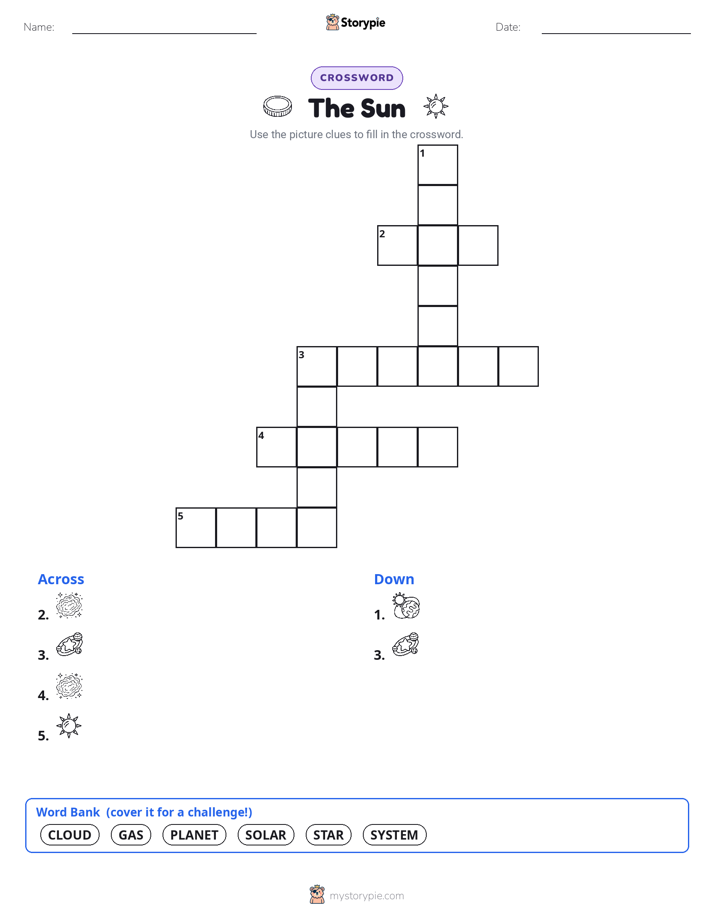
Print & create
Answer keys·No prep·Free with an account
28 worksheets · answer keys · full story · quiz · Ages 10-12 · CEFR B2
Plus adds 102,000+ more stories in 27 languages, audio for every one, and printables for all of them.
Just want The Sun?
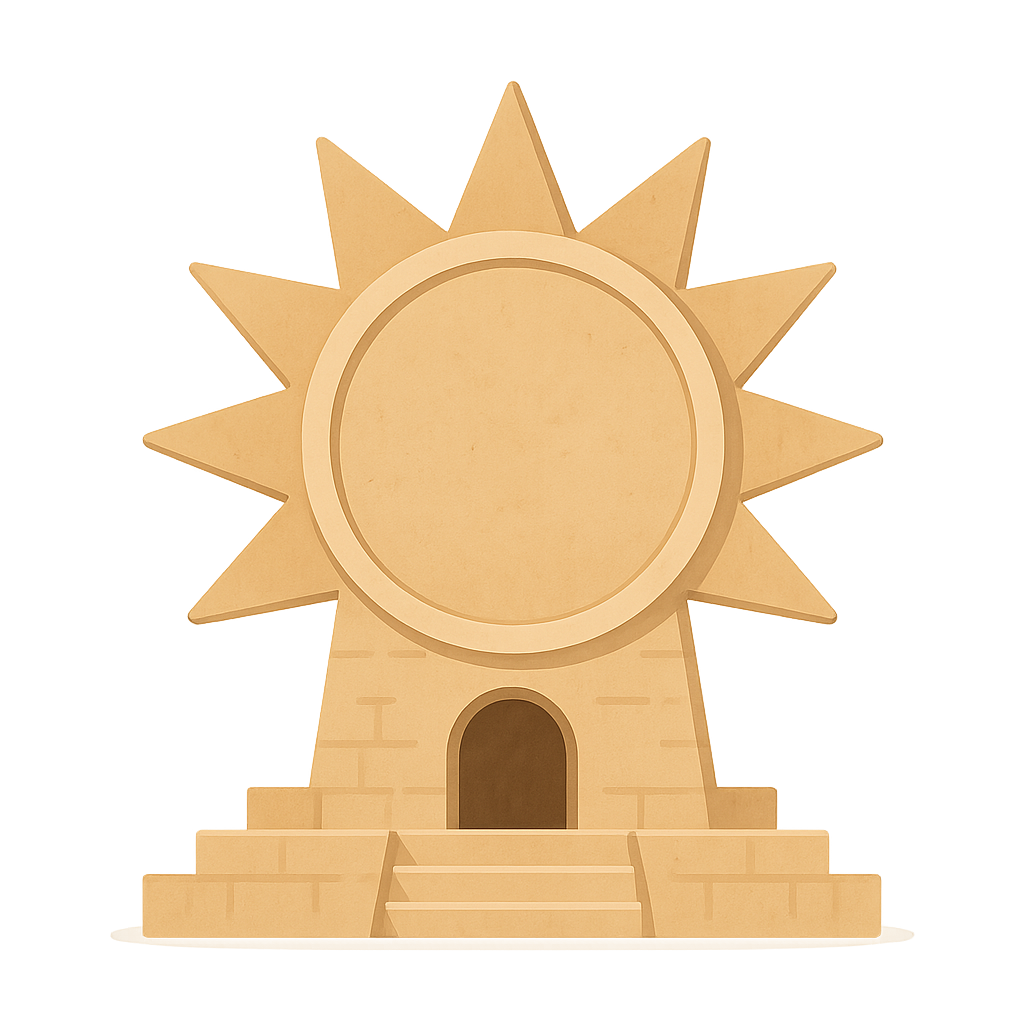
From the very center of your cosmic neighborhood, I watch. I am a colossal sphere of fire, a churning ocean of incandescent gas so vast that you could fit one million planets the size of your Earth inside me. My surface roars with temperatures that would vaporize any rock in an instant, and my power radiates across millions of miles of empty space. All around me, planets perform a silent, graceful dance, from tiny Mercury, scurrying close to my heat, to distant Neptune, a cold blue jewel in the darkness. They are all held in my embrace by an invisible, unbreakable tether—a force you call gravity. They spin and circle, following paths they have traveled for billions of years, all tied to me, their anchor and their guide. For all my power and majesty, you know me well. You feel my warmth on your skin and see my light paint your sky in shades of orange and blue. I am the star you know best. I am your Sun.
My life began long before yours, around 4.6 billion years ago. Before there were planets or people, there was only a vast, cold, and dark cloud of gas and dust drifting through the galaxy. This was the solar nebula, a majestic, spinning cloud of cosmic leftovers. But gravity is patient and persistent. Slowly, over millions of years, it began to pull the dust and gas together. The cloud spun faster and faster, flattening into a disc, and at its very center, an enormous clump of matter began to grow. This clump was my beginning. As more and more material fell into me, the pressure at my core became unimaginable. The temperature soared to millions of degrees. Then, the miracle happened. The atoms of hydrogen, the most basic element in the universe, were crushed together with such force that they fused, becoming a new element: helium. This transformation, which you call nuclear fusion, unleashed a torrent of energy. A great wave of light and heat blasted outward, and I ignited. My fiery heartbeat began, a steady, powerful engine that has been converting matter into energy ever since, and I was born as a true star.
A Star's Story
From the very center of your cosmic neighborhood, I watch. I am a colossal sphere of fire, a churning ocean of incandescent gas so vast that you could fit one million planets the size of your Earth inside me. My surface roars with temperatures that would vaporize any rock in an instant, and my power radiates across millions of miles of empty space. All around me, planets perform a silent, graceful dance, from tiny Mercury, scurrying close to my heat, to distant Neptune, a cold blue jewel in the darkness. They are all held in my embrace by an invisible, unbreakable tether—a force you call gravity. They spin and circle, following paths they have traveled for billions of years, all tied to me, their anchor and their guide. For all my power and majesty, you know me well. You feel my warmth on your skin and see my light paint your sky in shades of orange and blue. I am the star you know best. I am your Sun.
My life began long before yours, around 4.6 billion years ago. Before there were planets or people, there was only a vast, cold, and dark cloud of gas and dust drifting through the galaxy. This was the solar nebula, a majestic, spinning cloud of cosmic leftovers. But gravity is patient and persistent. Slowly, over millions of years, it began to pull the dust and gas together. The cloud spun faster and faster, flattening into a disc, and at its very center, an enormous clump of matter began to grow. This clump was my beginning. As more and more material fell into me, the pressure at my core became unimaginable. The temperature soared to millions of degrees. Then, the miracle happened. The atoms of hydrogen, the most basic element in the universe, were crushed together with such force that they fused, becoming a new element: helium. This transformation, which you call nuclear fusion, unleashed a torrent of energy. A great wave of light and heat blasted outward, and I ignited. My fiery heartbeat began, a steady, powerful engine that has been converting matter into energy ever since, and I was born as a true star.
For most of your history, the humans on that little blue planet looked up at me with a mixture of fear and reverence. They saw my daily journey across the sky as a sign of something divine. Some ancient civilizations imagined I was a god riding a golden chariot, while others believed I was a magical being who brought life to their crops. They built great stone monuments to track my path and held festivals to celebrate my return after the cold darkness of winter. But slowly, your curiosity grew stronger than your myths. Around 450 BCE, a Greek thinker named Anaxagoras dared to suggest something radical: that I was not a god, but a gigantic, blazing rock, even larger than his part of the world. It was a shocking idea, and he was punished for it. Centuries later, in 1543, a brilliant astronomer named Nicolaus Copernicus published a book that changed everything. He bravely proposed that Earth was not the center of everything—I was. The planets, including your own, revolved around me. It was a revolutionary thought that took time to be accepted. Then, around 1610, an Italian scientist named Galileo Galilei pointed his newly invented telescope at me. Through its lens, he saw that my face was not perfect and smooth. It had dark patches, blemishes he called “sunspots.” I had freckles. His discovery proved that I was a dynamic, changing world, not an unchanging celestial jewel.
Your quest to understand me had only just begun. For centuries, you knew I was hot and bright, but you didn’t know what I was made of. It was a puzzle that stumped the greatest minds. Then, in 1925, a young astronomer named Cecilia Payne-Gaposchkin made a discovery that changed stellar science forever. By studying the light that I radiate, she calculated that I was made almost entirely of hydrogen and helium, the two lightest elements in the universe. At first, many scientists refused to believe her, but her calculations were flawless, and her discovery unlocked one of my most fundamental secrets. Just over a decade later, in 1938, a physicist named Hans Bethe figured out the precise details of my engine. He described the exact chain of reactions in my core—the nuclear fusion process that turns my hydrogen fuel into brilliant starlight. Today, your exploration continues in ways that would have seemed like magic to Galileo. On August 12th, 2018, you launched the Parker Solar Probe, a courageous little spacecraft designed to fly right through my fiery outer atmosphere, my corona. It is “touching” a star for the first time in history, braving intense heat and radiation to help you understand the solar winds and powerful flares I send out across the solar system.
Everything you know, everything you see, is connected to me. I am the source of the light that allows you to see the world, and the heat that keeps your planet from freezing into a ball of ice. My energy drives the winds and the ocean currents, creating the weather that shapes your days. I am the power source for the plants that grow in your fields and forests, the very foundation of your food chain. Now, you are even learning to capture my light directly, using solar panels to power your homes and cities. I am your past, your present, and your future. So when you feel my warmth on a sunny day, remember the long journey of discovery that connected us. Continue to look up, to ask questions, and to explore the vast universe we share. I will be here for billions of more years, shining steadily, warming your days, and inspiring you to reach for the stars.
Wow facts
About
The Sun is the G-type main-sequence star at the center of the Solar System. It is the primary source of energy for life on Earth.
Take a Quiz
Question 1 of 5
What is the main idea of the section titled "Watching the Humans Wonder"?
Explore next




Want to do even more?
Go beyond exploring. Unlock tools that turn every story into real learning.

Storypie Plus for families
Full stories, quizzes, and printables. Nights and car rides, sorted.
- Unlimited audio stories
- Create Mode: your child stars in the story
- Offline downloads
- Printable worksheets & coloring pages

Why Storypie for Schools
Students engaged. Prep in seconds. Evenings back to you.
- Worksheets & Quizzes
- Classroom Management
- Formative Assessment
- Custom Curriculum & Lesson Plans
- 27 Languages

Why Storypie for Homeschool
Curriculum done. They'll ask for more. Hours back in your day.
- Worksheet Generator
- First-Person Audio Stories
- Built-in Comprehension Quizzes
- Custom Curriculum & Lesson Plans
- Print & Go Activities