Apollo 11 Moon Landing: Mission overview
Apollo 11 Moon Landing put three astronauts on a path to history. Neil Armstrong, Buzz Aldrin, and Michael Collins flew in July 1969. They launched from Cape Kennedy on July 16, 1969, at 9:32 a.m. EDT. A three stage Saturn V rocket lifted them skyward, completing a mission duration of 8 days, 3 hours, 18 minutes, and 35 seconds, covering a distance of approximately 953,054 miles.
Apollo 11 Moon Landing timeline
First, the Lunar Module Eagle touched down in the Sea of Tranquility on July 20 at 20:17 UTC, with only about 30 seconds of fuel remaining at landing, emphasizing the precision and risk involved in this historic event according to NASA. Then, Neil Armstrong stepped onto the lunar surface on July 21 at 02:56 UTC. He said: “That’s one small step for a man, one giant leap for mankind.” Meanwhile, Michael Collins stayed in Columbia, the Command Module, as Eagle landed.
Quick timeline for kids
- Launch July 16, 1969: Saturn V lifts off.
- Landing July 20, 1969: Eagle sets down in Sea of Tranquility.
- Moonwalk July 21, 1969: Armstrong and Aldrin outside for about 2 hours 31 minutes, during which they spent a total of 21 hours, 36 minutes, and 17 seconds on the lunar surface.
- Return July 24, 1969: Columbia splashes down in the Pacific and crew quarantine begins.
Roles, gear, and what they did on the Moon
Neil Armstrong served as commander. Edwin E. “Buzz” Aldrin Jr. served as Lunar Module pilot. Michael Collins stayed in the Command Module. On the surface, they collected 21.55 kilograms of rocks and soil, contributing to the total of 842 pounds (382 kilograms) of lunar rocks and soil that Apollo astronauts brought back to Earth, which continue to be studied today. Also, they planted a flag and set up experiments.
They deployed a seismic package and a laser reflector. Today, scientists still use that reflector to measure the Earth Moon distance. Those instruments and samples help researchers learn about Moon rocks and the Moon’s interior.
The landing and teamwork
The landing proved tense and heroic. During descent, the Lunar Module computer gave program alarms, such as 1202. Ground controllers judged the alarms noncritical and told the crew to continue. That calm call and clear teamwork helped the mission succeed. It remains a clear example of focused problem solving.
Why Apollo 11 Moon Landing still matters
The mission met President Kennedy’s goal to land a person on the Moon before 1970 and return them safely. It united much of the world. The TV broadcast reached hundreds of millions. Moreover, the retroreflector remains a working experiment. Moon rocks continue to teach us about planetary history. That scientific thread links 1969 to today in quiet, wonderful ways. The Eagle landed at coordinates approximately 0.67409° North latitude and 23.47298° East longitude, marking a significant point in our exploration of space.
Simple activities and conversation prompts
Try one small tactile activity to spark curiosity. Press a toy boot in flour to make a footprint. Then, ask your child to place a pebble where the Sun would be. Also, make a simple scale model with a ball for Earth and a marble for the Moon. For example, make Moon footprints in a tray of sand to show why real footprints last.
Conversation prompts invite wonder. Ask, “How do you think the astronauts trained to walk on the Moon?” Or ask, “What would you pack for a trip to the Moon?” These short questions invite thinking aloud.
Storypie and resources
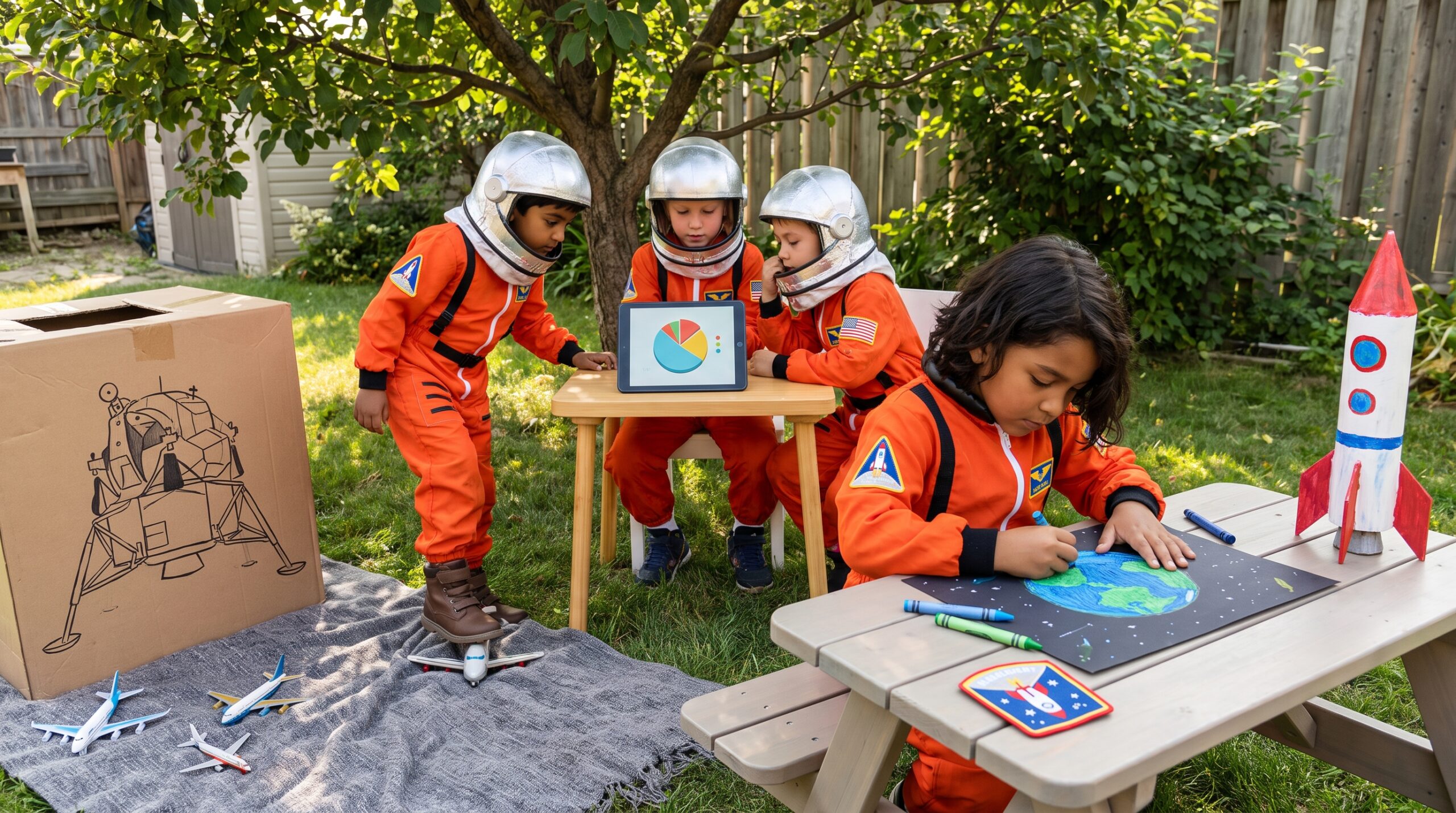
We added Neil Armstrong’s Apollo 11 Moon Landing to Storypie as a warm, child friendly tale. After listening, ask your child to draw the Earth-from-Moon view. Read or listen to a story about Apollo 11 Moon Landing now: For 3-5 year olds, For 6-8 year olds, For 8-10 year olds, and For 10-12 year olds. Also, explore the full event page on Storypie Read or listen to a story about Apollo 11 Moon Landing now.
Finally, keep questions short and tactile. Small rituals help learning stick, and they make history feel close and playful.