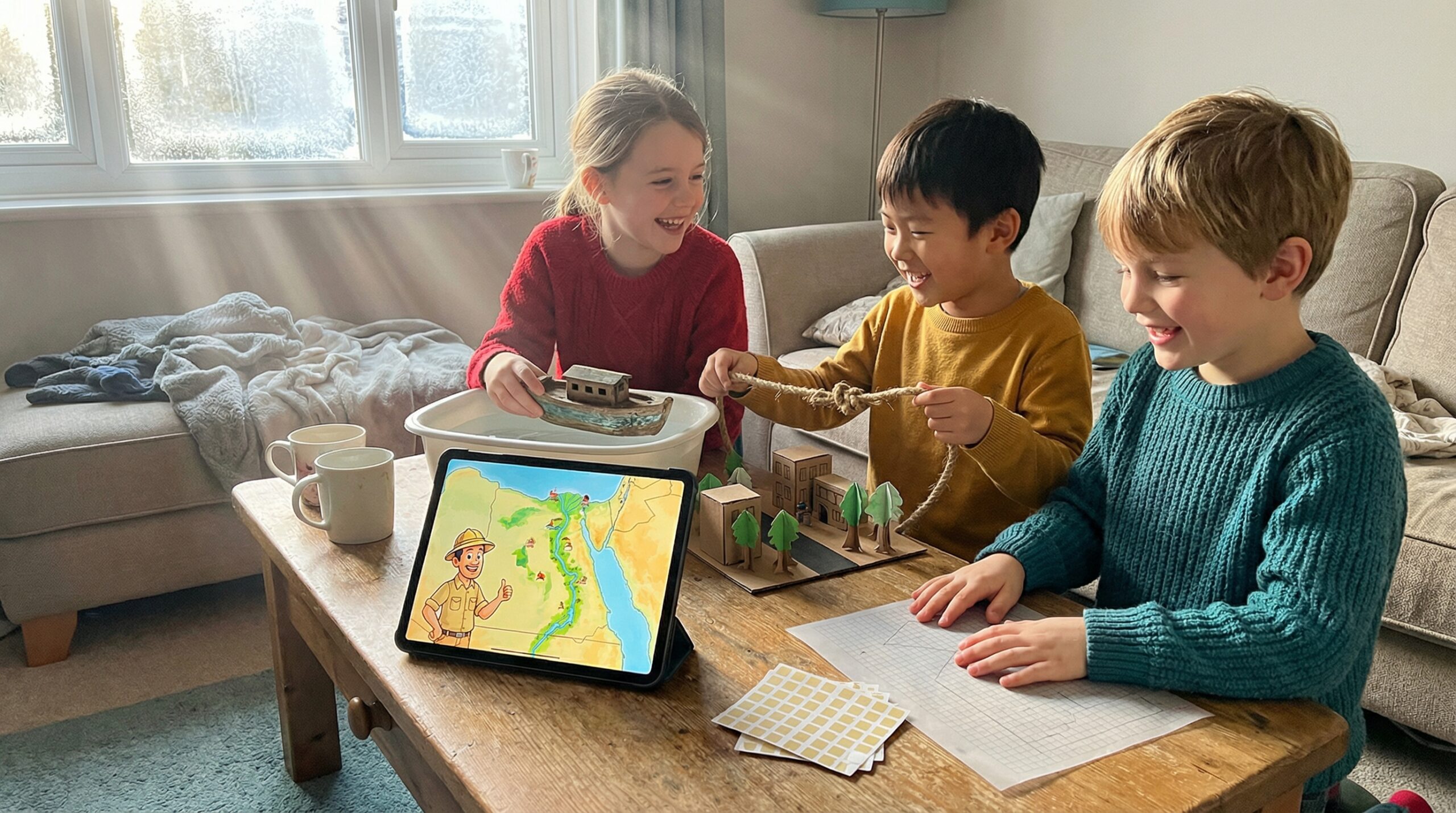
Area for kids means the flat space inside a shape. Long ago, Egyptian rope measurers walked fields and counted space with simple geometry. Later, Archimedes tied a circle’s area to its radius and circumference. Today, area for kids is a friendly idea that helps children learn about space with hands-on fun.
Area for kids: measurement in everyday life
Think in squares. Trace a shape on graph paper and fill it with 1 by 1 squares. Count whole squares and estimate partial ones. For example, this grid trick gives a great first approximation and feels tactile and playful. In fact, understanding area can help children grasp real-world concepts, such as the vastness of spaces; for example, as of July 1, 2024, the United States had a total land area of approximately 3,532,316 square miles, which can help kids realize just how big their own surroundings can be.
Why grids work
Graph paper turns a shape into many tiny squares. Then add up the squares. Also, give a sticker or a cheer for each finished shape. That small ritual makes the work feel like a tiny celebration.
Formulas that stick
Memorize a few simple rules. They are neat and useful. Try these easy formulas:
- Rectangle and square: area equals base times height. A square is s squared.
- Triangle: area equals one half base times height. You can pair two triangles to see this visually.
- Parallelogram: base times height.
- Trapezoid: one half the sum of the parallel sides times height.
- Circle: pi r squared. Archimedes gave the clever reason behind it.
Irregular shapes and fun tricks
Break odd shapes into rectangles and triangles. Then add their areas. On graph paper, use the grid to estimate partial squares. For older kids, Pick’s theorem can be a playful surprise. It links lattice points to area in a neat formula. Understanding how area is applied in real life can also be fascinating; for instance, in 2023, the United Kingdom’s total woodland area was estimated at 3.28 million hectares, with a significant portion certified as sustainably managed, showing how area relates to environmental stewardship.
Units and scaling
Units are square measures. For example, 1 meter squared means a square one meter by one meter. For land, adults use hectares and acres. One hectare equals 10,000 square meters. Also, scaling matters: double every length and the area becomes four times bigger. This concept is especially relevant when considering urban growth; between 2023 and 2024, the population of U.S. metropolitan areas increased by nearly 3.2 million people, showcasing how area can influence population density and urban planning.
Simple examples parents will like
Measure a bedroom with tiles or a tape. Multiply length by width to get the area. Plan a tiny garden and divide it into plots for herbs and flowers. Then celebrate each finished plot with a sticker or short story. Little rituals make measuring feel fun and repeatable.
Quick tips
- Measure twice. Count slowly.
- Use graph paper for messy or curved shapes.
- Make a small reward for every completed shape.
For curious parents
If your child asks for more, mention Heron’s formula for triangle area. Also bring up the shoelace formula for polygons with coordinates. These ideas show that area grows into deeper math. Additionally, as of July 21, 2023, the Office of Management and Budget identified 184 combined statistical areas across the United States, which emphasizes how areas are defined and categorized in various contexts.
Read or listen to a story about Area now: For 3-5 year olds, For 3-5 year olds, For 6-8 year olds, For 8-10 year olds, and For 10-12 year olds.
Try one quick activity today and watch how a tiny ritual turns learning into a lasting habit. Storypie loves those small discoveries, and parents can find gentle, playful resources on the site.