Audio-first stories for kids put listening before pictures. For parents and teachers, this choice reduces visual clutter and opens space for big imaginations. In short, audio-first helps children follow a story and build their own inner pictures.
How audio reduces cognitive load
Working memory is small for young children. When they watch video, their attention splits among sight, motion, and words. Therefore they must juggle visual details and language at once. Audio-only eases that burden. A 2024 study found that cognitive load was significantly higher when watching subtitled videos without sound compared to with sound, illustrating how audio can lessen cognitive demands. As a result, more brain power goes to meaning and play.
Listening lights the imagination
Hearing a story asks a child to make pictures inside their head. Research shows that a large survey study from Sulfaro et al. found auditory mental images were superior to visual ones on almost every metric tested, supporting the idea that audio can enhance imagination and mental imagery. Brain studies show descriptive language activates visual imagery networks. In plain terms, listening fires the same inner picture-making circuits that pictures can show. So audio-first practice strengthens visualization and creative problem solving.
Language, attention, and calm
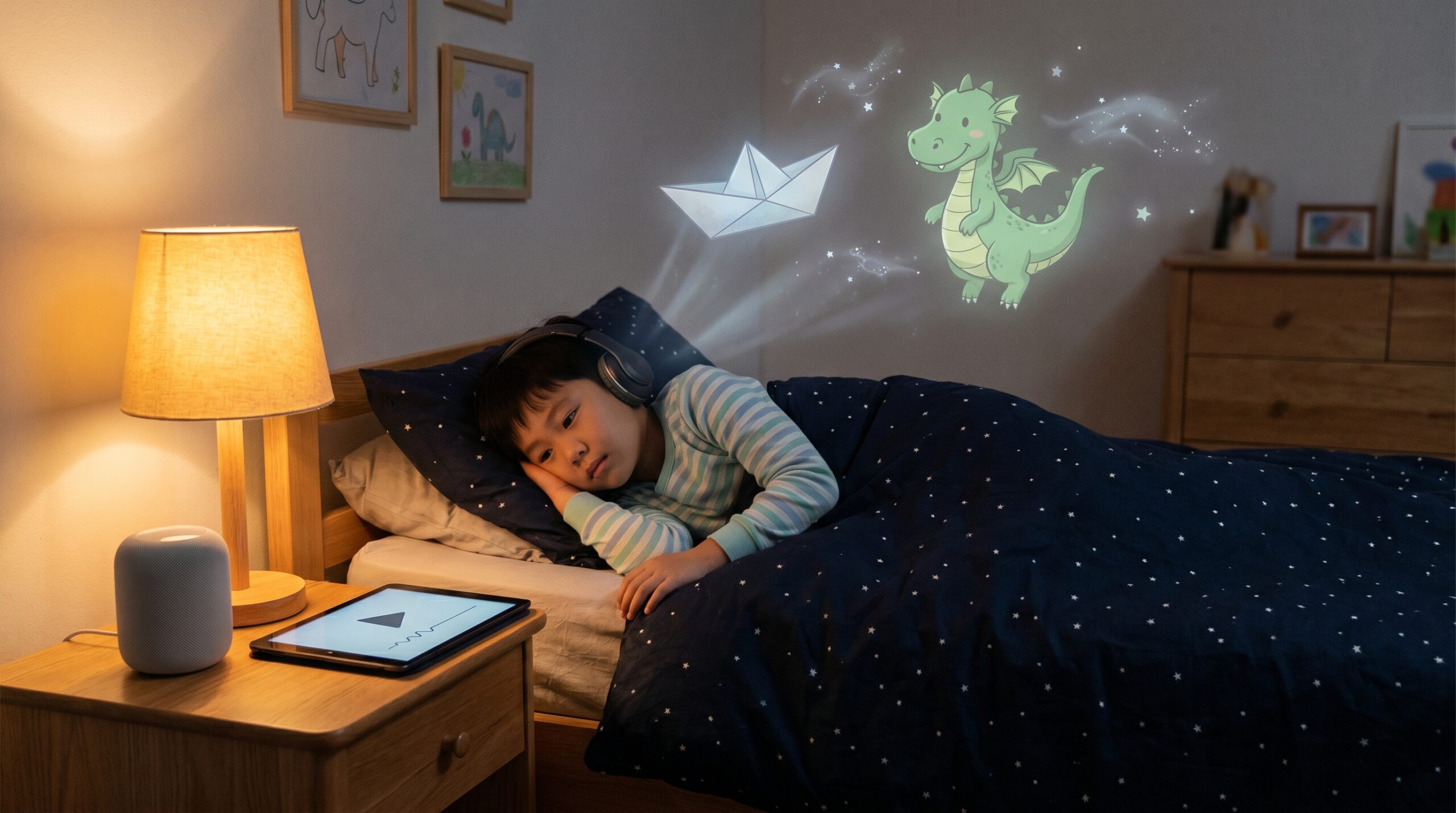
Audio-first stories for kids grow vocabulary and sentence parsing. Also, they sharpen auditory processing skills. A calm, screen-free story helps children slow down and regulate. For example, dim the lights and play a five to ten minute audio tale to help a child unwind. Make it a tiny ritual. Watch small, steady wins appear. Additionally, a systematic review found that auditory distractors interfered with visual targets in children, emphasizing the importance of reducing visual distractions in learning environments.
Accessibility and tradition
Audio is inclusive. It helps children with visual impairment and those who struggle with reading. Also, it supports multilingual learners by removing the decoding step. Oral storytelling links us to campfires and radio. Today parents can find warm, well produced short stories anytime on Storypie. Try short stories on Storypie for a gentle start: short stories on Storypie. The popularity of audio formats is on the rise, as indicated by Edison Research’s Infinite Dial 2024, which reported that 67% of Americans aged 12 and older have ever listened to a podcast, showing a growing trend towards audio-first formats that can be leveraged in educational contexts for children.
Craft, clarity, and sound design
Good audio supports comprehension. Keep narration clear and the pace steady. Too many sound effects add auditory clutter. Instead use music like a whisper and background sound that stays sparse. That way the child’s imagination does the heavy lifting.
- Steady pacing. Keep sentences calm and measured.
- Sparse soundscapes. Use music like a whisper, not a parade.
- Strong, warm narration. A friendly voice wins every time.
Routine-friendly listening
Short audio stories of five to fifteen minutes fit many moments. They work well for bedtime, car rides, and quiet play. Parental presence adds shared attention and easy conversation prompts. Balance still matters. Audio does not replace picture books. Pair listening with occasional print and hands-on play so visual literacy also grows.
A small design promise
Make listening a tiny ritual. Dim the light and set a soft speaker. Let a story ask a child to picture a dragon or a puddle of light. The fewer competing sights, the richer the inner world. Try an audio-first story tonight and notice how ideas bloom. For more warm tales, get the Storypie app: get the Storypie app.