
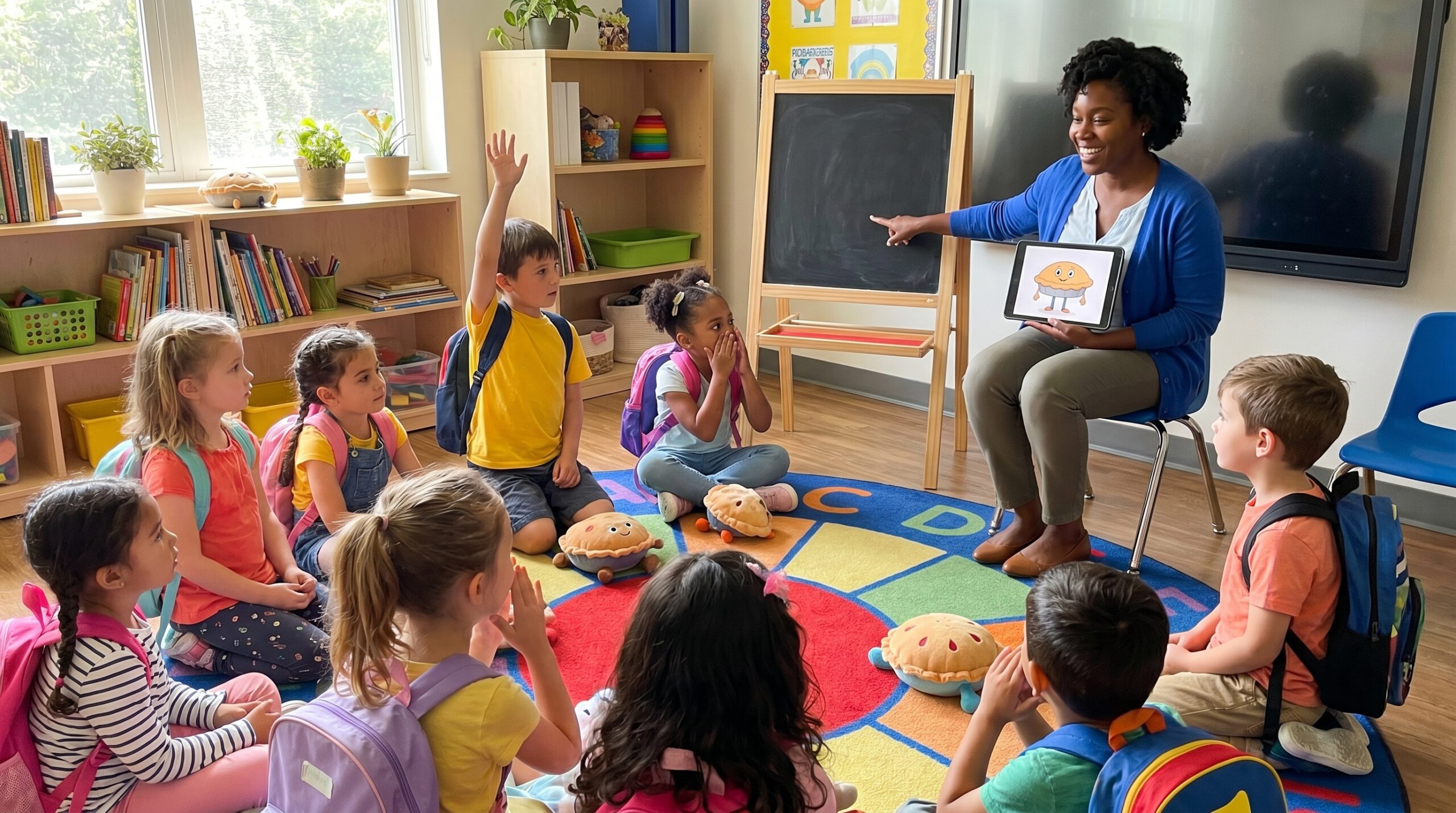
Education through storytelling ages 3-12 helps facts become people and places. At Storypie we turn lessons into memorable characters. Try a tiny ritual: ask one open question after the story to boost recall and conversation.
Why stories work for learning
Stories create images and emotion, so facts stay alive. For example, words plus pictures strengthen memory. Also, simple plots give children a neat mental shelf for new ideas. Neuroscience shows that emotional scenes light up memory centers and make details stick. In fact, a 2025 neuroimaging study tested 51 children (ages 6–12) and found that listening to a chapter of Alice’s Adventures in Wonderland activated canonical theory-of-mind brain regions, showing that narrative listening engages social-cognitive neural networks in children.
How stories fit each age
Education through storytelling ages 3-12 works differently at each stage. Below are quick fits for preschool to upper primary.
Ages 3 to 5: Preschool
Keep plots short and concrete. Focus on naming things, simple motives, and feelings. Share reading time and ask dialogic prompts. These moves boost vocabulary and early grammar. A 2025 meta-analysis of 25 studies found that interactive reading produces a medium aggregate effect on young children’s narrative ability, with the strongest effects observed in children aged 4–5 years.
Ages 6 to 8: Early primary
Use longer sequences and clearer cause and effect. Kids begin to reason about choices. Try a short audio story with a two-step problem to solve. This supports reading fluency and memory for connected events. Moreover, a longitudinal study published in May 2024 found that storytelling connectedness in children ages 5–8 predicted phonological awareness and reading comprehension measured 3–4 months later.
Ages 9 to 12: Upper primary
Offer layered plots and hypotheticals. Children can debate motives and transfer lessons beyond the page. Repetition with new details helps moral thinking and identity.
What stories teach beyond facts
Stories also build empathy and social skills. Modeled actions let children mentally rehearse behavior. Discussing motives strengthens perspective-taking. Repeated talk and follow-up grow moral reasoning. Research shows that storytelling contributes 68.2% to the improvement of early childhood empathy skills, especially at the age of 5–6 years.
Simple rules for sticky stories
- Keep it small: one main problem, one clear character.
- Ask and pause: one open question after the story.
- Repeat with variation: same theme, new detail.
- Match medium to age: picture book for little ones, short audio for early readers, layered chapters for older kids.
Design, digital, and a tiny ritual
Good multimodal design nudges attention without flashy distractions. Illustrated pages, read-aloud audio, and mindful app design expand access. End each session with one question. For example: Why did Sam share the toy? If a child brings the story up later, the lesson has landed.
Try ready-made stories
For curriculum-friendly stories and playful prompts, explore Storypie. To start telling tomorrow, get the Storypie app. These tools help make that small, repeated ritual feel joyful and simple.