
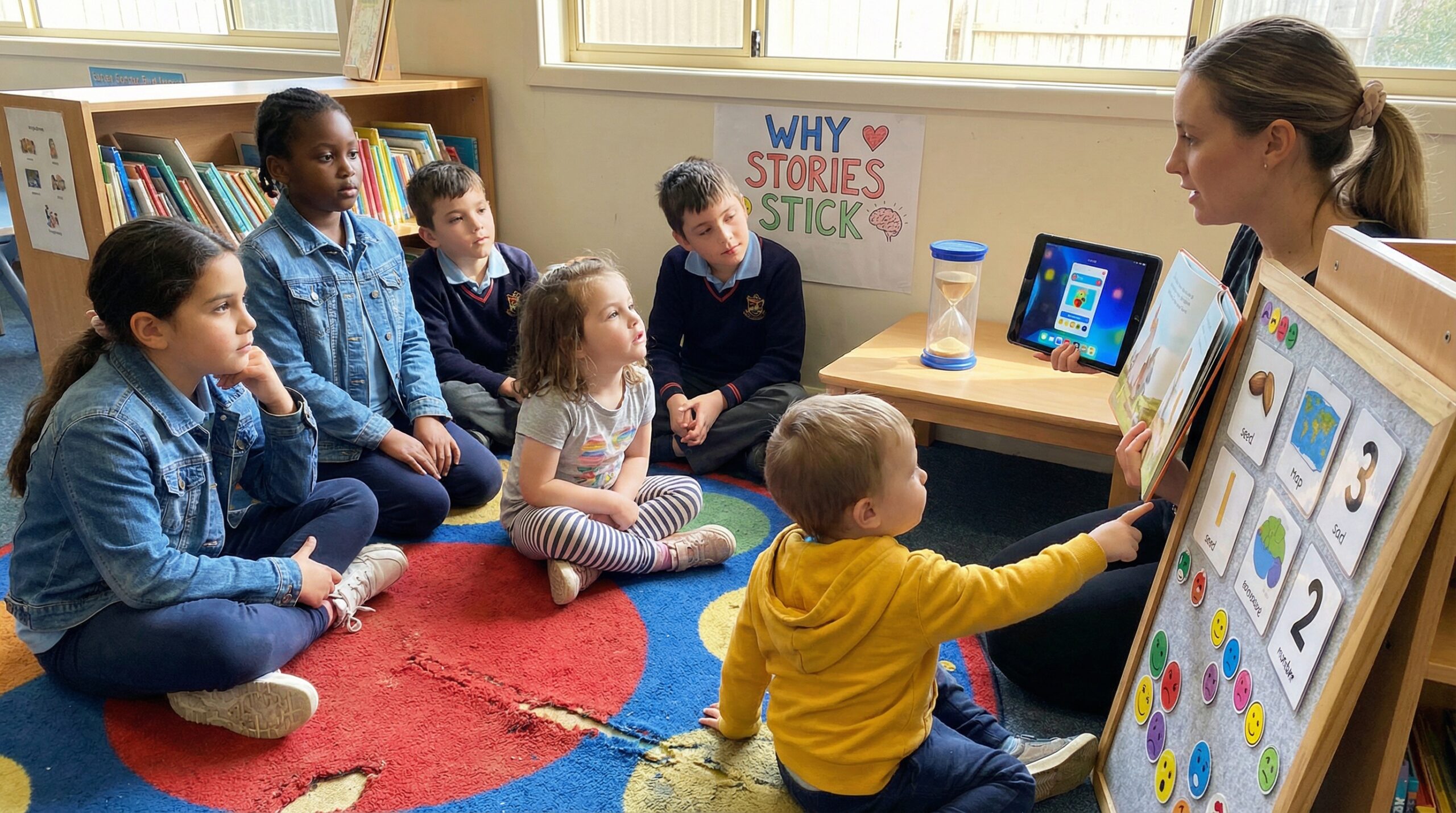
Education through storytelling ages 3-12 explains how stories turn facts into feelings. Parents and teachers see that stories give facts a shape. As a result, children remember vocabulary, sequence, and ideas more easily. In fact, a 2023 study found that children who learned through storytelling retained 70% of the information, compared to just 10% when taught through traditional methods.
How stories order memory and meaning
Stories put events in order, and order helps memory. For example, a plot links a problem to a solution. Therefore children store events as a chain instead of loose facts. This makes retrieval faster and learning stickier in a lovely way. Additionally, research from the Quarterly Journal of Economics shows that in controlled experiments, the average impact of statistical information on beliefs faded by 73% over the course of a day, while the impact of a story faded by only 32%. This illustrates how narratives are more effective than statistics in maintaining memory over time.
In addition, narrative ties information to emotion. Emotional encoding strengthens recall. Neuroscience finds that stories activate language and simulation systems in the brain. A 2025 neuroimaging study tested 51 children (ages 6–12) and found that listening to a chapter of Alice’s Adventures in Wonderland activated canonical theory-of-mind brain regions, showing that narrative listening engages social-cognitive neural networks in children. In plain terms, a child who imagines a scene remembers the words and the reason behind them.
Developmental stages: matching stories to age
Education through storytelling ages 3-12 meets children where they are. For preschoolers ages 3 to 5, stories build oral language and attention. Shared picture books boost vocabulary and sequencing. A longitudinal study published in May 2024 found that storytelling connectedness in children ages 5–8 predicted phonological awareness and reading comprehension measured 3–4 months later, emphasizing the long-term benefits of storytelling on critical literacy skills in young children.
Next, ages 6 to 8 bridge listening and decoding. Children map spoken patterns to text. Also they start to infer cause and effect in plots. By ages 9 to 12, kids follow more complex plots and weigh moral choices. They can handle multiple viewpoints and abstract themes.
What this means for language and thinking
Mechanically, narrative supports inference and prediction. Children learn to fill gaps and generalize lessons. Repeated exposure to rich story language grows receptive and expressive vocabulary. In short, reading aloud links to stronger comprehension and school readiness. A 2025 meta-analysis of 25 studies found that interactive reading produces a medium aggregate effect on young children’s narrative ability, with the strongest effects observed in children aged 4–5 years, underscoring the importance of interactive storytelling in developing narrative skills in early childhood.
Shared stories are social practice too. Tales model emotions and perspective taking. As a result, stories become rehearsal spaces for empathy and moral reasoning. Historically, oral tradition and classroom readers played this same role. Thus narrative is culture and curriculum combined.
Formats and access
Different formats reach children in different ways. Picture books invite touch and shared eye contact. Chapter books ask for longer attention. Audio and digital platforms widen access and support narrated language.
Storypie surfaces audio and personalized stories for families and classrooms. For example, try the Storypie app to find narrated, family-friendly stories and tools. Choose what fits your child and your routine.
Equity and long term impact
Early story exposure predicts stronger literacy outcomes. Access and representation shape whether narrative helps every child. Also mother tongue storytelling makes a big difference for many families.
For caregivers and educators the promise is clear. Stories are not extras. They are an engine for language, cognition, and social understanding. In short, education through storytelling ages 3-12 fits how children think, feel, and grow.
Explore Storypie for audio and personalized stories that support literacy and joy. Visit the Storypie app to get started.