
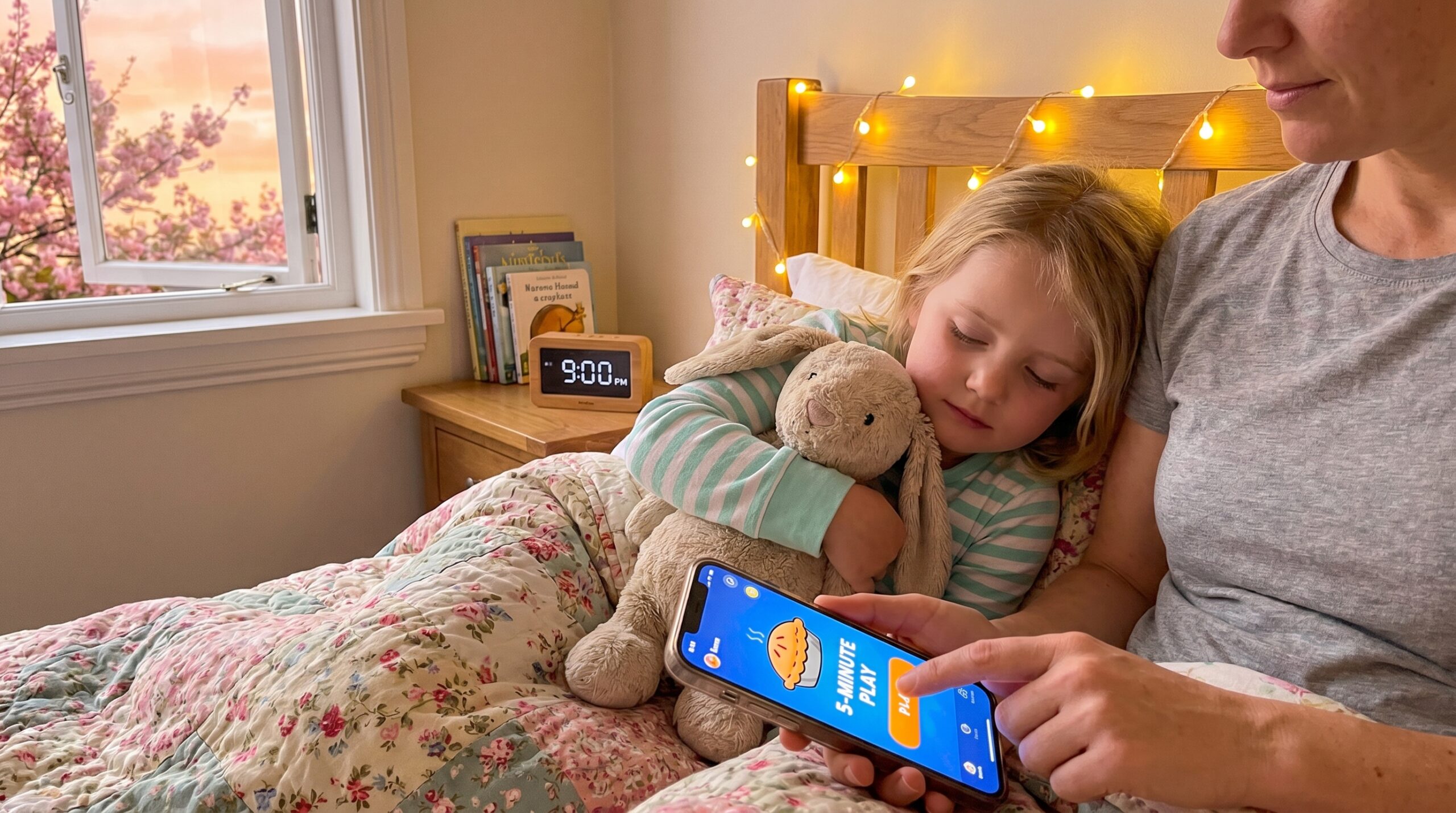
Bedtime wind-down mini story ritual is a short, consistent story cue that closes the day. It usually runs three to seven minutes. Five minutes sits sweetly in the middle.
What the ritual is
The bedtime wind-down mini story ritual is one tidy act. It is a single short read aloud or an audio-only play. It happens at a fixed clock time each night. In fact, a nationally representative C.S. Mott Children’s Hospital National Poll published in June 2024 found that 67% of parents of children ages 1–6 reported ‘reading bedtime stories’ as part of their child’s bedtime routine.
Often families pick a five-minute story at the same hour. Predictability does the heavy lifting. Over nights, the ritual becomes a gentle signal that sleep is next.
Core characteristics
The ritual stays small and steady. It is brief and repeatable. It uses a single play so the cue stays clear.
- Length: generally three to seven minutes.
- Timing: same clock time night after night.
- Delivery: live read or audio-only track.
Also, single-play matters. The story runs once and then stops. This boundary helps children learn the pattern. Research indicates that consistent bedtime routines, including storytelling started as early as 3 months, were associated with fewer night-time awakenings and longer sleep durations by age 3, as highlighted in a 2025 study.
Why predictability helps
Predictability trains the brain. When the ritual runs the same way, the body readies for rest. It cuts bedtime bargaining. It also supports sleep onset and steadier nights. A 2025 survey found that 71% of parents agreed that storytelling helps their children wind down at bedtime, with 49% naming it their preferred method. This highlights the popularity and perceived effectiveness of storytelling as a bedtime ritual among parents.
Benefits and accessibility
Short rituals offer clear benefits. They can speed sleep onset and reduce night wakings. They also build small moments of connection and boost language exposure. In a 2023 longitudinal study of toddlers, 86% of families reported a consistent bedtime routine by 24 months, which predicted fewer social-emotional problems at that age, emphasizing the importance of consistent bedtime routines for children’s emotional development.
Importantly, mini stories adapt well. Toddlers often prefer three to five minutes. Older children may enjoy slightly longer tracks. Neurodiverse children can benefit from consistent phrasing and sensory-friendly audio. Families can use second language recordings when they need them.
Seasonal and clock timing
Season affects the ritual. In spring evenings, light can delay sleepiness. Therefore, a clock-based cue keeps the routine steady. Set a time and protect it. A five-minute story at the usual time is a nightly anchor.
Simple example
It is spring. Ten minutes before bedtime you dim the lamp. You press play. The voice reads for five minutes. Then the story ends. The room feels softer. The child breathes more slowly. A tiny ritual has done its job.
Quick tips
- Set a fixed clock time and keep it regular.
- Prefer audio-only or very dim light for the cue.
- Choose one hero story for the week for extra predictability.
- Keep the device out of easy reach and use timers.
Explore short audio stories on Storypie for quick, single-play bedtime picks. Small rituals add up. Night after night they become the dependable signal that sleep is next. Additionally, substituting 50% of preschoolers’ screen time with book reading has been shown to improve sleep quality and reduce sleep problems, according to research published in Nature and Science of Sleep in March 2024.