Try a quick create your own hero challenge this weekend. Ten minutes can spark wild ideas, language growth, and confidence. In fact, a July 2026 study found that children who engage in creative activities, like this challenge, score significantly higher on measures of curiosity and creativity.
How the create your own hero challenge works
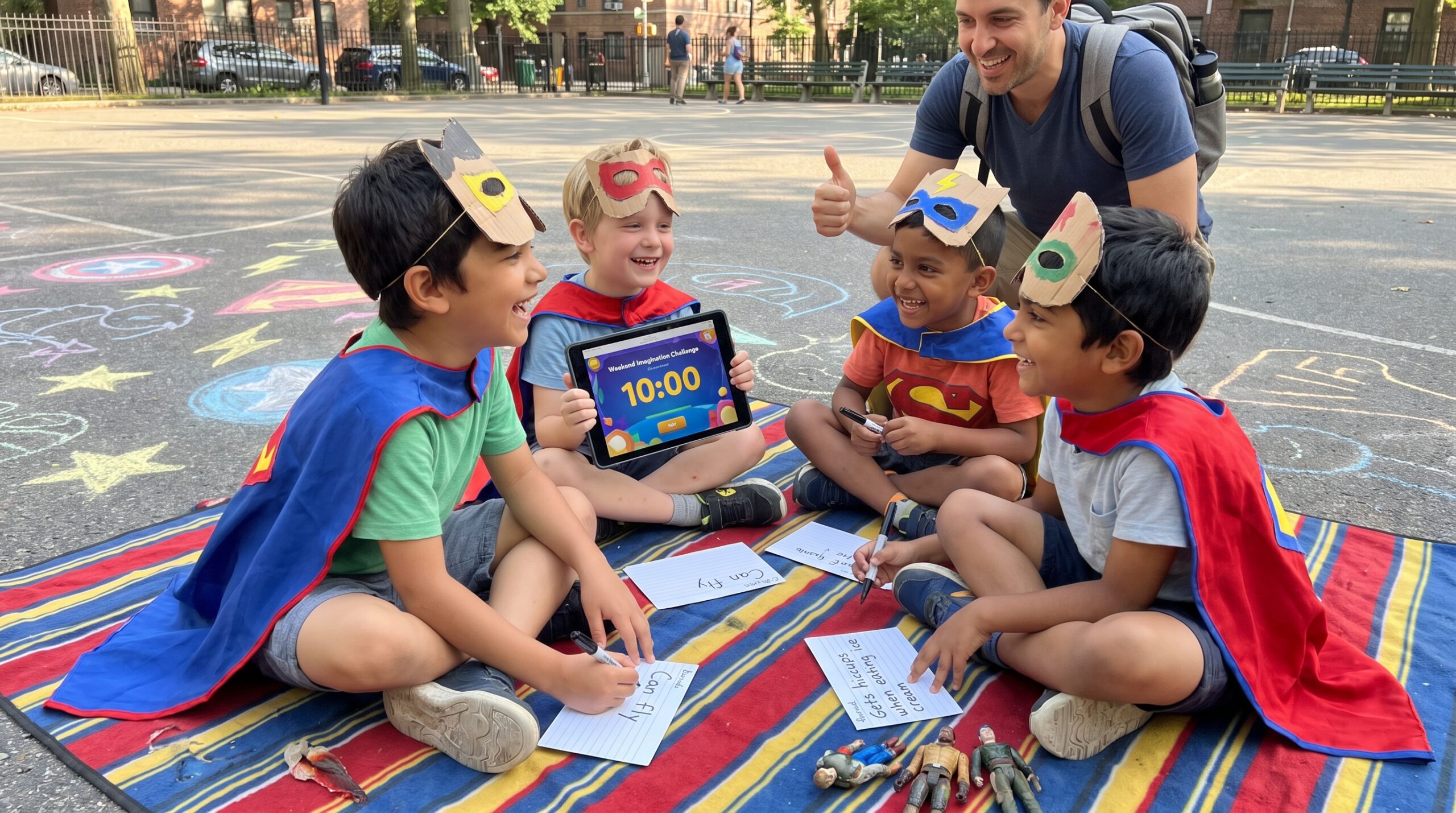
Set a timer for ten minutes. First, announce the rules. One power. One silly weakness. Keep the prep low. The goal is a quick spark, not a finished epic. Research indicates that creative play has a moderate-to-strong positive effect on creativity, especially in early childhood, making this challenge an excellent way to boost your child’s imaginative skills.
Next, celebrate every idea. Praise wildly. Encourage the child to name the hero and think of one power and one weakness. Simple rituals make play feel special.
Quick setup and rules
- Give 10 minutes. Short bursts work best.
- Ask for a name, one superpower, and one silly weakness.
- Keep materials simple: paper and crayons are fine.
- Celebrate ideas, not perfection.
Who this fits and how to adapt
This create your own hero challenge fits a wide age range. It works for family time and classroom minutes. Below are quick adaptations.
Preschoolers (ages 3 to 5)
Offer picture cues. Also give two power choices and two weakness choices. Let them draw or act the hero. Keep language short and playful. Research shows that during these early years, creative play has a particularly strong impact on nurturing creativity, with an effect size of 0.74.
Early elementary (ages 5 to 8)
Ask for a name, a power, a silly weakness, and a quick sketch. Then ask one question. For example, who would the hero help?
Older kids (ages 8 to 12)
Invite a short backstory or a symbol. Next, have them design a hero card or emblem. This makes the tiny ritual feel extra fun and meaningful. Interestingly, a study on “paracosms”—imaginary worlds created by children—showed that those aged 8 to 12 with such creations have higher creativity scores on storytelling tasks, reinforcing the value of imaginative play like this hero challenge (Child Development).
Example powers and playful weaknesses
Use simple, silly ideas. Try these for fast inspiration.
- Powers: super-speed, talking to animals, growing gardens fast, making rainbows, super listening.
- Weaknesses: sneezes at yellow, distracted by shiny buttons, needs mismatched socks to recharge, hiccups when lying, must tell a joke before using a power.
Tiny scene idea: At breakfast Captain Spoon turns cereal into confetti, then sneezes when the sun hits a yellow cup. Big grin guaranteed.
How to respond and encourage
Be specific. Say I love that power instead of saying good job. Then ask open questions:
- Why that power?
- Who would your hero help?
- What happens when the weakness appears?
Model a silly weakness to normalize risk taking. Above all, praise creativity, not correctness. Engaging in such practices can enhance children’s resilience and prosocial behavior, as highlighted by a scoping review of hero-based interventions that identified numerous benefits from these types of activities.
Materials, variations, and extensions
No props required. Use hats or scarves for role-play. Also try paper and crayons for hero cards. With permission, record an oral description to save the memory.
Variations to try:
- Family round-robin: each person adds one trait.
- Classroom mix-and-match: trade hero cards.
- Cooperative drawing: each person adds a detail.
Inclusion, safety, and sharing
Use gender neutral prompts. Highlight non-physical powers like kindness or fixing mistakes. Also avoid violent themes.
If you post a hero online, remove names and faces. Get consent before sharing a child who is not your own. For a simple memory, try saving the idea in Storypie.
Tips for shy kids and weekend ritual
Offer choice rather than pressure. Let them draw privately if they prefer. Give small rewards like a sticker to praise risk taking. Studies reveal that engaging children in creative tasks can positively influence their brain activity, specifically enhancing frontal EEG alpha activity during creative ideation.
Make this create your own hero challenge portable. Play in the car, at the park, or before bed. Ten minutes. A laugh. A new hero. Small predictable magic.
Want to save a tiny ritual? Try Storypie to record the idea or tuck it into a weekend journal. Visit the Storypie app to keep the memory.