Try the create your own hero challenge this weekend. It is quick, cozy, and full of wonder. First, ask your child to name one superpower. Then ask why that power matters. That is the whole challenge.
Why the create your own hero challenge matters
This challenge builds real skills. When kids invent names, powers, and missions, they practice vocabulary and sequencing. Also, they try on feelings and choices in a safe way. Small acts of imagination help both thinking and empathy to grow. In fact, a 2023 study by the National Alliance on Mental Illness reported that 61% of participants who engaged in creative activities experienced reduced feelings of stress or anxiety. This highlights the mental health benefits of engaging in imaginative play for children as well.
What to include in the challenge
Keep the list short and friendly. Use these elements as a guide.
- Name and age or identity
- One or two powers or special skills
- A short origin story or reason they became a hero
- Costume or visual detail
- A goal or mission
- One strength and one weakness
- A friend, sidekick, or helper
How to run the create your own hero challenge (15 to 30 minutes)
First, gather and make it cozy. A winter afternoon works great. Next, prompt with a few simple questions. Try: “What is your hero called? What one power do they have? How did they get it?” Keep prompts short and playful.
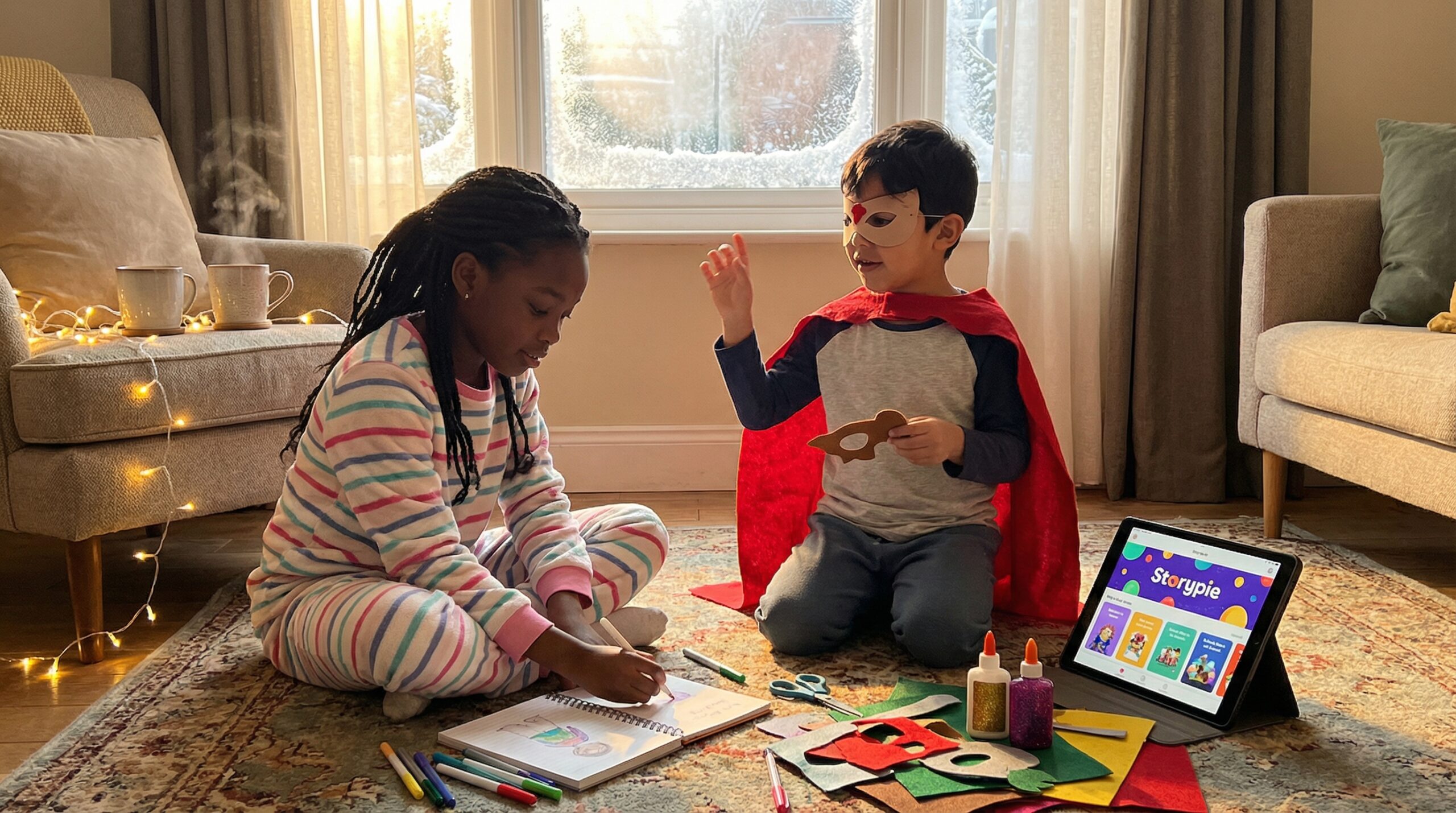
Then draw or craft. Paper masks, cardboard capes, or a quick crayon portrait help ideas stick. After that, role-play a short scene. One problem, one clever solution, and a quick cheer will do.
Finally, record a tiny audio or video clip if you want. Keep recordings 30 to 90 seconds. Also, you can save the clip for a family listening night.
Age-friendly variations
- Preschool (3 to 5): One power, one colour, and a favourite toy as sidekick. Keep activities to 5 to 15 minutes.
- Early elementary (5 to 8): Add an origin and a simple mission. Then draw a mask or cape. Aim for 15 to 30 minutes.
- Older kids (9+): Design a team, invent gadgets, or make a short audio scene. Let them edit a 60 to 90 second clip.
A tiny example loop
Child: “My hero is MoonMender. She fixes broken stars.” Adult: “How did she get her power?” Child: “She ate a glowing berry on a mountain.” Adult: “Show me how she patches a star.” Two quick lines of role-play. Laughter. A new twist. Done.
Inclusion and safety notes
Invite diverse heroes. Encourage different abilities, backgrounds, and bodies. Heroes can be grandmothers, kids, or anyone. Supervise scissors and check small parts for choking hazards. Also, set screen-time limits for recordings. Use first names only or blur faces before sharing online.
Extend the challenge
Turn the create your own hero challenge into a weekend project. Day one: design and draw. Day two: perform and record. Hold a family listening night where each person plays a short scene. Use recycled materials for costumes to keep costs low and hands on.
For a gentle next step, try a Storypie story to save or share the audio clip. Start with a Storypie story: https://www.mystorypie.com/get-app.
Final thought
Start small and celebrate wildly. The create your own hero challenge turns a short family moment into a lasting boost for language, empathy, and creative thinking. Research from a 2024 preregistered meta-analysis found small but significant cognitive benefits from reading fiction, particularly in empathy and theory-of-mind measures, indicating that imaginative activities can enhance cognitive skills. Try it, share a tiny clip, and enjoy the giggles.