Equation for kids is a friendly way to say two expressions match. First, think of x + 3 = 5. The left side and the right side balance. Variables hide unknowns. Constants stay the same. Operators show action. The equals sign ties both sides together. In short, an equation tells us equality and invites a tiny adventure.
Equation for kids: a quick definition
An equation names a relationship between two expressions. For example, 2 + 2 = 4. Also, equations can include letters like x or y. These letters stand for unknown numbers. Moreover, the equals sign acts like a scale. It asks us to keep both sides even. This simple idea builds big thinking. A 2024 study involving vocational students found that changing coefficients in linear equations can significantly affect how students solve these equations, highlighting the importance of understanding the complexity behind them.
A short time-travel tale
Long before our symbols, people solved the same puzzles. Ancient Babylonian clay tablets show methods like ours. Likewise, the Rhind Papyrus from Egypt records practical problems. Later, Al-Khwarizmi wrote the book that shaped algebra. Then in 1557 Robert Recorde used two parallel lines and called them equal. I use this tiny history as a friendly map. It turns symbols into people and moments that feel alive.
Why equations matter
Equations describe relationships. For instance, speed equals distance divided by time. Also, F = ma links force, mass, and acceleration. Even E = mc2 changed how scientists think about energy. Some equations feel like magic. For example, Euler’s identity, eiπ + 1 = 0, looks like a tiny postcard from math. Above all, equations help us predict and solve real problems. In fact, a 2023 review highlighted the growing use of data-driven methods, including machine learning algorithms, to discover causal relations and equations from observational data in various scientific fields.
A 10-minute equation hunt
Try this tonight. First, pick a spark like a recipe, a game score, or a shopping price. Then set a tiny goal: find one equation in ten minutes. Next, talk it out and ask where the unknown might hide. Finally, record it by drawing the balance or leaving a quick voice note. This becomes a delightful mystery children want to solve again.
- Pick a spark and set a short timer.
- Find an unknown and write a simple equation.
- Explain the equals sign as a balance.
- Celebrate the mini discovery fast and warmly.
Read or listen to a story about Equation now: Read or listen to a story about Equation now: For 3-5 year olds, For 6-8 year olds, For 8-10 year olds, and For 10-12 year olds.
Hands-on balance activity
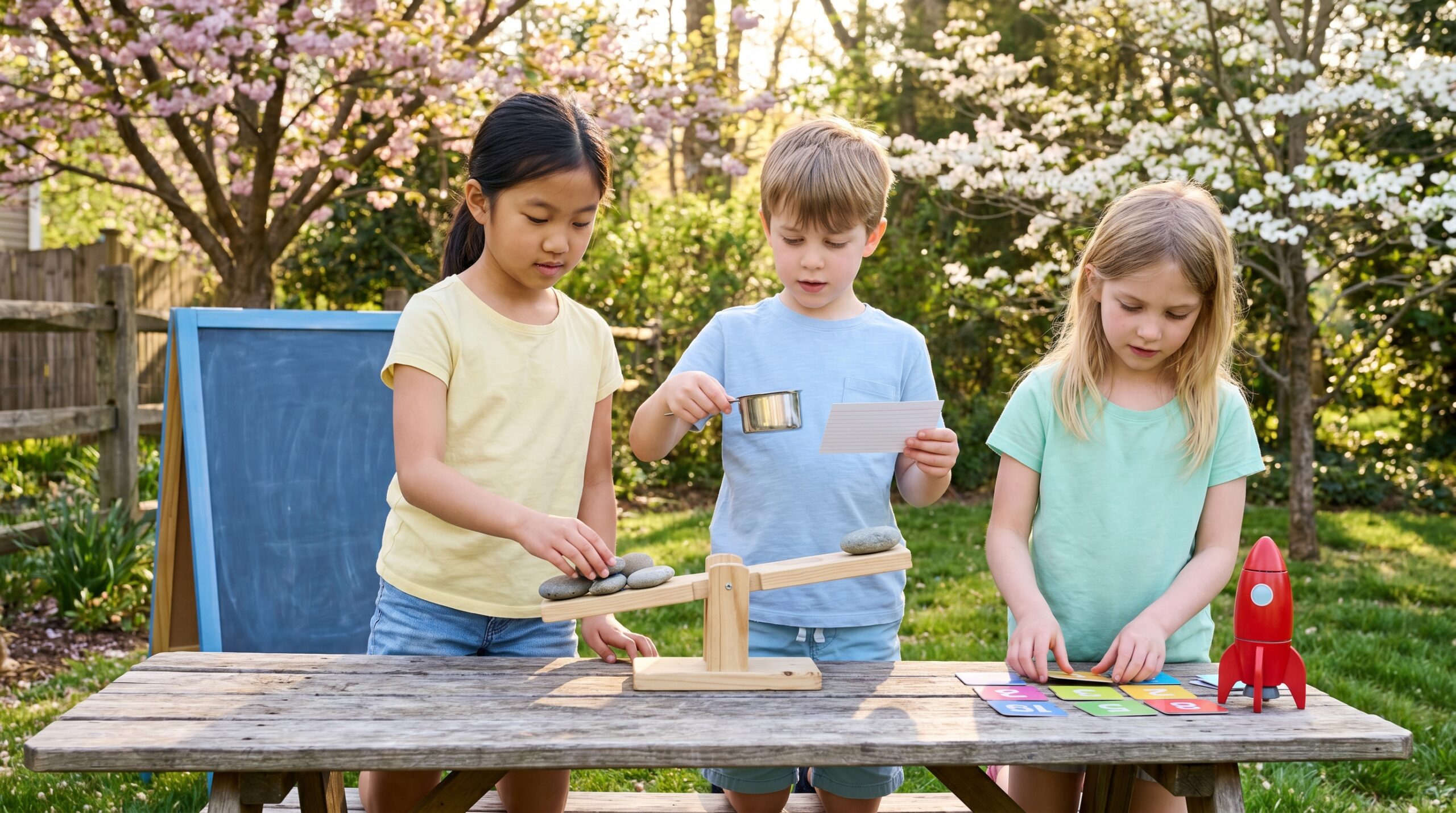
Use a kitchen scale or an improvised balance. Put equal weights on both sides. Then move a small object from one side to the other and watch the balance change. Ask, what must we add to make both sides equal again? This physical model helps kids see equality, not only compute answers. It also sparks curiosity and hands-on thinking.
Visuals, progression, and age-friendly tips
I suggest a simple timeline from Babylon to Recorde, then to Euler and Einstein. Also show a balance-scale illustration, algebra tiles, and a number line. For young learners, start with boxes for unknowns. In middle years, introduce substitution and simple graphing. In secondary school, show quadratics, systems, and real applications. Here are quick tips by age:
- Primary: Use balance games and boxes for unknowns.
- Middle years: Practice isolation and substitution.
- Secondary: Factor, use formulas, and model problems.
Teacher and parent tips
Emphasize the equals sign as a balance. Use many visual models and celebrate reasoning steps. Also encourage questions over quick answers. At Storypie I love how short, playful prompts make equations memorable. Visit Storypie for more story-driven learning prompts.
Try the mini-experiment tonight: a ten-minute hunt and a balance. Watch a tiny eureka happen. Kids love the discovery and you get a calm, curious evening.