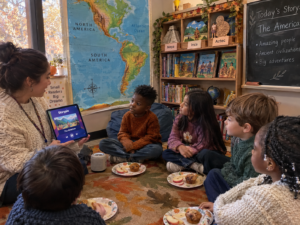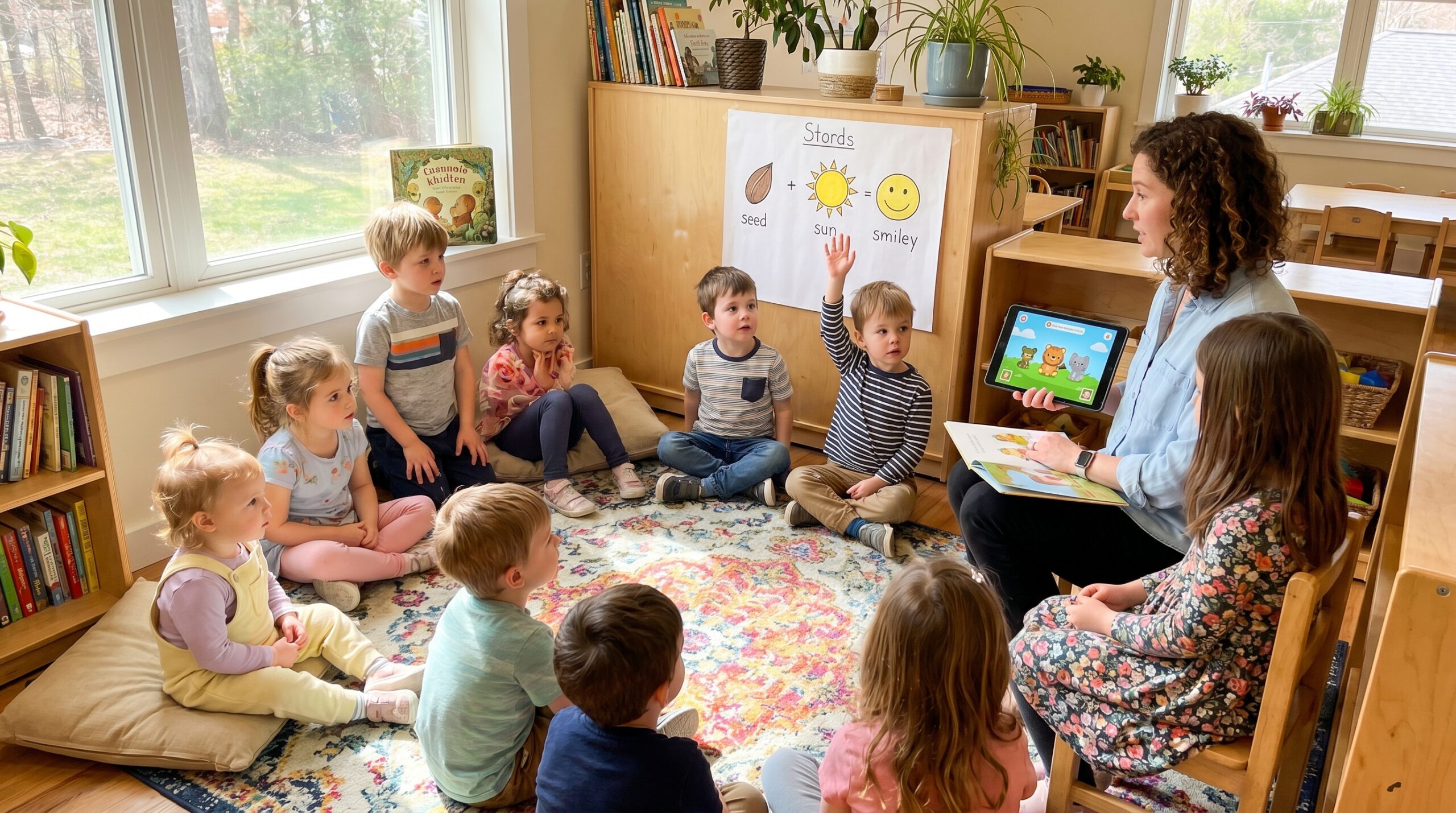
Good spring morning. I build products and tell bedtime stories. I believe education through storytelling ages 3-12 is the single most delightful way to make facts stick.
Why education through storytelling ages 3-12 works
Stories give children a path from feeling to fact. Moreover, narratives link events and ideas. As a result, the brain stores a sequence, not loose bits of information. Research shows that storytelling contributes 68.2% to the improvement of early childhood empathy skills, especially at the age of 5–6 years, emphasizing how narratives enhance emotional development alongside cognitive growth.
Three clear reasons narrative sticks
- First, causal order reduces load. A plot ties A to B to C so memory becomes simple. A 2025 study indicated that narrative structure significantly enhances memory accuracy, linking storytelling techniques to improved retention in children.
- Second, emotion anchors details. Memories tied to feeling are easier to retrieve later.
- Third, social talk builds meaning. Conversation around a story turns words into thinking.
What research shows about education through storytelling ages 3-12
Shared reading and storytelling boost vocabulary, receptive language and comprehension. Large reviews and classroom studies show read-alouds and interactive story sessions help young children learn new words and reasoning. A 2025 meta-analysis of 25 studies found that interactive reading produces a medium aggregate effect on young children’s narrative ability, with the strongest effects observed in children aged 4–5 years. Neuroscience also supports this view. Specifically, narratives activate language, emotion, and sensory systems. Consequently, stories create richer memory traces. A longitudinal study published in May 2024 found that storytelling connectedness in children ages 5–8 predicted phonological awareness and reading comprehension measured 3–4 months later.
Age-related characteristics
Different ages respond to stories in distinct ways. Therefore teachers and parents notice different strengths at each stage.
Ages 3-5
Young children prefer short, repetitive picture stories. They pick up new words and simple cause and effect. Also, stories at this age often support early life concepts and feeling words.
Ages 6-8
Children begin to sequence goals and reasons. Small mysteries and problem-based plots build comprehension. Moreover, this stage helps with classroom transfer of new vocabulary and planning skills.
Ages 9-12
Older children handle multiple perspectives and nuance. Longer plots support abstract thinking and empathy. In short, narratives at this age strengthen argument skills and deeper reasoning.
Curriculum and classroom fit
This approach aligns with the EYFS and the English National Curriculum. For example, both frameworks stress spoken language, reading aloud and comprehension. Consequently, story-based learning maps neatly to assessed literacy outcomes.
Formats and practical characteristics
Books, oral telling, audio and apps all carry narrative power. However, digital formats shine when used alongside adult interaction. Active conversation and retell tasks tend to strengthen learning gains more than passive listening alone.
How educators measure impact
Common measures include story retell tasks, vocabulary checks, narrative production scoring and curriculum attainment checks. These metrics typically show gains in lexical diversity, retell length and inferencing after sustained story work.
Cautions and equity
Stories can simplify or embed bias. Therefore representation matters. High-quality, diverse stories improve identity affirmation and learning. Also, access matters. Be critical of claims and check who authored content and whose voices are missing.
About Storypie and next steps
Storypie builds tools that support education through storytelling ages 3-12. For example, our app stores family stories and helps preserve children’s voices. Explore Storypie features for educators and families, and get the app to try friendly, evidence-aligned content.
Learn more: Storypie features and Get the Storypie app.