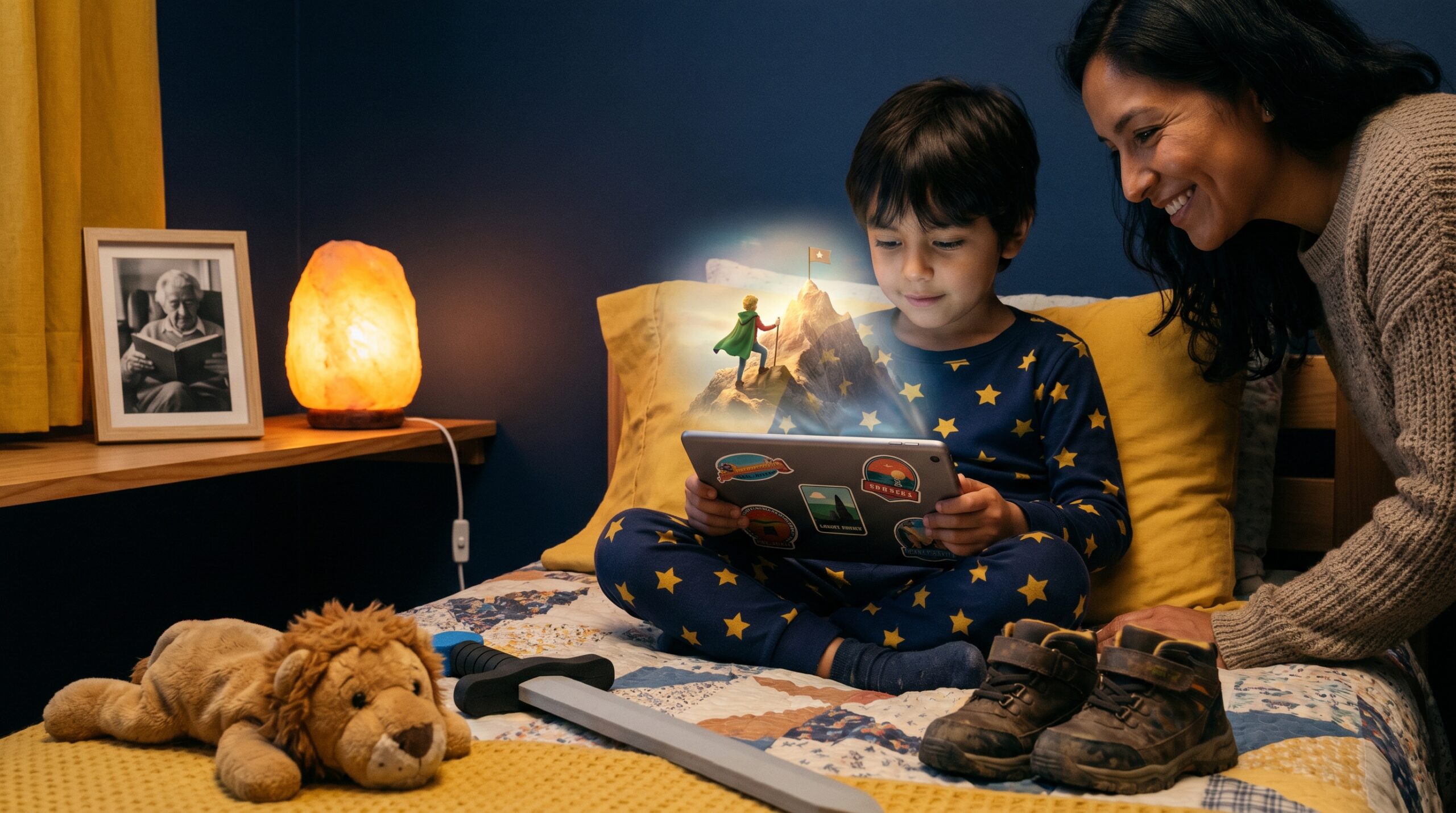
I build products and tell bedtime stories for a living, and I notice one clear truth: kids become the hero when they feel like the main character. In that moment play shifts into practice. Children move from listener to actor. They act, decide, fail, try again, and grow. It feels small, but it changes everything.
When kids become the hero: a simple timeline
First, pretend play appears around 18 to 24 months. Then, between ages three and six, play gets richer. By ages six to twelve, children hold longer stories. They use clearer beginnings, middles, and ends. Those steps track with gains in language, planning, and perspective. As brains mature, kids carry bigger hero arcs.
Characteristics of the child-as-hero experience
The child-as-hero pattern shows a few steady traits. Agency stands first. A child makes choices and takes action. Second, there is a clear goal. Third, there is an age-appropriate challenge or risk. Fourth, a learning moment appears. Finally, the child feels accomplishment. These parts repeat across play, books, and myths. They teach resilience and practical coping skills.
Why this matters for development
Research supports the idea that kids become the hero through play. Make-believe supports symbolic thought and self-regulation. Bandura showed that doing builds belief. Narrative practice boosts vocabulary, memory, and sequence skills. Playful challenges strengthen executive functions like working memory and flexible thinking. In short, this is brain work disguised as fun. In fact, a systematic review found that ‘guided play’ produced positive learning effects, particularly in early math skills and shape knowledge, showcasing how structured play can empower children and enhance their learning experiences (Child Development).
History and culture of child-centered tales
Stories have put children at the center for a long time. Think of Peter Pan, Matilda, and many folktales. These stories let young heroes act, not just watch. Over time, new media widened those possibilities. Today, audio apps and interactive tools let a child hear themselves as the lead character. Storypie joins this ecosystem by offering personalized audio that places a child at the center of a narrated adventure. For more, visit the Storypie homepage or try the Storypie app.
Common outcomes when kids become the hero
- Greater confidence in decision making.
- Improved narrative skill and vocabulary.
- Stronger problem solving and flexible thinking.
- More willingness to try after a failure.
In short, letting kids take the lead builds character. It builds skill. And it builds imagination in the most joyful way. In a 2024 study, 70% of early childhood teachers reported high self-efficacy in helping children develop self-confidence, highlighting the vital role of educator support in fostering children’s heroic journeys (Teachers’ Understanding of Self-efficacy). Moreover, research indicates that children prompted to imagine a positive future were over four times more likely to engage in positive actions, further empowering them to feel heroic in their endeavors (Journal of Experimental Child Psychology). So, when a child leans in and becomes the hero, we see real growth.
If you want gentle ways to explore this idea, check Storypie for ideas and tools that center the child as the main character.