
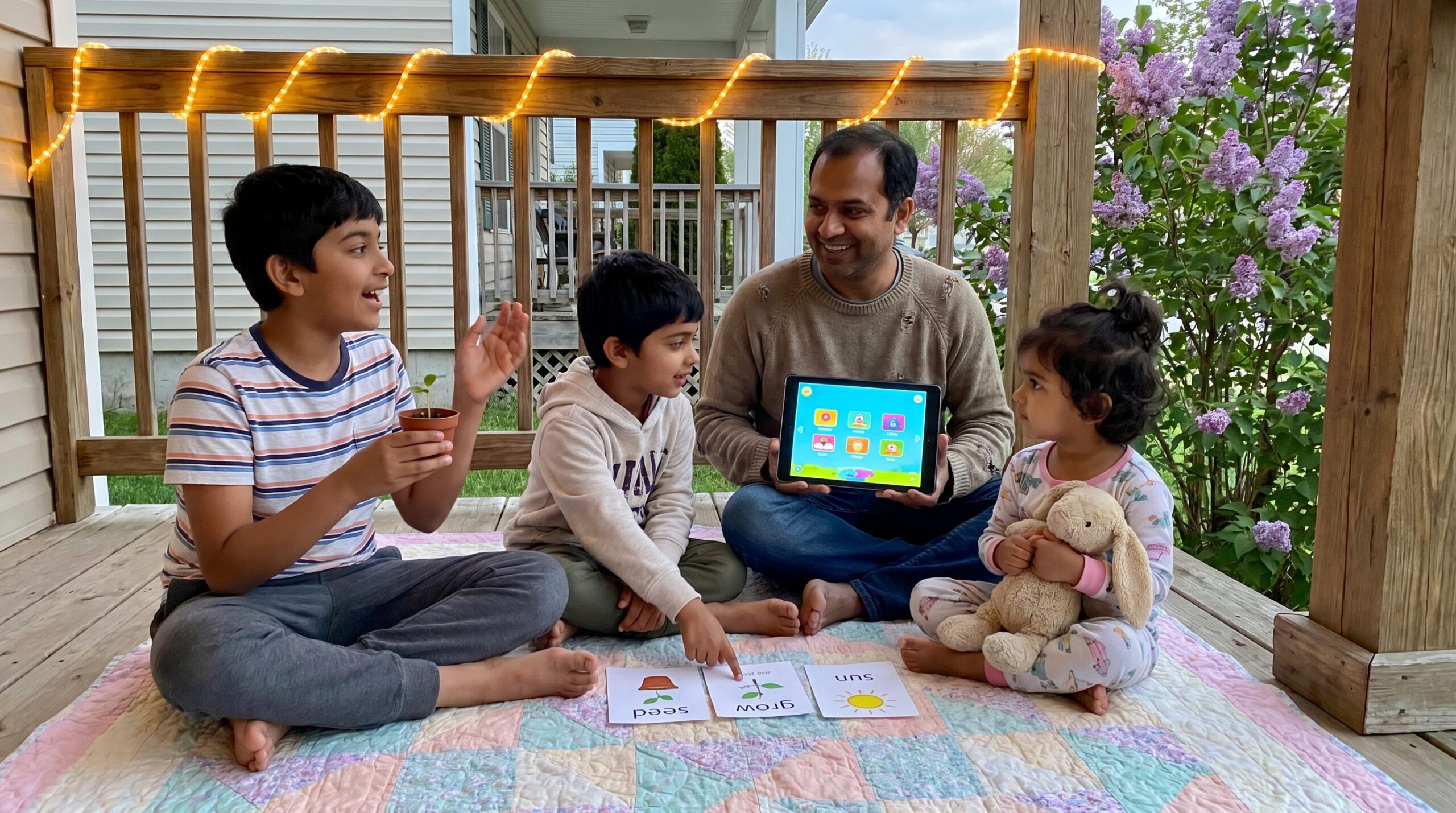
Education through storytelling ages 3-12 helps facts stick in a child’s mind. In the first sentence I mean exactly that. Stories give facts a clear shape. Therefore, the brain finds them easier to remember than lists.
Why education through storytelling ages 3-12 works
Stories create tiny mental scenes. Characters, events, and cause and effect form a simple timeline. Neuroscience shows that stories light up language, sensory, and memory areas. Also, emotion networks join the party. In short, stories make learning feel personal and memorable. A 2025 neuroimaging study tested 51 children (ages 6–12) and found that listening to a chapter of *Alice’s Adventures in Wonderland* activated canonical theory-of-mind brain regions, showcasing how narrative listening engages social-cognitive neural networks in children.
How stories map to development
Children change a lot between ages three and twelve. So stories must change a bit too. For ages three to five, keep plots small and concrete. Repeat catchphrases and use rhyme. For example, a repeated line helps new words stick. A 2025 meta-analysis of 25 studies found that interactive reading produces a medium aggregate effect on young children’s narrative ability, with the strongest effects observed in children aged 4–5 years. For ages six to eight, children follow multi-step plots. They enjoy predicting outcomes. Therefore, cause and effect puzzles boost reasoning. For ages nine to twelve, kids handle complex motives and moral gray areas. They like characters who face real choices. Each age band needs a slightly different story diet.
Language, memory, and social benefits
Language and literacy grow inside stories. When a child hears a word in context, they learn how it behaves. Sentence rhythm teaches grammar. Retelling strengthens recall and vocabulary. Repetition matters, but so does variety. Picture books, short chapter stories, and family tales each add flavor. A longitudinal study published in May 2024 found that storytelling connectedness in children ages 5–8 predicted phonological awareness and reading comprehension measured 3–4 months later, highlighting the long-term benefits of storytelling on critical literacy skills.
Stories also scaffold causal thinking. They help children build mental models of people and events. Research finds kids remember facts better when wrapped in narrative. Moreover, when a storyteller and listener sync up, learning and connection increase. Emotion helps too. An engaging tale releases chemicals that link to empathy and bonding. In fact, research shows that storytelling contributes 68.2% to the improvement of early childhood empathy skills, especially at the age of 5–6 years.
Social learning through narrative
Fiction gives children a safe space to practice perspective taking. Through characters they rehearse social problem solving. Over time, this practice supports empathy and moral judgment. In short, stories are social schooling with a gentle touch.
Practical reminders and tiny rituals
Stories live in routines. Bedtime, classroom read alouds, and backyard tales are small learning moments. Try a tiny ritual. For example, use a special lamp or a two line cheer. Ask your child to retell the ending. Often, a child choosing the story again is pure gold.
For families who want simple digital help, Storypie makes it easy to weave stories into daily life. Try Storypie for small rituals and joyful repeat reads. Visit the Storypie homepage or explore Storypie features for ideas.
Takeaway
Education through storytelling ages 3-12 fits how young minds work. It speeds language, sharpens thinking, and grows empathy. Keep stories short and steady. Also, keep rituals tiny and fun. Over time, learning will stick.