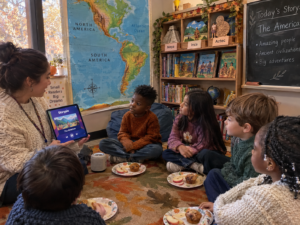

Education through storytelling ages 3 to 12 helps facts and feelings travel together. Because stories give events a clear order, children remember ideas more easily. This approach uses characters, cause and effect, and emotional hooks to make learning stick. In fact, a 2023 study found that children who learned through storytelling retained 70% of the information compared to just 10% when taught through traditional methods, highlighting the effectiveness of narratives in education.
Why narrative sticks for children
Stories group events into a beginning, middle, and end. Therefore children store and retrieve ideas more easily. Narrative also links cause and consequence. As a result facts become part of a chain, not isolated trivia. A 2025 meta-analysis of 25 studies found that interactive reading produces a medium aggregate effect on young children’s narrative ability, with the strongest effects observed in children aged 4–5 years.
Emotion and attention matter a great deal. When children care about a character they notice details and remember outcomes better. Research shows narrative formats often boost recall, comprehension, and transfer more than disconnected facts. For teachers and parents, that makes narrative a dependable way to support learning. Additionally, a longitudinal study published in May 2024 found that storytelling connectedness in children ages 5–8 predicted phonological awareness and reading comprehension measured 3–4 months later, demonstrating the long-term benefits of storytelling on literacy skills.
How storytelling changes across ages
Young children prefer concrete sequences and repetition. For ages 3 to 5, short stories build vocabulary and episodic memory. Also repeated phrasing helps early listeners join in. Research shows that storytelling contributes 68.2% to the improvement of early childhood empathy skills, especially at the age of 5–6 years, making it a valuable practice for social development.
Children aged 6 to 8 enjoy multi step plots and simple inference. These stories strengthen reasoning and executive skills. Next, children from 9 to 12 follow longer arcs and discuss motives. They understand multiple viewpoints and moral nuance.
Characteristics by age group
- 3 to 5: simple sequence, strong repetition, vivid sensory detail
- 6 to 8: problem and solution, gentle inference, growing complexity
- 9 to 12: longer arcs, multiple perspectives, moral discussion
Cognitive and social benefits
Education through storytelling ages 3 to 12 supports many key skills. For example it builds vocabulary, listening comprehension, and causal reasoning. In addition it supports working memory and theory of mind.
Stories also spark empathy. Children imagine a character’s feelings and choices. Then they practice social judgment in safe ways. Across classrooms and homes, narrative remains a practical bridge between facts and behavior. Moreover, three cluster-randomized controlled trials conducted in Italian elementary and middle schools found that substituting 1 hour/day of standard language instruction with teacher read-aloud for 4 months produced stronger gains on standardized measures of intelligence.
History and lasting value
Oral traditions once shared safety rules and cultural values. Today picture books, read alouds, and short audio tales keep that thread alive. Over time, narrative proved to be an efficient memory machine. Therefore educators still rely on stories to make learning meaningful and memorable.
For educators and families who want tools that match these strengths, see Storypie features and get the Storypie app for friendly, character driven content. Visit Storypie to learn more about our approach and offerings.
Final thought
Education through storytelling ages 3 to 12 turns facts into scenes that children revisit. Because stories combine cause, character, and feeling, they help children remember and apply ideas later. Try a short, vivid tale tonight and notice the difference.