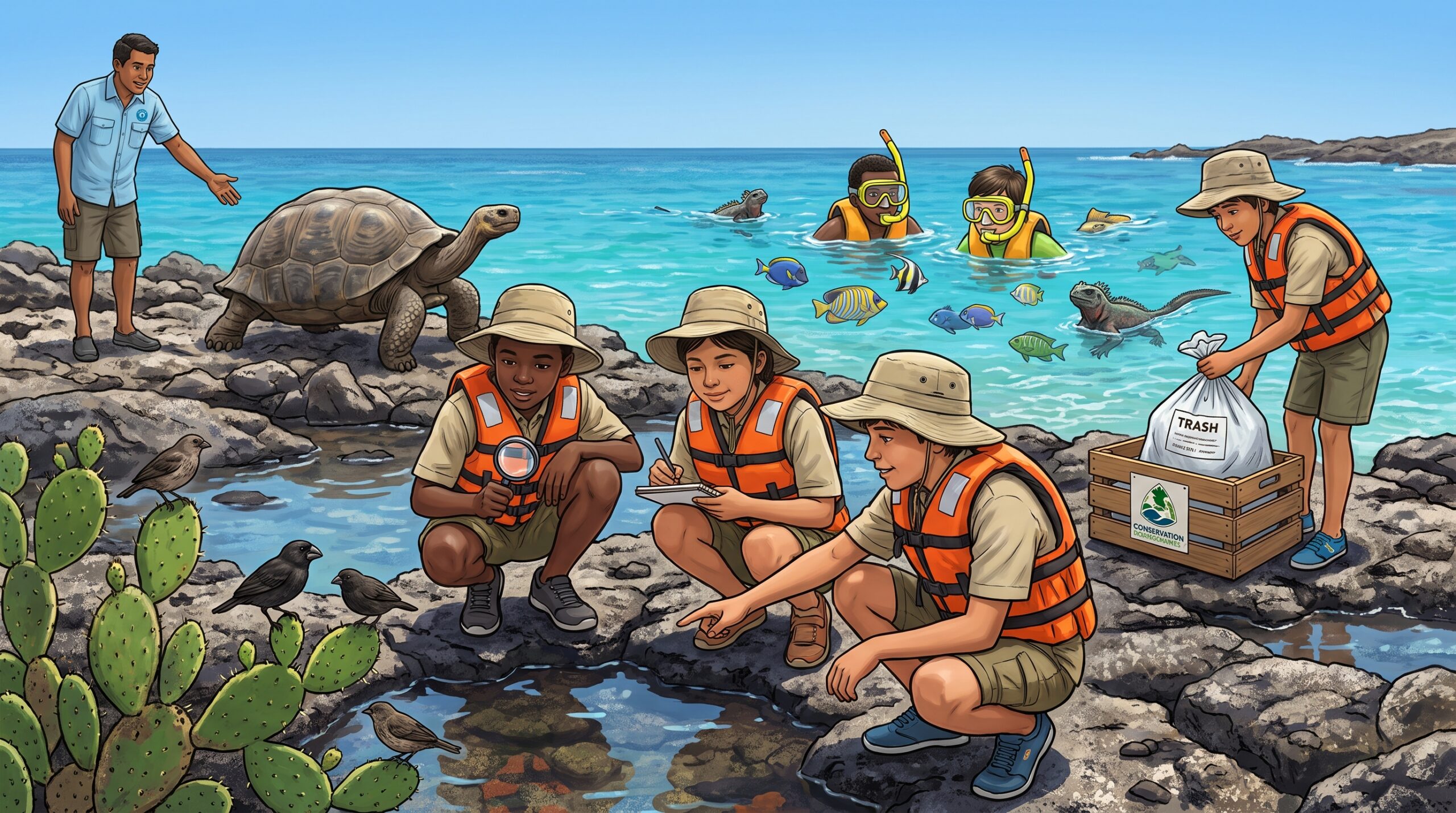
I was a little finch with a funny beak, and I liked poking into new things. That small wonder helps spark curiosity in children. This short guide to Galápagos Islands for kids fits a ten-minute read. Also, it points out the islands, the wildlife, and why people protect them.
Galápagos Islands for kids: Where they are
The Galápagos lie in the eastern Pacific. They sit about 900 to 1,000 kilometers west of Ecuador. The islands belong to the Republic of Ecuador. Volcanoes made them when the Nazca tectonic plate moved over a hotspot. Some islands are only a few million years old. Meanwhile, other islands are much older. Volcanoes still shape places like Fernandina and Isabela. Lava keeps changing the shorelines.
Main islands and landscapes
There are about a dozen main islands and many small islets. Famous islands include Isabela, Santa Cruz, San Cristóbal, Santiago, Floreana, Española, Genovesa, North Seymour, Baltra and Fernandina. The group mixes black volcanic rock, sandy beaches, and tidal pools. That variety creates many different homes for life. Visitors see stark lava fields and soft white sand within short distances.
Wildlife you will love on the Galápagos Islands
The wildlife here is calm and unique. For example, Darwin’s finches show different beak shapes on different islands. Each beak fits a different food. This is adaptive radiation in one neat example. Giant tortoises live long and move slowly. Some tortoise types are unique to specific islands. Today there are approximately 20,000–25,000 wild Galápagos giant tortoises remaining—down from historic levels of 100,000–200,000 over two centuries ago. Marine iguanas are the only lizards that swim to graze on algae. Then they warm on lava rocks in the sun. The Galápagos penguin is the only penguin species north of the equator. Also, the flightless cormorant lost flight but gained strong swimming wings. Playful sea lions wobble on beaches and greet visitors. The Galápagos Islands harbor more than 6,000 species of terrestrial and marine organisms, with approximately 1,870 of those species being endemic to the archipelago, showcasing their unique biodiversity.
Why scientists care
Charles Darwin visited in 1835 aboard HMS Beagle, and he took careful notes. Those notes helped shape his ideas about natural selection. Today the Charles Darwin Foundation and Ecuador’s park authorities run long-term research. Therefore, the islands remain a live outdoor laboratory for evolution and conservation.
Conservation and the future of the Galápagos Islands
About 97 percent of the land is part of Galápagos National Park, established in 1959. Also, the Galápagos Marine Reserve covers over a hundred thousand square kilometers of ocean. UNESCO named the islands a World Heritage Site in 1978. These protections allow focused conservation work.
Conservation faces tough problems and hopeful wins. For example, invasive rats, cats, and goats once harmed native plants and animals. Programs to remove goats and control pests have helped native species rebound. Captive breeding and reintroduction returned tortoises where they had vanished. Tourism brings money but also pressure; in 2024, the Galápagos Islands received a total of 279,277 tourists—reflecting a 4% increase over 2022, although this was a 15% decrease compared to 2023. For that reason, strict visitor rules, guided trails, and biosecurity checks keep wildlife safer. Finally, climate events like El Niño can reduce food and change survival rates.
Quick activity for curious kids
The Galápagos show adaptation in plain sight. Try this: draw two beaks and invent what each eats. Then ask what the beaks tell you about the island. This simple activity makes big ideas feel close and fun.
Read or listen to a story about Galápagos Islands now: For 3-5 year olds, For 6-8 year olds, For 8-10 year olds, and For 10-12 year olds. Also visit the main place page: Read or listen to a story about Galápagos Islands now.
I still think like that curious finch. Tiny marvels spark big questions, and the Galápagos deliver plenty of wonder.