
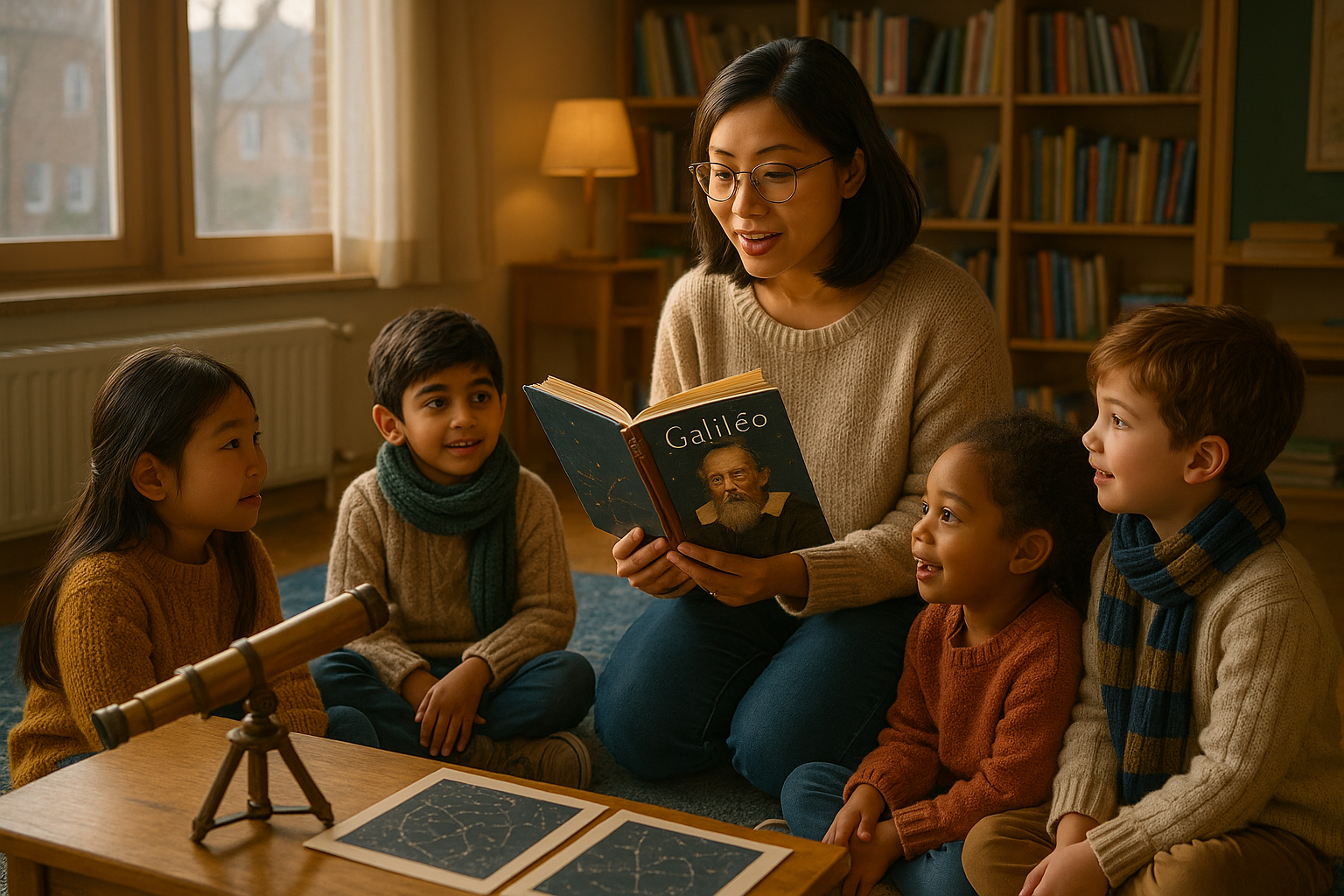
Discovering Galileo Galilei: The Curious Mind from Pisa
Imagine living over 450 years ago in Pisa, Italy. That was Galileo Galilei, a man who couldn’t stop asking questions. From a young age, Galileo was fascinated by the stars and the secrets of the sky. His curiosity was not just a passion; it was his guide.
Galileo Galilei loved exploring. He built and improved his own telescope to look deeper into the night sky. In 1610, he spotted something amazing—the four largest moons of Jupiter. This discovery showed people the universe was far more complex than they thought.
Galileo Galilei’s Bold Ideas Changed How We See the Sky
Back then, many believed Earth was the center of the universe. People thought the sun and stars all moved around our planet. But Galileo Galilei had a different idea. He found proof that Earth and other planets orbit the sun—a concept called heliocentrism. This was a daring idea that challenged common beliefs.
Galileo shared his ideas in a book called “Dialogue Concerning the Two Chief World Systems.” He wrote it as a story anyone could understand. However, this brave move upset powerful leaders, including the Church. In 1633, Galileo faced trial and had to take back his teachings or face harsh punishment. He spent his remaining years under house arrest but kept his love for science alive.
More than Just a Stargazer
Galileo Galilei also studied motion and gravity. He learned how objects fall, which laid the groundwork for physics. He created early thermometers and improved compasses that helped sailors explore the seas. His work helped people understand not just the stars but how the world works.
Galileo Galilei’s Legacy: Curiosity and Courage
What makes Galileo so inspiring? It’s his endless curiosity and bravery. Science is about asking questions, testing ideas, and sometimes failing—but always trying again. Galileo’s story shows us that curiosity leads to discovery.
Now it’s your turn to be curious. Look up at the night sky. What do you see? Could planets like Jupiter have moons? What if things don’t fall the way you expect? Explore with a ruler or a stick. These small experiments are your first steps to becoming an explorer, just like Galileo Galilei.
Read or listen to a story about Galileo Galilei now: For 3-5 year olds, For 6-8 year olds, For 8-10 year olds, and For 10-12 year olds.
Remember Galileo Galilei, the starry-eyed explorer who changed our view of the universe. Let your questions lead you to new adventures. Stay curious and brave—just like him.