
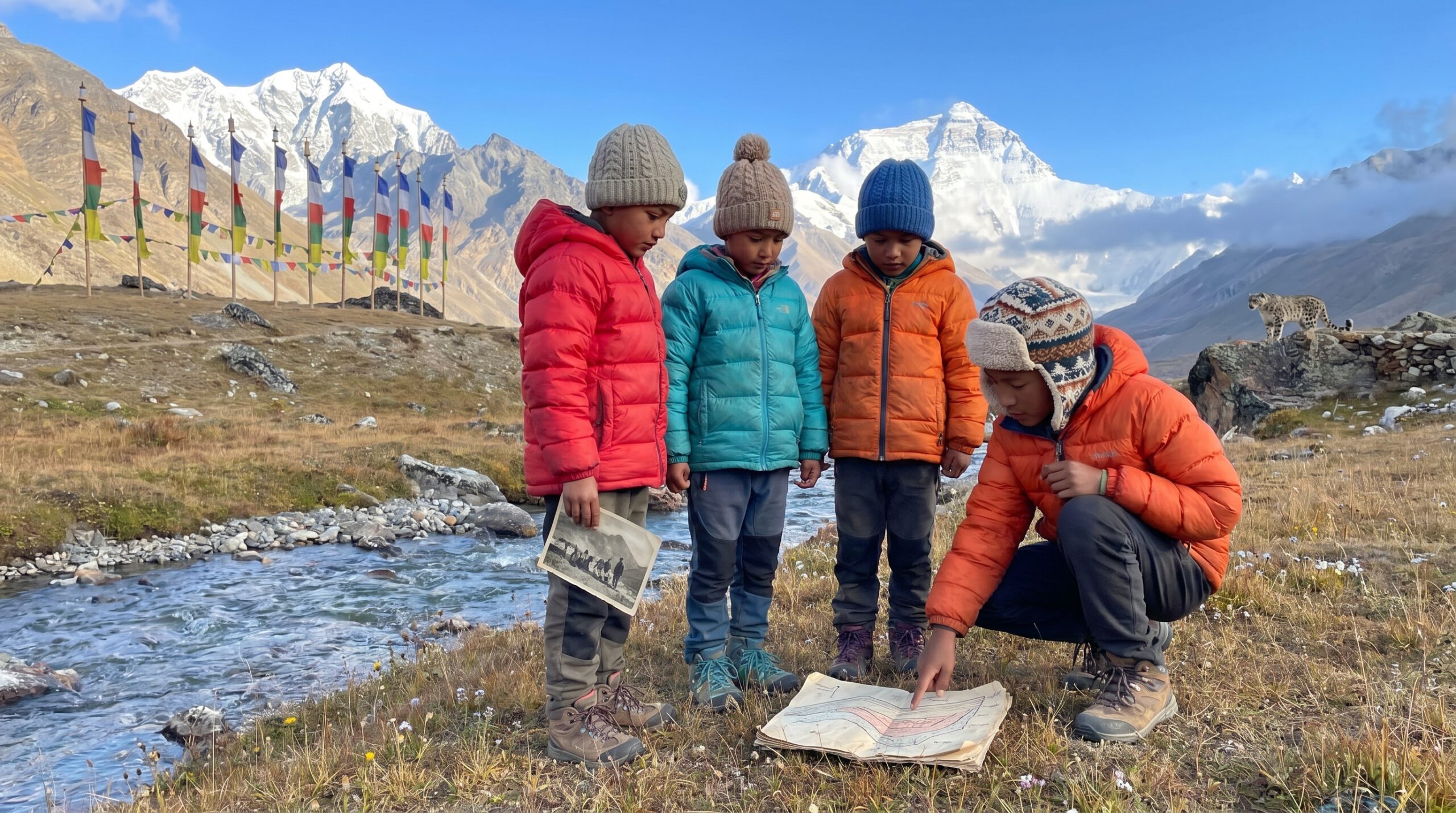
Himalayas for kids is a simple, lively guide to the world’s tallest mountains. At Storypie we share big ideas in small bites. Read, listen, and wonder together.
How the Himalayas formed
The Himalayas began when the Indian Plate pushed into the Eurasian Plate. Over 40 to 50 million years, rock rose and folded. Today the plates still move slowly. As a result, the range stays young and very tall. Earthquakes and uplift keep changing the mountains.
Where the Himalayas reach and why they matter
The Himalayas span approximately 2,400 kilometers (1,500 miles) across five countries: India, Nepal, Bhutan, China, and Pakistan. They mark the edge of the Tibetan Plateau. The tallest summit is Mount Everest at 8,848.86 meters. Also, fourteen peaks above 8,000 meters sit in the Himalayan-Karakoram area.
Importantly, glaciers and permanent snow sit high on the slopes. The Himalayas are home to more than 15,000 glaciers, which store about 12,000 cubic kilometers of freshwater. Meltwater feeds rivers like the Indus, Ganges, and Brahmaputra. In fact, the Himalayas are the source of 19 major rivers, including the Indus and the Brahmaputra, each having catchment basins in the mountains of about 260,000 square kilometers. These rivers water farms and cities for millions. So the Himalayas shape weather and the monsoon. Therefore changes in glaciers and rainfall affect many people downstream.
Major features and fast changes
Elevation zones shift quickly on Himalayan slopes. You can pass from warm forests to alpine meadows in a single day. Rivers begin here. Glaciers store water as ice and snow. In short, the Himalayas act like a giant water tower.
Wildlife, plants, and people
Wildlife adapts to each elevation zone. Look for rhododendrons and broadleaf forests low down. Higher up you find conifers and alpine herbs. Animals include snow leopards, Himalayan tahr, blue sheep, and the red panda. Colorful birds like the Himalayan monal brighten the peaks.
People have lived here for a very long time. Many mountain communities raise yaks and goats. They farm terraced fields and trade along old routes. Sherpa people are world famous for mountain skills. On May 29, 1953, Sir Edmund Hillary and Tenzing Norgay reached Everest’s summit. That climb showed teamwork and local knowledge.
Current threats and conservation
Glaciers are losing mass. Rainfall patterns are changing. According to ICIMOD’s Snow Update Report 2024, substantially below-normal seasonal snow persistence has been observed, with the Indus basin being about 23.3% below normal. Stronger storms and landslides follow. The region stays seismically active. Development and tourism also add pressure.
Conservation includes national parks and community efforts. Responsible trekking and local rules help protect wild places. In addition, protected areas try to balance people and nature.
Try this at home tonight
Creativity: Draw a mountain scene and name a new animal. Also, teamwork: Talk about the 1953 Everest climb and one time your family worked together. Stewardship: Leave no trace on a local trail and share why it matters.
Tip: Tonight, ask one question about teamwork. Then listen closely. Small conversations lead to big learning.
Read or listen to a story about Himalayas now: For 3-5 year olds, For 6-8 year olds, For 8-10 year olds, and For 10-12 year olds. Also visit our main page for the place: Read or listen to a story about Himalayas now.
Want the app? Get it at Storypie and explore more place stories with your child.
Final thought: Mountains teach us about time, teamwork, and care. The Himalayas feel grand, lively, and vital. Ask one question about teamwork tonight and enjoy the answers.