
The telephone history for kids begins with a curious experiment and a bright idea. In 1876 Alexander Graham Bell turned a spill into a famous first sentence. On March 7, 1876 he won a U.S. patent. Then on March 10, 1876 he spoke to his assistant Thomas A. Watson and said words the world remembers: “Mr. Watson come here I want to see you.” Today, the legacy of the telephone lives on, with about 9.1 billion mobile-cellular subscriptions worldwide, which is equal to 112 mobile-cellular subscriptions per 100 inhabitants.
Early inventors and a lively debate
However, Bell was not the only person working on voice transmission. Antonio Meucci, Johann Philipp Reis, and Elisha Gray also pursued similar inventions. In fact, debate followed for decades. In 2002 the U.S. House of Representatives recognized Meucci’s contributions. Still, Bell’s patent shaped the early telephone industry.
The simple science behind the telephone
Sound travels as vibration through air. A transmitter or microphone turns those vibrations into electrical signals. Then signals travel along wires or as radio waves in modern phones. At the other end a speaker changes the signals back into sound we hear. Early improvements made voices stronger and clearer, paving the way for the advanced technology we see today.
Why the carbon microphone mattered
For example, the carbon microphone improved long-distance speech. Because it boosted signal strength, conversations became practical. Thus the telephone moved from a tricky experiment to a useful tool.
How people connected before automation
Early telephones used a handset with a transmitter and receiver. Operators at switchboards then connected calls by hand. Later, automatic switching reduced the need for people at switchboards. Almon Strowger’s automatic switch appeared in 1889. Afterwards, rotary dials arrived. Then touch tone followed in the mid 20th century. Today tiny computers send voice as packets across the internet. Remarkably, a recent report indicated that 5G subscriptions reached above 1.9 billion globally in Q2 2024, accounting for about 22% of all mobile subscriptions, showcasing the rapid advancements in mobile technology.
The telephone changed daily life
First, households could arrange visits more easily. Next, businesses sped up many tasks. Also, emergency help became faster to reach. Bell’s interest in sound came from family life. His mother and wife were deaf. So he worked to teach and improve speech. That practical kindness helped inspire the invention. Interestingly, as of July–December 2023, 86.8% of U.S. households were ‘wireless-only’, indicating a significant shift away from traditional landline telephones.
Furthermore, according to a Pew Research Center survey published on January 31, 2024, 90% of U.S. adults reported owning a smartphone, demonstrating the widespread adoption of this technology that has transformed communication.
A short timeline to share
- Reis: 1860s
- Meucci: mid 1800s through 1870s, congressional recognition in 2002
- Bell patent: March 7, 1876
- First call: March 10, 1876
- Bell Telephone Company: 1877
- First commercial exchange: 1878
- Automatic switching: late 1800s
- Touch tone: mid 20th century
- Mobile and smartphone era: late 20th to 21st century
Try a small activity
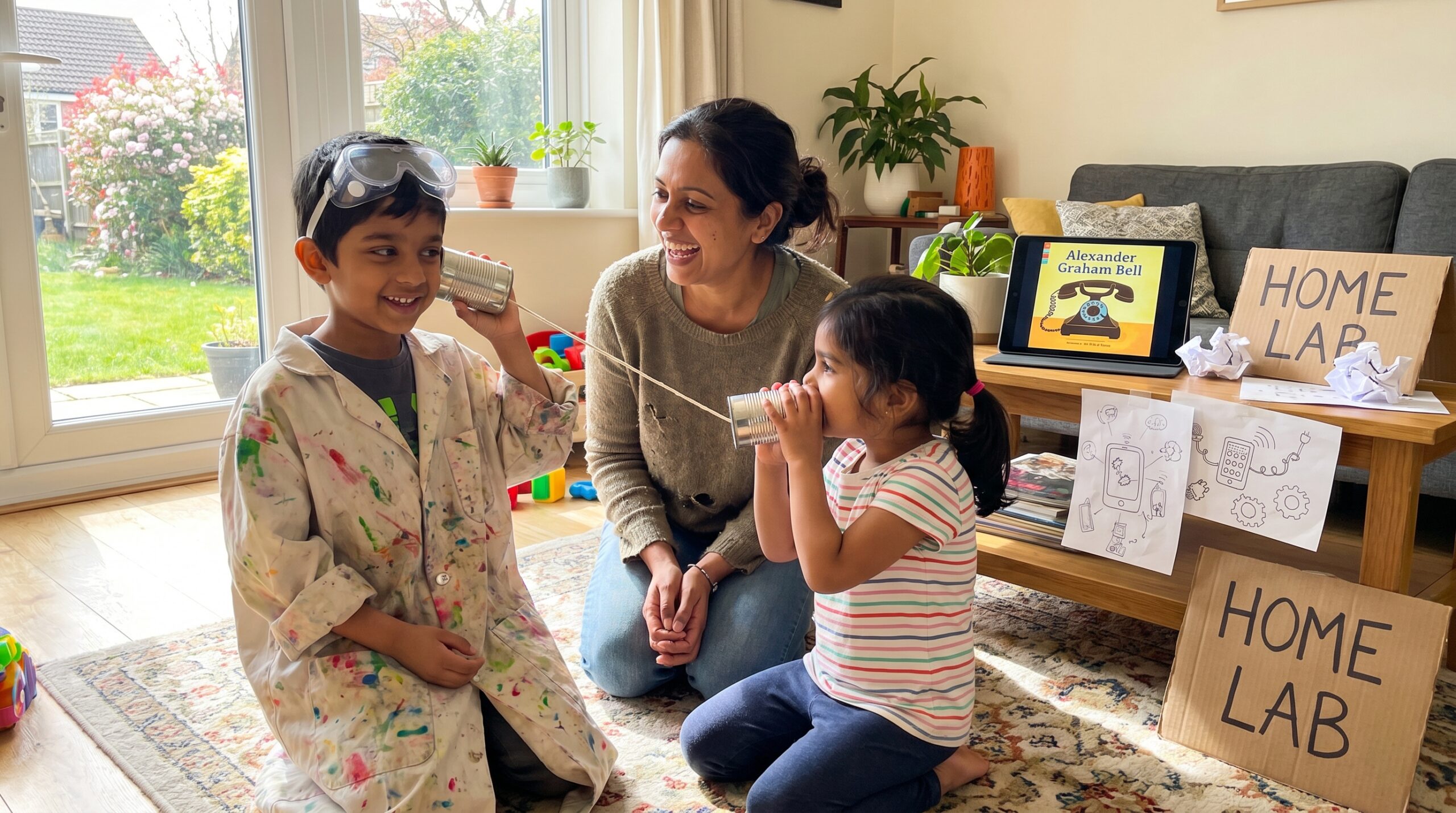
Try a quick 3-minute phone game with your child. For example, use two paper cups and a string. Alternatively, whisper and repeat. This playful test shows how sound travels. It also builds listening and clear speech. Above all, it is simple and fun.
Read or listen to a story about The Telephone now: Read or listen to a story about The Telephone now
Read or listen to a story about The Telephone now: For 3-5 year olds, For 6-8 year olds, For 8-10 year olds, and For 10-12 year olds.
Finally, if you want a short, sweet story to share at the kitchen table, visit Storypie for more tales and audio. Enjoy the chatty history and the tiny marvel that is the telephone. By 2025, 98% of U.S. adults are projected to own a cellphone of some kind, with 91% owning a smartphone, marking a significant milestone in communication technology.