Laser for kids can sound like a big idea. Yet the idea fits in a tiny beam of light. At Storypie, we tell the laser’s story simply and playfully. Read or listen together this summer for about ten minutes to spark curiosity.
What a Laser Is
Laser for kids means light that behaves like a marching band. Every wave lines up. All the light is nearly one color. It sails in a narrow, focused beam. That tidy beam is what makes lasers special and surprising. In fact, the global laser technology market grew from $12.52 billion in 2022 to $13.82 billion in 2023, reflecting the increasing importance and relevance of laser technology in our world today, with a compound annual growth rate (CAGR) of 10.4% according to Laser Technology Global Market Report 2023.
How a Laser Works, Simply
Inside a laser, some atoms get excited. Then one excited atom can nudge another to release matching light. That copying is called stimulated emission. To make a strong beam, the laser holds more excited atoms than calm ones. Scientists name that population inversion. Mirrors form an optical cavity. Light bounces back and forth and grows brighter until a thin beam escapes.
Key laser traits
- Coherent: waves march together.
- Nearly monochromatic: one neat color.
- Directional: the beam stays narrow.
- Variable power: from soft pointers to powerful cutters.
Everyday Places Families See Lasers
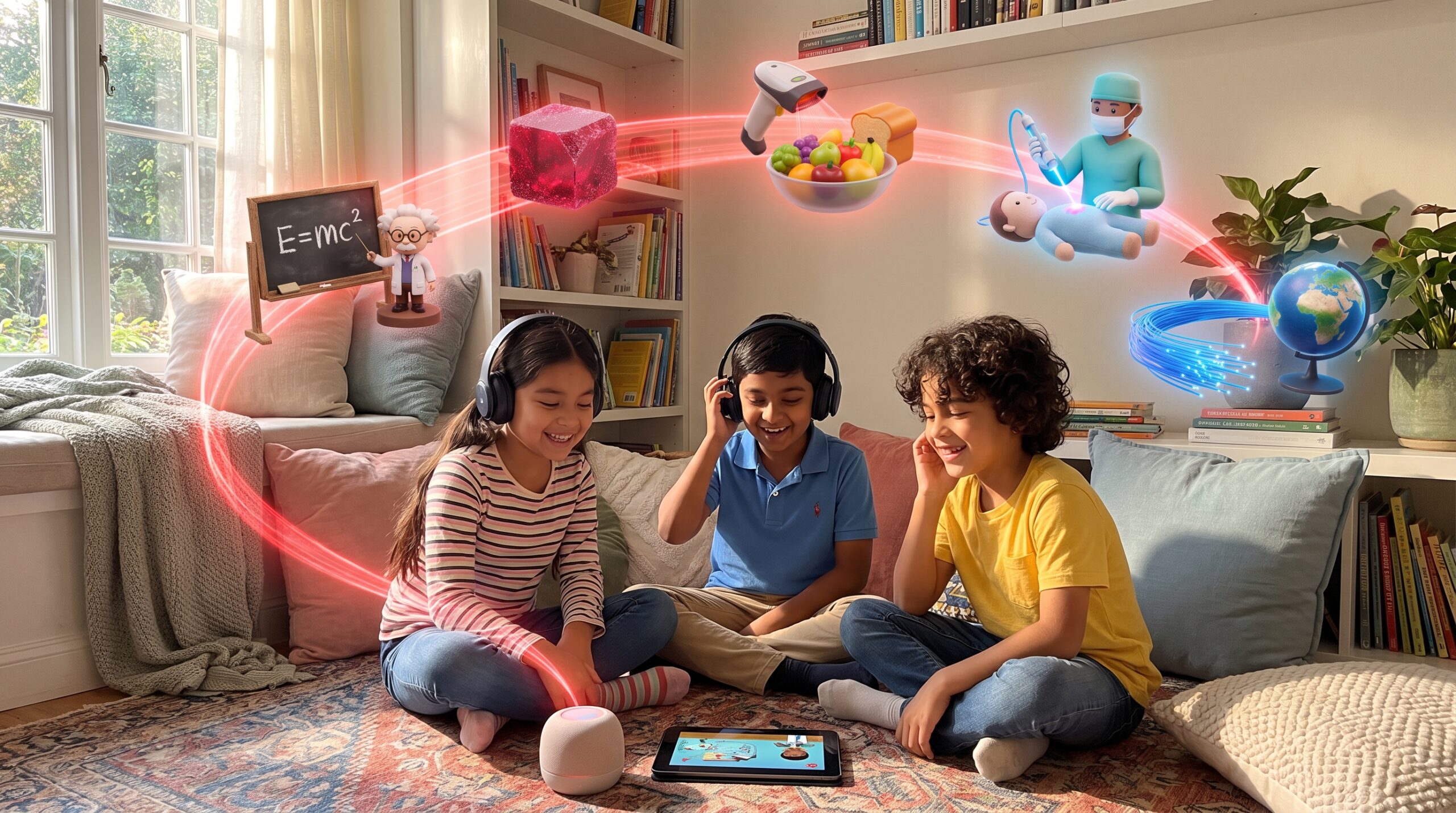
Lasers appear in many familiar gadgets. For example, barcode scanners at the grocery use them. Laser printers also use laser light to make crisp pages. CDs and DVDs read with lasers as well. Even fiber optic internet uses lasers to carry data as light signals. Did you know that in 2023, cutting and welding applications represented 55% of industrial laser demand? This shows how lasers play a crucial role in industries we encounter daily, as highlighted by Lasers Photonics Industry Statistics.
Big Uses and Cool Science
Lasers do big jobs. They help surgeons in LASIK eye procedures. They cut and weld in workshops. In fact, fiber lasers were used in 70% of metal cutting processes in automotive manufacturing in 2023, making them an integral part of car-making technology, according to Lasers Photonics Industry Statistics. They map landscapes with LIDAR on drones. Also, ultrafast lasers help scientists study tiny, fast events. In fiber optics, laser diodes send data pulses through glass. Different colors can carry many channels at once.
Safety Basics for Families
Laser safety matters. Devices have class ratings from 1 to 4. Class 1 is safe for general use. Class 4 can injure eyes or skin. Never point lasers at people, vehicles, or aircraft. Supervise children closely. Choose low power, labeled devices. For demos, use manufacturer-approved kits and wear goggles when required.
Quick safety checklist
- Check the class rating before use.
- Avoid direct eye exposure.
- Do not aim at reflective surfaces.
- Use diffraction cards or approved kits for demos.
A Simple, Safe Demo
Try a supervised demo with a low power laser and a diffraction grating. The grating makes a tiny rainbow. Keep demonstrations brief and always supervise. This activity makes the laser visible and playful without risk.
Read or listen to a story about Laser now: For 3-5 year olds, For 6-8 year olds, For 8-10 year olds, and For 10-12 year olds.
Read or listen to a story about Laser now: Read or listen to a story about Laser now
Final Thought and Questions
Lasers are quiet, precise, and full of surprises. Ask children where they have seen lasers today. Or ask what they would build with a laser if they could. Small questions can spark big imagination. Furthermore, the global aesthetic lasers market was valued at $3.3 billion in 2023 and is projected to reach $8.2 billion by 2033, growing at a CAGR of 9.5% between 2023 and 2033, showcasing an exciting area where lasers are making a big impact in beauty and health, as noted by Aesthetic Lasers Market Report.
Explore more stories and activities at Storypie. Enjoy a short listen together and let curiosity lead the way.