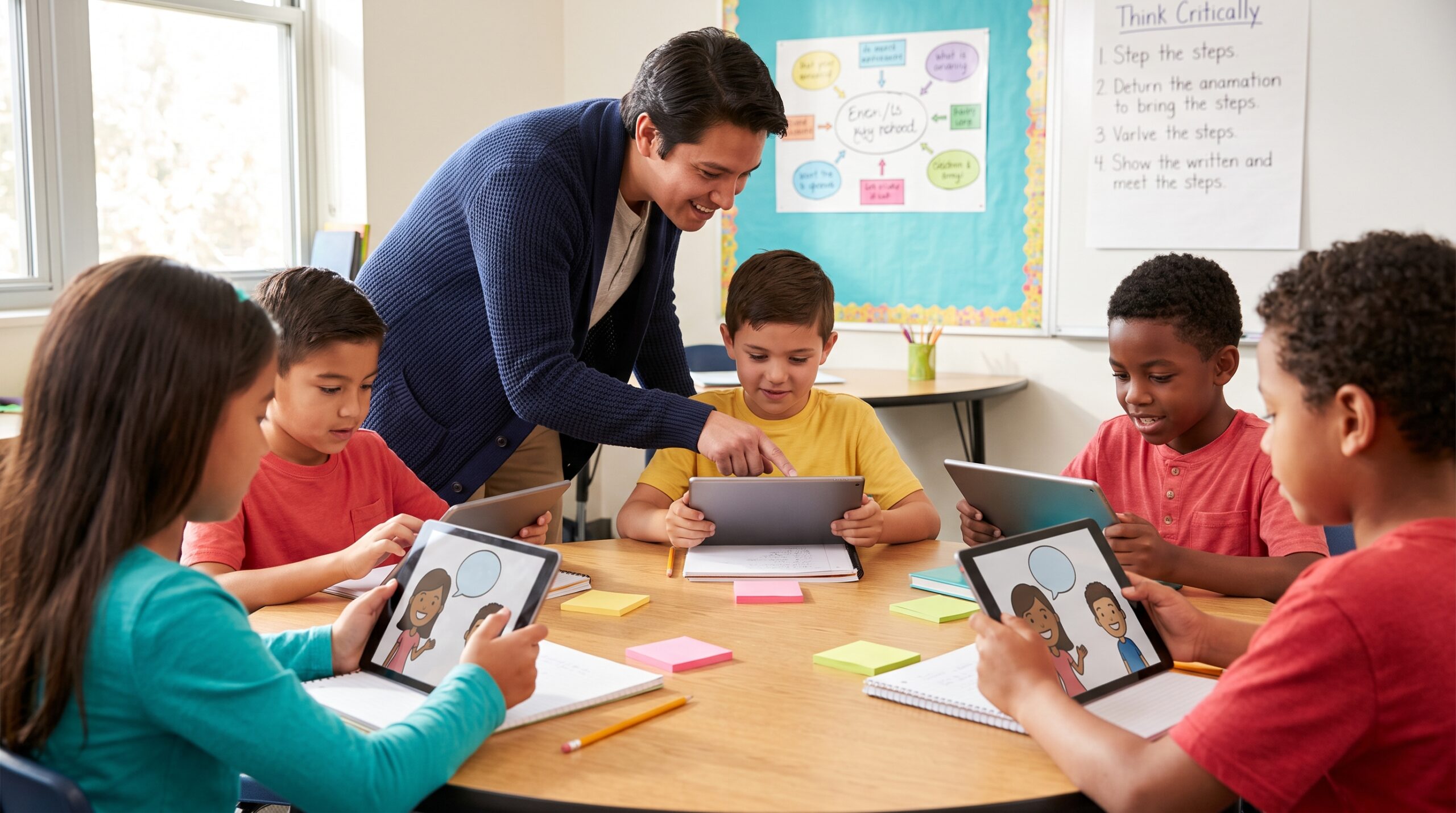
Artificial intelligence has quickly become one of the most talked-about topics in education. School districts across the United States are increasingly being encouraged—or even required—to incorporate AI into teaching and learning. As more states release AI guidance and funding opportunities for schools, the question is no longer whether educators will use AI, but how they will use it effectively.
Despite this rapid adoption, one major challenge remains: most teachers have received little or no formal training on how to use AI effectively, ethically, or in ways that support student learning.
This gap matters because AI is not simply another educational technology. Unlike calculators or search engines, generative AI actively participates in writing, explaining, brainstorming, and problem-solving. How learners interact with these systems can influence not only what they produce but also how they think.
The Impact of AI in Critical Thinking
Researchers are actively investigating how AI affects learning, memory, critical thinking, and metacognition. So far, the evidence suggests that the answer is nuanced.
Some studies raise important concerns. A systematic review by Zhai et al. (2024) found evidence that learners may rely on AI for quick answers without carefully evaluating information, reducing opportunities to practice critical thinking. This phenomenon, often called cognitive offloading, occurs when individuals rely on technology to perform mental processes they would otherwise complete themselves. Over time, excessive cognitive offloading may reduce opportunities for deep processing, knowledge encoding, and metacognitive reflection. A huge concern for learning and long-term retention.
At the same time, AI is far from inherently harmful. Another systematic review by Li et al. (2025), which examined 67 studies of ChatGPT in higher education, found that AI can enhance creativity, reasoning, and higher-order thinking when it is paired with intentional instructional supports, such as reflective prompts, structured questioning, and clear evaluation rubrics.
In other words, AI itself is neither good nor bad for learning. How it is used makes the difference.
Not If They Will Use it but How
Students, teachers, parents, and professionals are already using AI every day. The technology is here to stay, and attempting to prevent its use entirely is neither realistic nor productive.
Instead of asking, “How do we stop students from using AI?”, we should be asking, “How do we help people use AI in ways that strengthen learning rather than replace it?”
Unfortunately, many educators are being asked to integrate AI into their classrooms without receiving the professional development needed to do so confidently or responsibly. Recent surveys (see Gallup News) suggest that many K–12 teachers report little or no formal training in AI despite growing expectations that they incorporate these tools into instruction. A problem given that research has emphasized how the use of AI is optimized with scaffolded instruction.
Bridging the Gap Between Research and Practice
At Storypie, we believe educators deserve more than another AI tool. They deserve guidance grounded in learning science.
Our goal is to bridge the gap between cognitive science research and classroom practice by helping teachers understand when, why, and how AI can support learning.
Through our webinar series, educators learn:
- What generative AI actually is and what it is not.
- Common misconceptions about AI and its capabilities.
- The latest research on AI’s benefits and limitations for learning.
- Strategies for reducing cognitive offloading while encouraging critical thinking.
- Practical techniques for writing effective prompts and refining AI-generated responses.
- Classroom demonstrations, checklists, and examples that teachers can immediately apply.
Rather than encouraging educators to simply “use AI”, we focus on helping them use it intentionally. Storypie is an AI educational platform, and supporting education in any way we can is in our core mission.
AI Should Support Teachers, Not Replace Them
As AI becomes a permanent part of education, teachers need professional development that keeps pace with the technology. Effective AI integration is not about automating teaching—it is about empowering educators to make informed decisions that improve student learning.
Storypie was built with that philosophy in mind. We don’t aim to be just another AI platform. We strive to be a partner that supports teachers throughout curriculum development while promoting ethical, evidence-based, and effective AI use in the classroom.