The Loch Ness Monster Scottish appears in stories and family lore. Children love Nessie because the tale invites wonder and questions. Above all, the legend blends history, mystery, and playful imagination.
Read or listen to a story about The Loch Ness Monster – Scottish now: For 3-5 year olds, For 6-8 year olds, For 8-10 year olds, and For 10-12 year olds.
Short history of the Loch Ness Monster Scottish
The Loch Ness Monster Scottish traces back many centuries. Early written accounts appear in a 7th century life of St Columba. That text tells of a water-beast and a saint. Then, in 1933, newspapers printed a cluster of modern sightings. Photographs and film followed. The 1934 Surgeon’s Photograph became famous. Later it proved staged, but it made Nessie known worldwide.
Why Loch Ness helps the story stick
Loch Ness is huge and very deep, approximately 37 kilometers long. In addition, the loch drops to over 200 metres in places. Because of this, it holds more freshwater by volume than all lakes in England and Wales combined, making it the largest by volume in the British Isles. The water looks dark and peat-stained. Therefore visibility is low. So small shapes and waves can seem mysterious and make for great storytelling.
Science, searches, and surprising findings
Over the 20th and 21st centuries, investigators used sonar and underwater cameras. They launched a major effort called Operation Deepscan. Sonar and cameras gave intriguing returns but no proof of a large unknown animal. More recently, scientists tested environmental DNA across the loch. The results did not show a breeding population of unknown large creatures. However, the eDNA work did show abundant eel DNA. That finding helps explain some sightings. In August 2023, the largest search for the Loch Ness Monster in 50 years was conducted, utilizing thermal-imaging drones, infrared cameras, and a hydrophone to detect underwater sounds, highlighting the ongoing interest in the legend according to the Associated Press. Additionally, a peer-reviewed analysis published on July 21, 2023, examined the ‘giant eel’ hypothesis and concluded that the existence of exceedingly large eels in Loch Ness is unlikely, adding a scientific critique to one of the popular theories about the Loch Ness Monster as noted by JMIRx Bio.
Hoaxes, natural causes, and common sense
Many famous sightings later proved hoaxes or misidentifications. For example, floating logs, boat wakes, clustered birds, and large eels often explain reports. Scientists also point to the lack of a food supply and fossil evidence. Because of these reasons, a surviving large prehistoric reptile seems extremely unlikely. A 2025 study analyzed over 1,800 reports of the Loch Ness Monster, emphasizing the importance of considering biases and the correct statistical population when evaluating such data, shedding light on the analytical approach to the phenomenon according to the Journal of Statistics and Data Science Education.
Family-friendly ways to explore Nessie
Families can enjoy Nessie without searching for proof. Try gentle, imaginative activities that pair play with learning. For example:
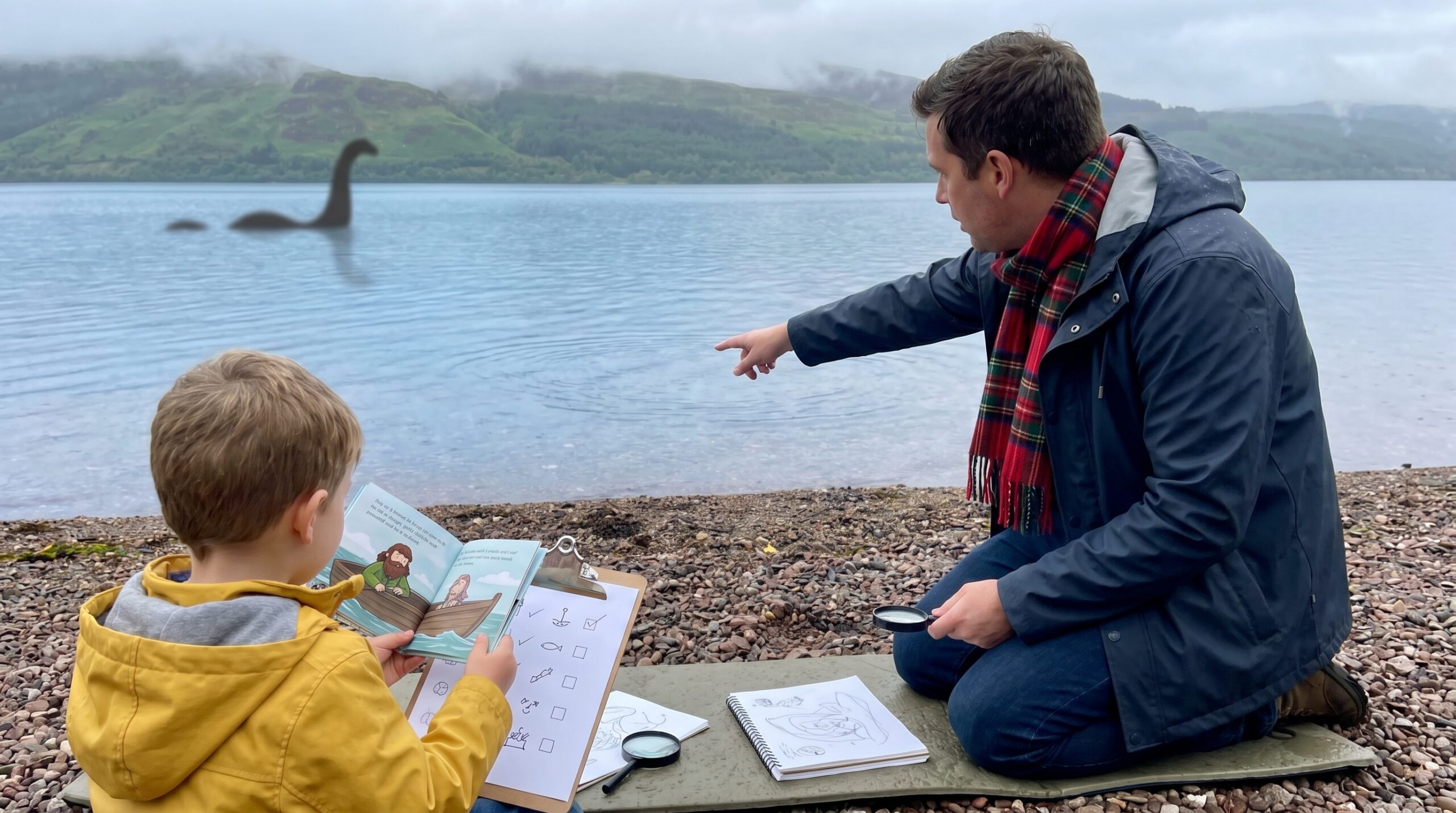
- Take a loch-side walk and spot shapes in the water.
- Make a Nessie trail with stones and tell short story lines at each stop.
- Ask children to invent a Nessie backstory and draw a silhouette.
- Visit Urquhart Castle viewpoint or the Loch Ness Centre and Exhibition for friendly displays.
Always remember safety. Loch Ness is deep and very cold. Stay on shore and join organised tours for on-water views. Also, explain simply how sonar works or how scientists test water for DNA. These small talks turn wonder into thoughtful questions.
Final thought
The Loch Ness Monster Scottish stays delightfully mysterious. In short, Nessie is a perfect doorway to curiosity. Stories spark imagination and invite gentle science. In March 2025, the Loch Ness Centre reported the first potential sighting of the monster for that year, continuing the long-standing tradition of reported encounters as reported by the Midland Reporter-Telegram. For family-friendly prompts and audio, explore Storypie and our Nessie stories to help children make wonder-filled tales.
Read or listen to a story about The Loch Ness Monster – Scottish now or visit Storypie for more myths and prompts.