
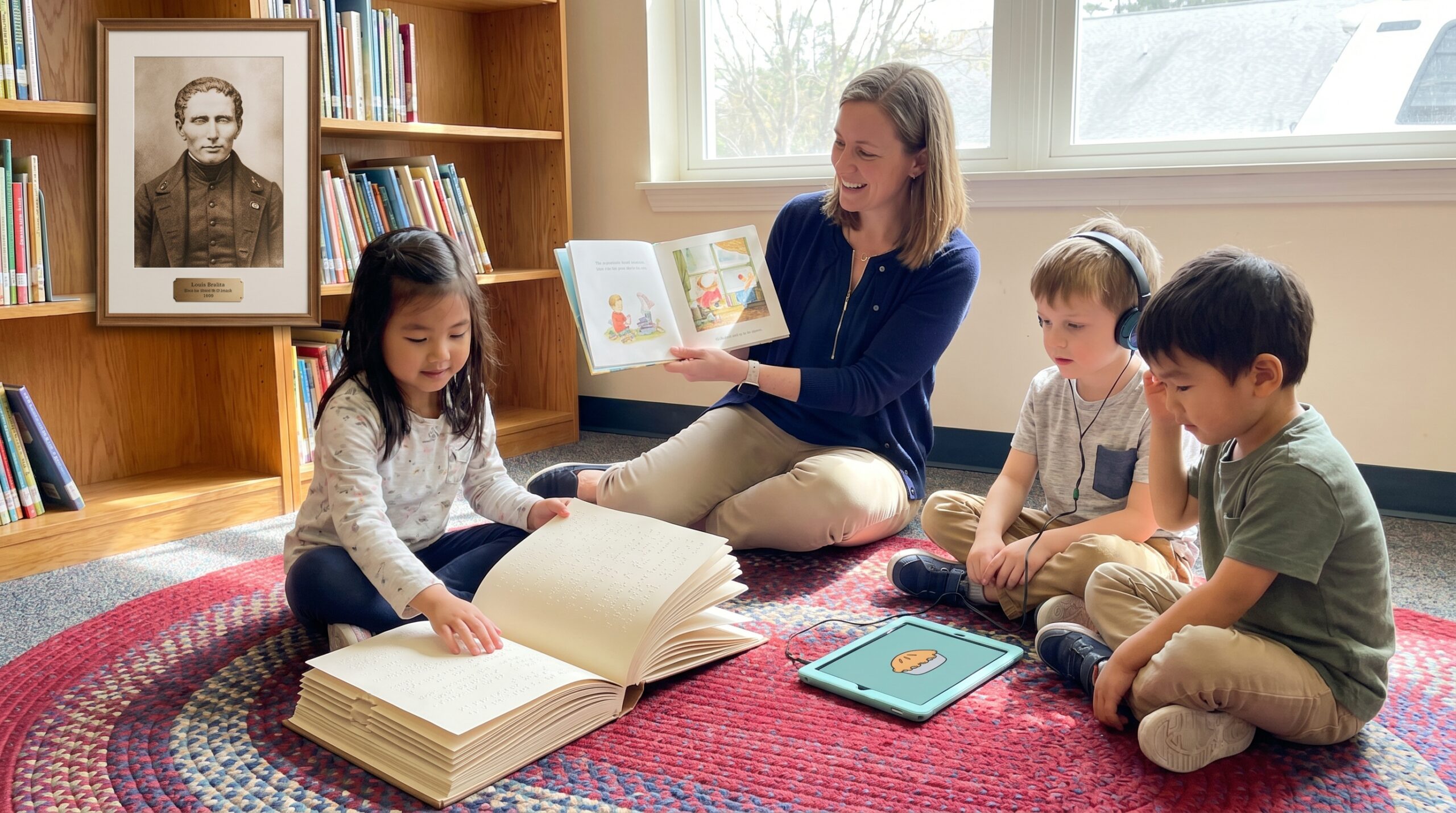
Louis Braille biography begins on January 4, 1809 in Coupvray, France. Louis Braille lost his sight as a small child. Yet his curiosity and kindness shone bright. He died on January 6, 1852, at the age of 43, leaving behind a legacy that would transform the lives of countless individuals.
Early life and school years
Louis grew up in a leather worker’s home. At about age three he hurt one eye in his father’s workshop. An infection followed and by age five he was blind in both eyes. Still, he stayed curious and clever.
In 1819, at about age ten, Louis enrolled at the Royal Institute for Blind Youth in Paris. It was among the first schools for blind children. There he learned to read by touch and he loved music. Later he became a cellist and organist. Eventually he also taught at the same school.
How Louis Braille created a simple, powerful system
As a teenager, at the age of 15 in 1824, Louis looked at an earlier tool called night writing. That tool came from Charles Barbier and it was bulky. Louis simplified the idea and made a tiny, neat cell of six dots. He numbered the positions 1 to 6. With those six dots, Louis made letters, numbers, punctuation, and music signs. In 1829 he published Method of Writing Words, Music, and Plain Songs by Means of Dots, for use by Blind Persons. He kept improving the system and added braille music notation. This allowed blind musicians to learn and compose. Notably, in 1837, he published a three-volume braille edition of a popular history schoolbook, further promoting his tactile reading system.
Resistance at first, then a growing reach
At first some teachers resisted braille. Change can be slow. Braille was not officially adopted at the Paris school where he taught until 1854, two years after his death. Louis Braille did not see wide adoption during his life. However, after his death, the system spread. By the late 1800s and into the 1900s many countries embraced braille. The World Congress for the Blind recognized braille internationally in 1878. Devices like the Perkins Brailler and modern braille embossers soon made writing easier. Today refreshable braille displays and smartphone accessibility work with braille.
Why the Louis Braille biography still matters today
Braille remains essential for literacy, education, and employment for blind people. There are Grade 1 and Grade 2 literary codes in English. Later, Unified English Braille harmonized rules across many countries. World Braille Day falls on January 4, Louis Braille’s birthday. The United Nations General Assembly adopted resolution A/RES/73/161 on December 17, 2018, proclaiming January 4 as World Braille Day; the first observance was on January 4, 2019. Museums in Coupvray and archives in Paris preserve early braille materials.
Quick activities and a gentle call
Try a small home activity. Make a card with six raised dots. Let a child feel different patterns. This builds curiosity and empathy in a gentle way.
Read or listen to a story about Louis Braille now: For 3-5 year olds, For 6-8 year olds, For 8-10 year olds, and For 10-12 year olds.
Remembering Louis Braille: a tiny hero with an enormous gift. At Storypie, listening opens a doorway to wonder. For more, visit our biography hub: Read or listen to a story about Louis Braille now.