
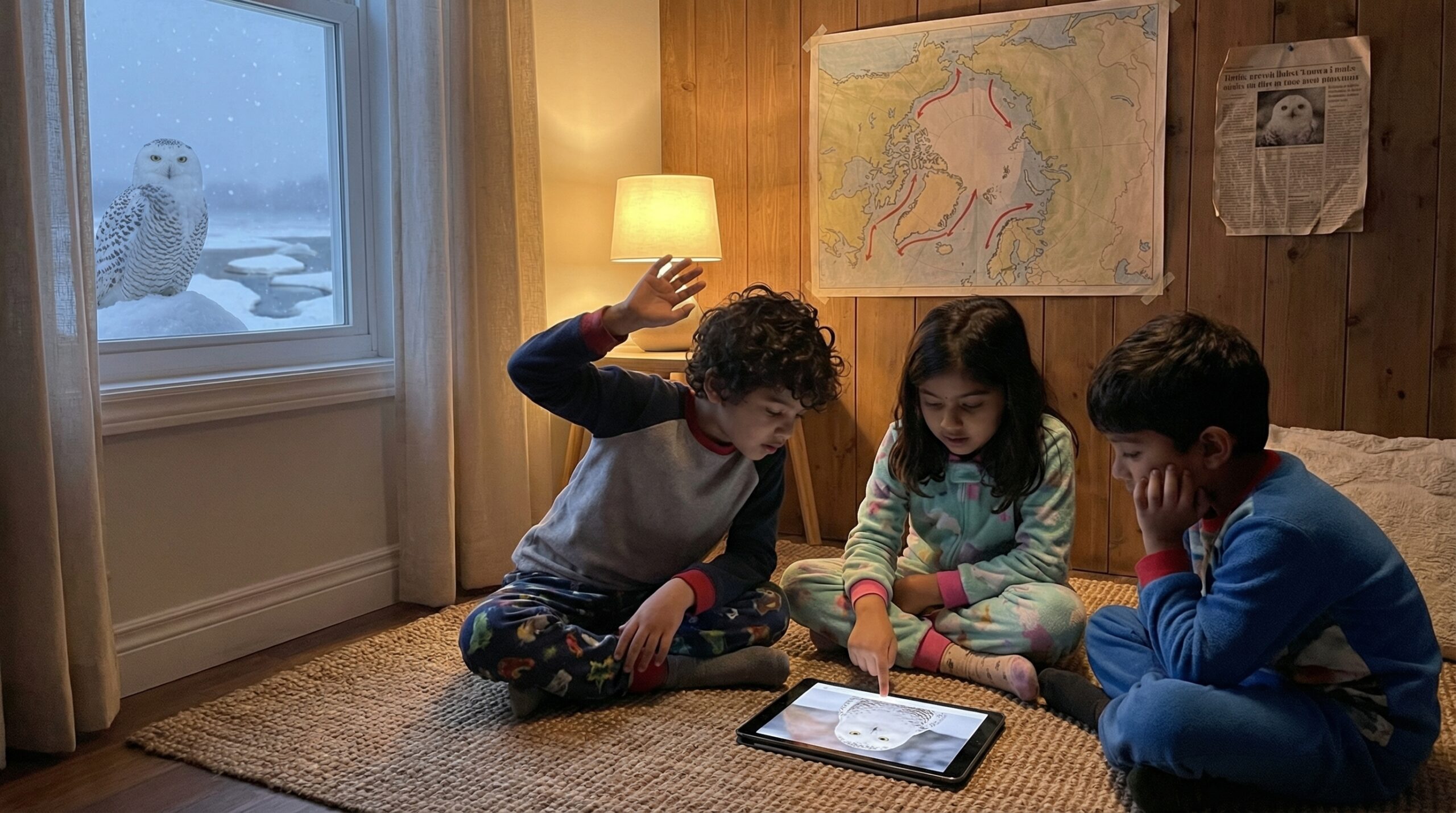
Snowy Owl facts for kids introduce one of the Arctic’s most striking birds. These owls can look almost all white, which helps them hide on the snow.
Snowy Owl facts for kids: size, look, and range
Snowy Owls are large tundra owls. Adult length ranges from about 52 to 71 cm, with a wingspan ranging from 4.2 to 4.8 feet (approximately 1.3 to 1.5 meters) according to National Geographic. Males often appear nearly all white. However, females and young birds wear dark bars for camouflage.
They breed across the circumpolar Arctic. In winter, many move widely, and some travel far south in irruptions. For example, the 2013-14 irruption brought many into cities and coasts across North America and Europe.
Diet, hunting, and breeding
Snowy Owls hunt mainly during the day. They eat small mammals, especially lemmings when those are abundant. In fact, an adult Snowy Owl may consume more than 1,600 lemmings in a year, averaging three to five per day as noted by National Geographic. Also, they take voles, mice, rabbits, and birds.
Pairs nest on the ground on open tundra or rocky coasts. Clutch size varies with food supply. In rich years a nest may hold more than ten eggs. Incubation lasts about thirty days.
Amazing Arctic adaptations
Snowy Owls wear dense plumage and feathered feet that help them stay warm. Their white feathers provide excellent camouflage on snow. In addition, they have sharp eyesight and hearing. These features help them find prey even under snow.
Threats and conservation
Scientists note population declines and urge monitoring. Long‑term Christmas Bird Count (CBC) data from 1966 to 2023 show a decline of −72.0% in the wintering population, equivalent to about −2.3% per year over that period according to the Government of Canada. Climate change alters Arctic habitat. Shrub growth reduces open tundra. Meanwhile, energy development and rodenticide poisoning also pose risks. Collisions with vehicles and structures can cause harm. Snowy Owls are classified as “Vulnerable” on the IUCN Red List, indicating they are at risk of extinction in the wild. Furthermore, the Committee on the Status of Endangered Wildlife in Canada (COSEWIC) assessed Snowy Owl (Bubo scandiacus) as “Threatened” in May 2025 as reported by the Government of Canada.
How to watch safely
If you spot a Snowy Owl, keep back and watch with binoculars or a spotting scope. Also, keep dogs leashed and never approach a nest. Avoid drones and loud disturbance. Finally, record sightings with adult supervision to help science.
Kid-friendly activities
- Play Binocular Bingo to spot white birds in a safe place.
- Draw an owl and label feathered feet and white plumage.
- Listen to calls and guess whether a bird sounds calm or alarmed.
- Try a simple citizen science snapshot noting time and place.
Family curiosity challenge
Listen to the Storypie audio for ten minutes tonight. Then ask one question together. Next week, explore that question one step further. A small habit can grow into a real love of nature.
Read or listen to a story about Snowy Owl now: For 3-5 year olds, For 3-5 year olds, For 6-8 year olds, For 8-10 year olds, and For 10-12 year olds.
Also, listen and explore more on Storypie: Get the app. It makes family listening easy and cozy.