
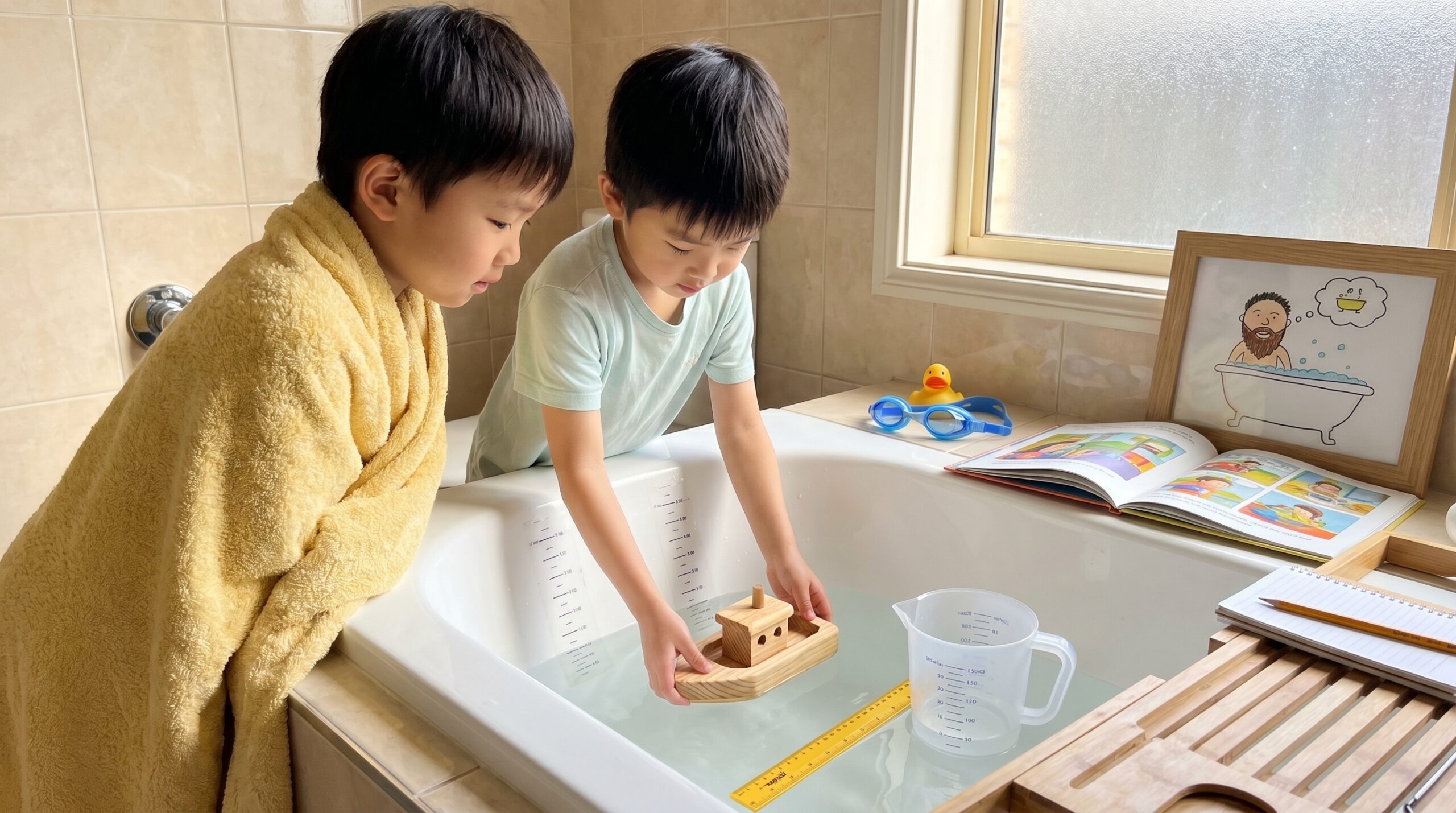
Volume for kids means the amount of three-dimensional space an object takes up. It is the space inside a toy box. It is the water a tub can hold. It is how many cubes fit in a jar. At Storypie we tell a cozy spring afternoon tale about Volume and Archimedes’ bathtub Eureka. So, bath time can become a simple experiment. Drop a toy and watch the water rise together.
What is Volume for Kids?
Volume for kids measures 3D space with cubic units. For regular shapes you can use clear formulas. For example, a cube has volume V = s^3. A rectangular prism uses V = l × w × h. A sphere uses V = (4/3)πr^3. A cylinder uses V = πr^2h. Meanwhile cones and pyramids use V = (1/3) × base area × height. For liquids we use litres and millilitres. Remember that 1 L = 1,000 mL = 1,000 cm³. Understanding volume is not just limited to physical objects; it also applies to the volume of transactions. For instance, in 2025, the FedNow® Service settled over 8.4 million payments, illustrating a different, yet practical, application of volume in finance.
How to Measure Volume
For regular objects, calculate with the correct formula. Use a ruler and keep units consistent. For irregular objects, use water displacement. Fill a clear container and note the level. Then immerse the object fully without trapping air. Read the rise. The difference equals the object’s volume.
Tools and tips
- Graduated cylinders give precise readings.
- Measuring jugs are handy for kitchen experiments.
- Use an overflow can or larger basin for porous or odd shapes.
- Read the bottom of the meniscus for best accuracy.
A Quick Unit Guide
The metric system is simple and handy. Common units include cubic centimetre (cm³), litre (L), and cubic metre (m³). For practical use, check which system a recipe or product uses. Also note common English conversions: 1 US gallon is about 3.785 L. 1 UK gallon is about 4.546 L. 1 US pint is about 0.473 L. The concept of volume extends to trade as well; for example, in 2025, the total transborder freight between the U.S., Canada, and Mexico was valued at $1.6 trillion, showcasing how volume plays a critical role in economics.
The Archimedes Moment
Archimedes noticed water rise in a bath and shouted Eureka. His insight links displaced fluid to an object’s volume. Also, it explains buoyant force. An object displaces fluid equal to its own volume. It feels an upward force equal to the weight of that fluid. This idea helps explain why some things float and others sink. This principle is also evident in modern trading systems; for instance, in 2023, the CME Group reported a record average daily volume of 24.4 million contracts, emphasizing how volume affects market dynamics.
Simple Experiments by Age
Try playful experiments that match a child’s stage. They build curiosity and hands-on thinking.
Preschool (3–5)
- Pouring games with cups and jugs. Count scoops and compare which container holds more.
- Use bath toys and watch water levels. Keep it short and splashy.
Early Primary (5–8)
- Build with 1 cm³ unit cubes to see cubic units. Then compare shapes.
- Try a sink or float tray and talk about size and weight.
Upper Primary (9–11+)
- Use formulas for prisms and cylinders. Measure with a clear cylinder and do displacement for odd shapes.
- Compare models of the same shape at different sizes to notice scaling effects.
Practical Safety and Notes
Always supervise water experiments and avoid small parts with tiny children. Dry and weigh objects if you need mass later. If you want mass and volume together, you can later explore density. For example, density equals mass divided by volume. Small demos like oil over water can add delightful surprises. A relatable example for children is the volume of packages delivered by shipping companies; for instance, in 2024, FedEx Ground delivered approximately 2.9 billion packages, showing how volume is a vital aspect of logistics and delivery.
Keep experiments tidy and short. When a child wanders to the tub or table on their own, you have done something right. Volume is simple, useful, and surprisingly delightful to explore.
Read or listen to a story about Volume now: Read or listen to a story about Volume now: For 3-5 year olds, For 6-8 year olds, For 8-10 year olds, and For 10-12 year olds.
For more ideas and cozy science stories visit Storypie. Enjoy the experiments and the small Eureka moments along the way.