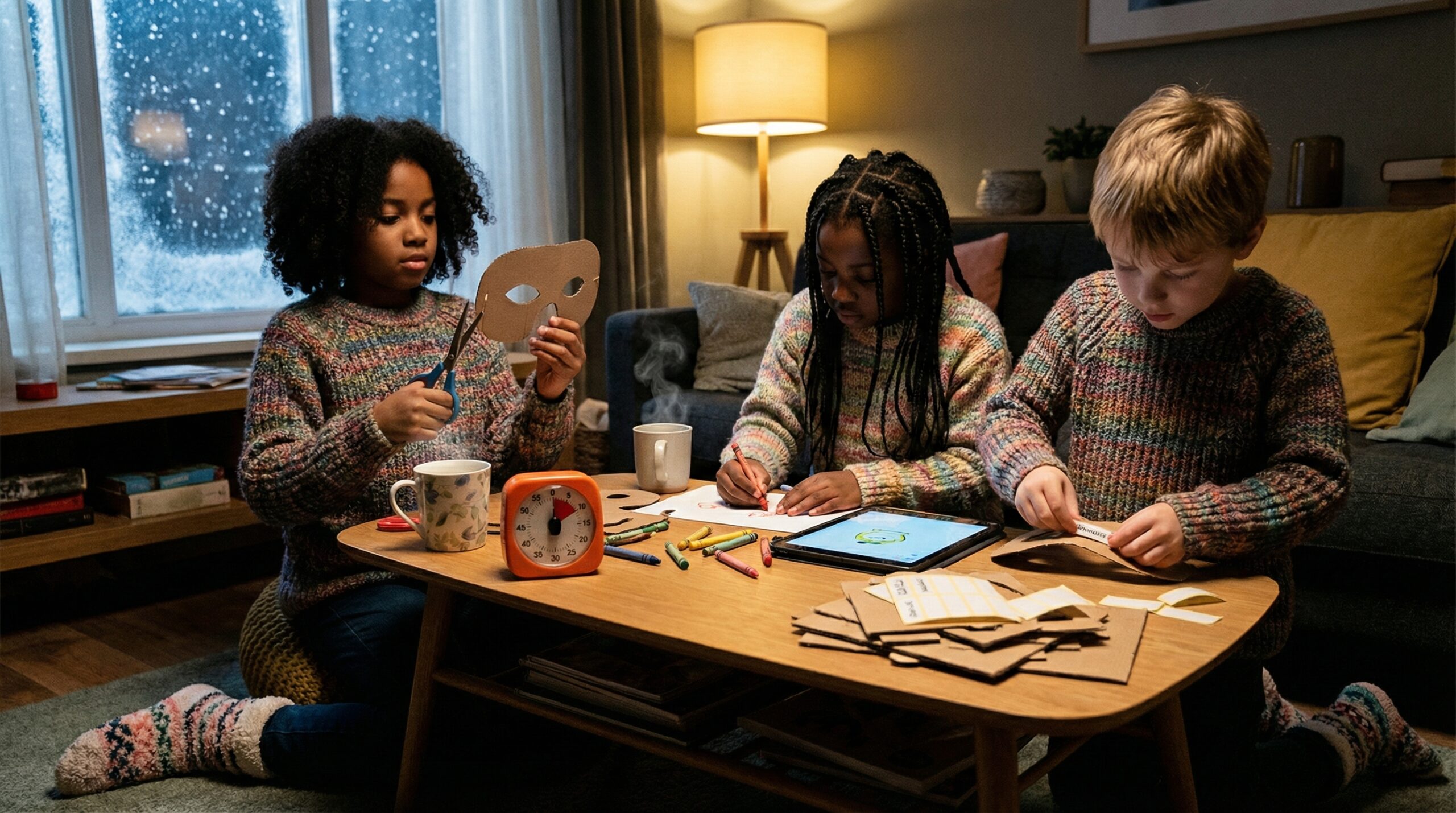
Weekend imagination challenge: create your own hero is a cozy, low-pressure prompt families can try on a chilly afternoon. It asks children to invent a tiny-but-mighty hero with one everyday power. Then they tell, draw, or record the result. This fast activity sparks quick wins, storytelling confidence, and bursts of giggles. Engaging in such creative activities can greatly benefit mental health; a 2023 study by the Adobe Foundation and the National Alliance on Mental Illness found that 61% of individuals who engage in creative activities report reduced feelings of stress or anxiety.
Weekend imagination challenge: create your own hero
This weekend imagination challenge keeps things simple and joyful. Families spend ten to twenty minutes. Children pick one small power and a mission. Next, they name the hero and add a tiny weakness to keep the story grounded. The process feels familiar and exciting, and it makes creativity feel doable. According to a 2023 poll by the American Psychiatric Association, 46% of Americans use creative activities to relieve stress or anxiety, supporting the idea that this challenge can be beneficial.
A thread through history
Hero making goes back to ancient tales. For example, people told stories of Gilgamesh and Greek heroes long ago. Then modern media introduced comic icons like Superman in 1938. That long tradition shows why inventing a hero feels both familiar and thrilling today.
What a home hero usually needs
Children commonly build heroes from repeatable parts. Keep these parts simple and satisfying.
- Name: Choose a short, memorable name.
- Look: Add a costume, emblem, or a favorite toy as a stand-in.
- Everyday power: One ability, such as calming plants or fixing toys.
- Mission: A brief why, like helping neighbors or finding lost mittens.
- Tiny weakness: A small limit that keeps the story grounded.
Why pick an everyday power
An everyday power keeps the task accessible. Also, one focused ability lowers thinking pressure. It invites practical problem solving and a sense of agency. Children imagine helping, not being all-powerful. That tiny-but-mighty angle feels very empowering. Research shows that a creative outlet can significantly boost children’s confidence; a 2024 survey commissioned by Crayola found 92% of children aged 6–12 said being creative boosts their confidence.
Benefits for learning and growth
Short creative challenges support language and memory. They also build sequencing and theory of mind. In practice, kids who invent heroes practice storytelling structure and emotion naming. A ten-minute prompt is a small wonder that boosts confidence. Also, it produces a shareable artifact families can revisit. Furthermore, a 2023 study published in the journal Child and Adolescent Psychiatry and Mental Health reported that adolescents participating in a two-week creative arts intervention showed significantly reduced depression symptoms and improved well-being, illustrating the positive impact of creativity on young people’s mental health.
Age and accessibility
Adapt the weekend imagination challenge to each child. For preschoolers, offer picture prompts and let them draw or act. For early elementary kids, add one or two sentences of origin. Older children can expand into comic panels or recorded audio with sound effects. For different abilities, use photos, collage, or simple voice recordings.
Quick parent prompts
- Start with one vivid line. For example, “What if the park bench could talk?”
- Set a 10-minute timer to write or draw.
- Ask three questions: Who, power, and why.
- Celebrate with a read-aloud or quick show-and-tell.
Capture and share safely
Record drawings, take a photo of a costume, or save a voice clip. Then save creations in a family library. Storypie helps families organize and revisit their projects. Use privacy settings, avoid full names, and ask caregiver consent before posting a child’s voice or image.
Also, invite heroes from different cultures and abilities. Sharing builds community and shows children many models of courage. However, protect privacy by using group accounts or private settings when possible. A Boston Children’s Museum survey
found 89% of parents said play is essential to their child’s healthy development and 88% said it is essential to their child’s learning, reinforcing the importance of play and creativity in child development.
Try the weekend imagination challenge: create your own hero today with a cozy, playful workshop. If you want a simple place to save stories, try Storypie for family-friendly organization and replay.
Final thought
This weekend imagination challenge invites small, joyful experiments in storytelling. Every child has a hero inside. Help them name it, sketch it, and cheer as it steps into the world.