English

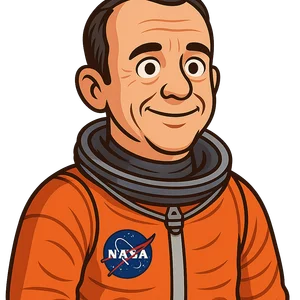
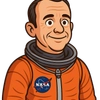
Alan Shepard
Alan Shepard was an American astronaut, naval aviator, and test pilot.
Reads at Grades 6–8 Listens at Grades 4–8
Print & create
Answer keys·No prep·Free with an account
28 worksheets · answer keys · full story · quiz · Ages 10-12 · CEFR B2
Plus adds 279,000+ more stories in 27 languages, audio for every one, and printables for all of them.
Just want Alan Shepard?
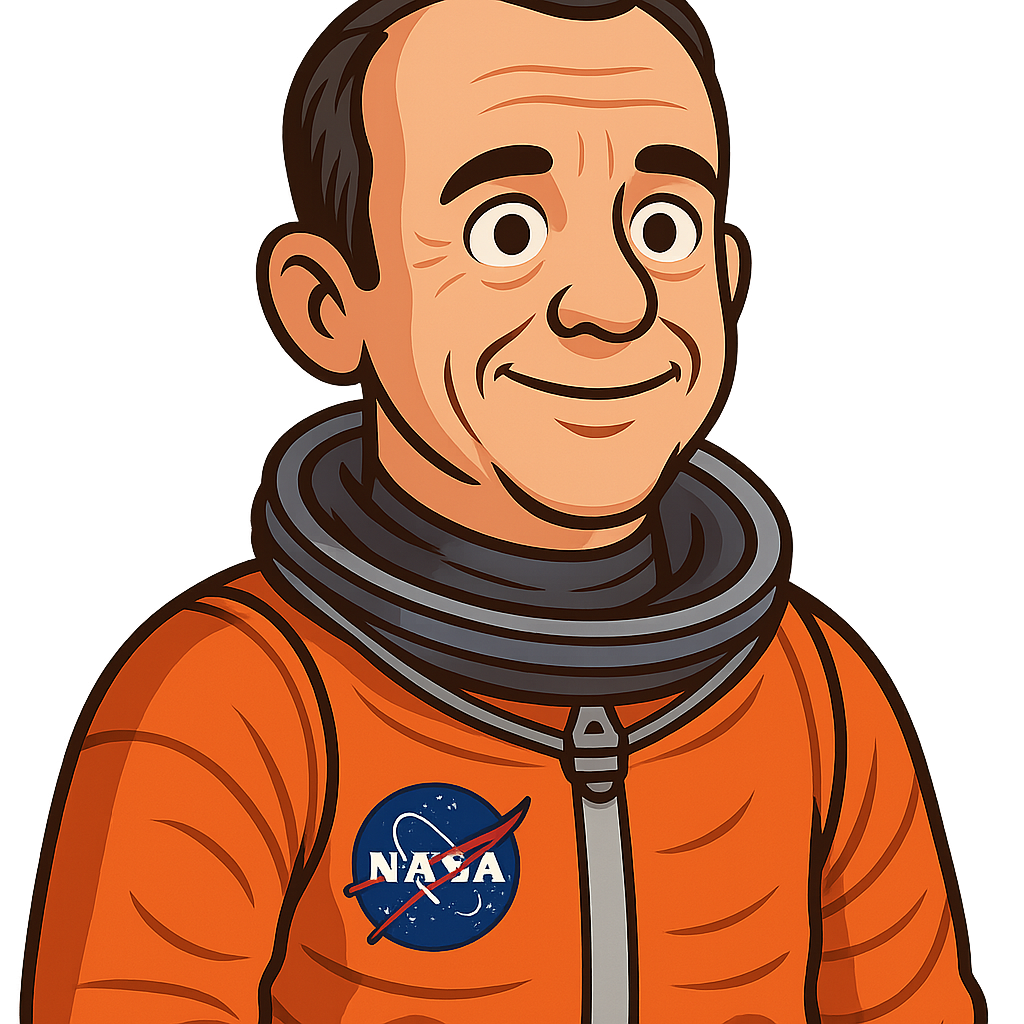
Hello, my name is Alan Shepard, and I had the incredible adventure of being the first American to travel into space. My story began on November 18th, 1923, in the town of Derry, New Hampshire. Even as a boy, I was completely fascinated by airplanes. I would spend hours watching them fly overhead, dreaming of one day being in the cockpit. That dream guided my choices, and I knew I wanted to serve my country and fly. I worked hard in school and earned a place at the United States Naval Academy. The world was in the middle of World War II when I graduated in 1944. My time at the academy was challenging, but it taught me discipline and leadership, preparing me for a future I couldn't yet imagine, one that would take me far beyond the skies I used to watch as a child.
After the war ended, I continued my career in the Navy, determined to earn my wings. In 1947, I finally achieved my goal and became a naval aviator. There was nothing like the thrill of flying powerful jet aircraft, especially taking off from and landing on the enormous deck of an aircraft carrier moving through the ocean. I loved pushing the limits of what was possible, so I took the next big step in my career. In 1950, I graduated from the U.S. Naval Test Pilot School. Being a test pilot was one of the most demanding jobs a pilot could have. We were tasked with flying brand-new, experimental aircraft to see how they performed. It required incredible focus, quick thinking, and courage. Every flight was a new challenge, testing both the machine and my own skills. This experience flying on the cutting edge of aviation technology was the perfect training for the even greater adventures that were waiting for me just around the corner.
Alan Shepard: A Journey to the Stars
Hello, my name is Alan Shepard, and I had the incredible adventure of being the first American to travel into space. My story began on November 18th, 1923, in the town of Derry, New Hampshire. Even as a boy, I was completely fascinated by airplanes. I would spend hours watching them fly overhead, dreaming of one day being in the cockpit. That dream guided my choices, and I knew I wanted to serve my country and fly. I worked hard in school and earned a place at the United States Naval Academy. The world was in the middle of World War II when I graduated in 1944. My time at the academy was challenging, but it taught me discipline and leadership, preparing me for a future I couldn't yet imagine, one that would take me far beyond the skies I used to watch as a child.
After the war ended, I continued my career in the Navy, determined to earn my wings. In 1947, I finally achieved my goal and became a naval aviator. There was nothing like the thrill of flying powerful jet aircraft, especially taking off from and landing on the enormous deck of an aircraft carrier moving through the ocean. I loved pushing the limits of what was possible, so I took the next big step in my career. In 1950, I graduated from the U.S. Naval Test Pilot School. Being a test pilot was one of the most demanding jobs a pilot could have. We were tasked with flying brand-new, experimental aircraft to see how they performed. It required incredible focus, quick thinking, and courage. Every flight was a new challenge, testing both the machine and my own skills. This experience flying on the cutting edge of aviation technology was the perfect training for the even greater adventures that were waiting for me just around the corner.
By the late 1950s, the world was captivated by the 'space race,' a competition between the United States and the Soviet Union to explore the cosmos. In 1959, a new government agency called NASA was looking for pilots for its first human spaceflight program, Project Mercury. I applied and was incredibly honored to be chosen as one of the original seven astronauts. We became known as the 'Mercury Seven.' The training we went through was unlike anything we had ever experienced. We were spun in centrifuges, subjected to extreme temperatures, and spent countless hours in simulators to prepare our bodies and minds for the unknown environment of space. Then, on the morning of May 5th, 1961, it was my turn. I climbed into a tiny capsule named Freedom 7, perched atop a powerful rocket. The rocket launched me into the sky, and for a breathtaking 15 minutes, I traveled into space. I became the first American to ever leave Earth's atmosphere. Though my flight was short, I saw the beautiful curve of our planet against the blackness of space, a sight that changed my life forever.
My journey, however, was not without major obstacles. A few years after my historic flight, in 1964, I was suddenly grounded. Doctors diagnosed me with an inner-ear condition called Ménière's disease, which caused dizziness and hearing problems. For a pilot, this was devastating news. I was no longer medically cleared to fly, and it seemed my dream of returning to space was over. It was a huge disappointment, but I refused to give up on the space program. Instead of leaving NASA, I took on a new and very important role as the Chief of the Astronaut Office. In this position, I was responsible for managing all astronaut activities. I oversaw the training of the astronaut crews for the Gemini and Apollo missions, making sure they were prepared for their complex and dangerous flights. Even though I couldn't fly myself, I made sure I was doing everything I could to help my fellow astronauts reach for the stars and, eventually, the Moon.
I never lost hope that I might one day fly again. I kept searching for a solution to my medical condition, and finally, there was a breakthrough. In 1969, I underwent a risky but successful surgery that corrected the problem in my inner ear. After years of being grounded, I was medically cleared to return to flight status. It felt like a second chance. My ultimate goal was now within reach: to walk on the Moon. I was assigned to command the Apollo 14 mission. In January 1971, my crew and I launched from Earth, heading for the lunar surface. On February 5th, 1971, I experienced a moment that I had dreamed of for years. I stepped out of our lunar module, Antares, and became the fifth person to walk on the Moon. The landscape was unlike anything on Earth—silent, dusty, and magnificent. Before we left, I did something a little unusual. I had brought along a makeshift six-iron and two golf balls. I hit them across the lunar surface, watching them sail for what felt like miles in the low gravity. It was a moment of joy that I hoped would show the world the human spirit of exploration.
After my incredible journey to the Moon, I continued to serve at NASA for a few more years. In 1974, I retired from both NASA and the Navy, having reached the rank of Rear Admiral. I then began a new chapter in my life as a businessman. Looking back, my path was filled with amazing highs and difficult challenges. I lived to be 74 years old, and I hope my story is remembered as one of perseverance. From being the first American in space to overcoming a career-ending illness to finally walking on the Moon, I learned that you should never give up on your dreams. My legacy is as a pioneer who helped open the frontier of space, and I hope it inspires you to push your own boundaries and reach for your own stars.
Wow facts
About
Alan Shepard was an American astronaut, naval aviator, and test pilot. In 1961, he became the first American to travel into space, and in 1971, he became the fifth person to walk on the Moon during the Apollo 14 mission.
Take a Quiz
Question 1 of 5
What was the main conflict or problem Alan Shepard faced in the middle of his career, and how was it resolved?
Explore next






Want to do even more?
Go beyond exploring. Unlock tools that turn every story into real learning.

Storypie Plus for families
Full stories, quizzes, and printables. Nights and car rides, sorted.
- Unlimited audio stories
- Create Mode: your child stars in the story
- Offline downloads
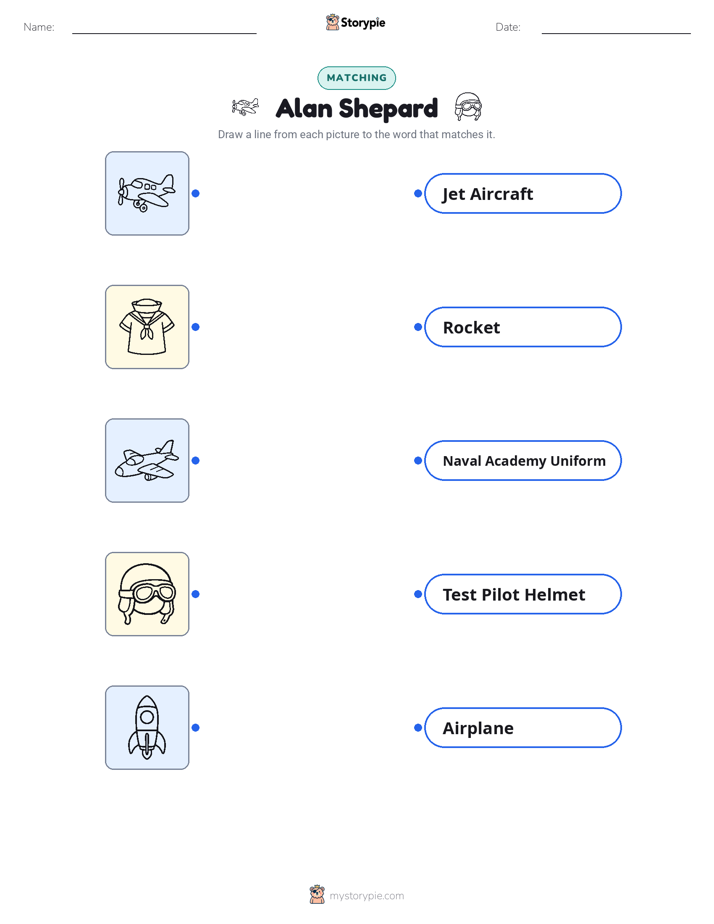
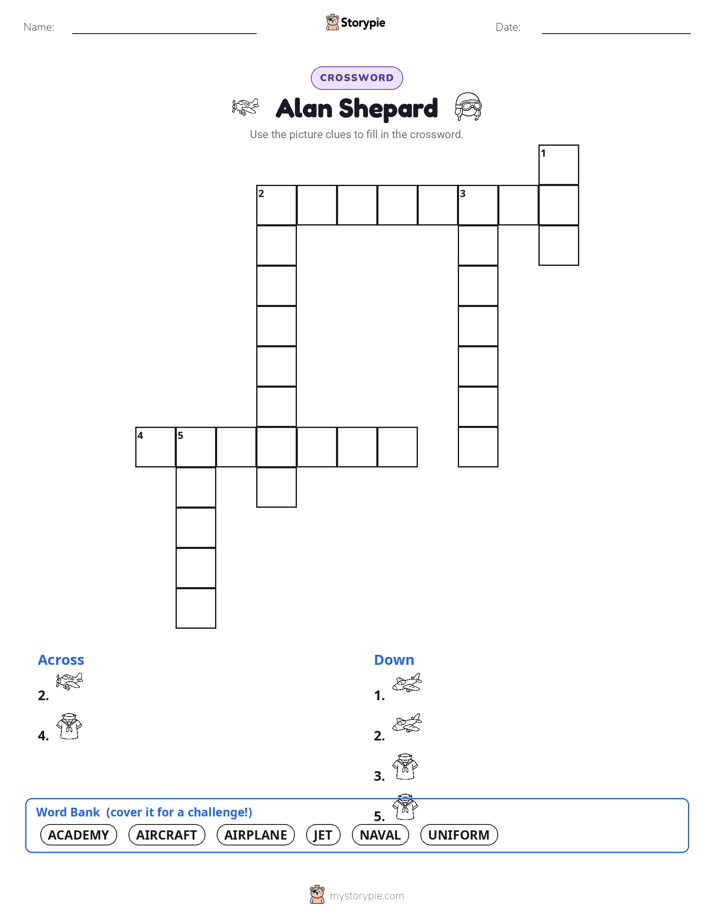
- Printable worksheets & coloring pages

Why Storypie for Schools
Students engaged. Prep in seconds. Evenings back to you.
- Worksheets & Quizzes
- Classroom Management
- Formative Assessment
- Custom Curriculum & Lesson Plans
- 27 Languages

Why Storypie for Homeschool
Curriculum done. They'll ask for more. Hours back in your day.
- Worksheet Generator
- First-Person Audio Stories
- Built-in Comprehension Quizzes
- Custom Curriculum & Lesson Plans
- Print & Go Activities