English

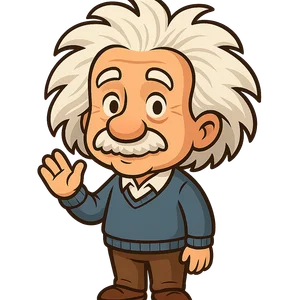
Albert Einstein
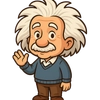
Albert Einstein was a German-born theoretical physicist who developed the theory of relativity…
Reads at Grades 6–8 Listens at Grades 4–8
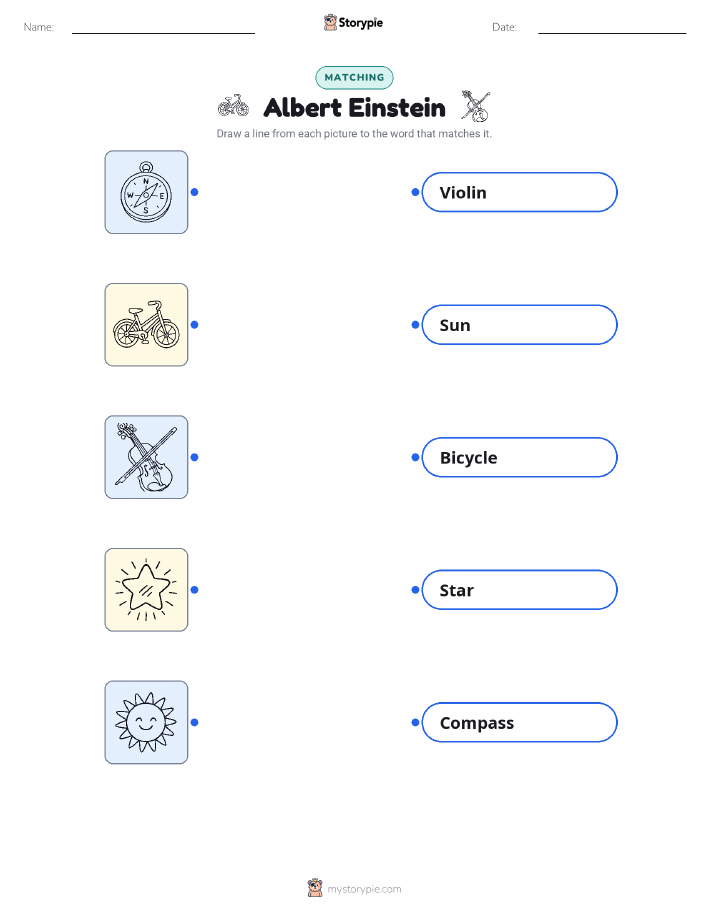
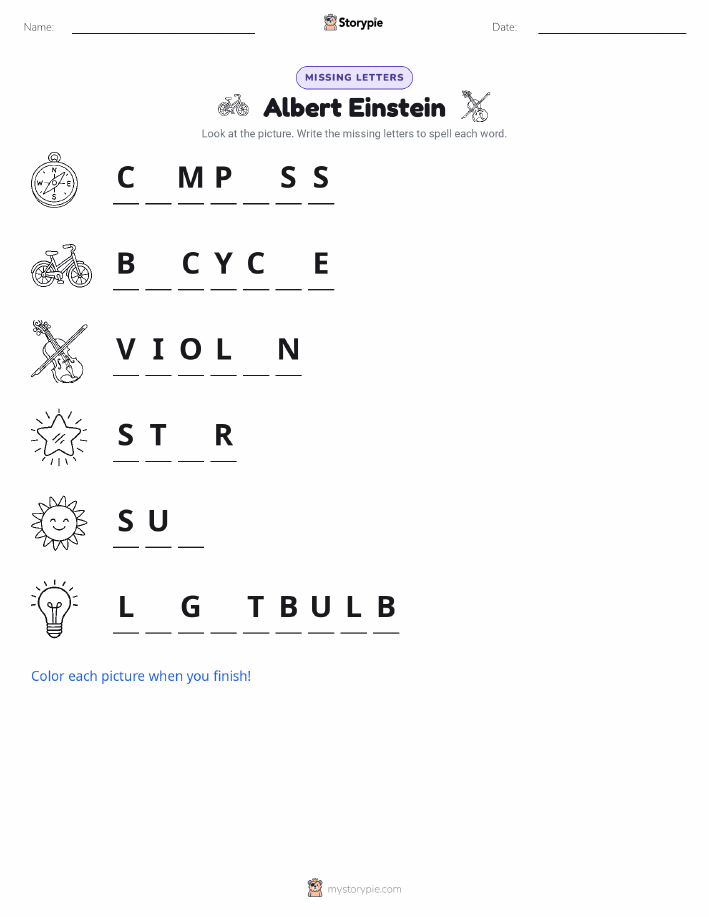
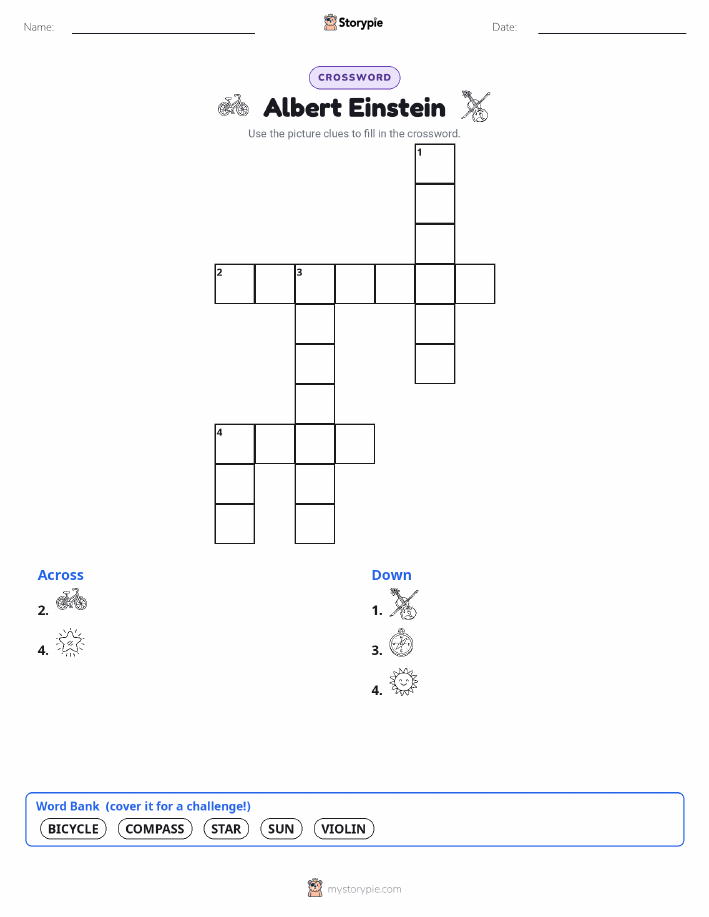
Print & create
Answer keys·No prep·Free with an account
28 worksheets · answer keys · full story · quiz · Ages 10-12 · CEFR B2
Plus adds 244,000+ more stories in 27 languages, audio for every one, and printables for all of them.
Just want Albert Einstein?
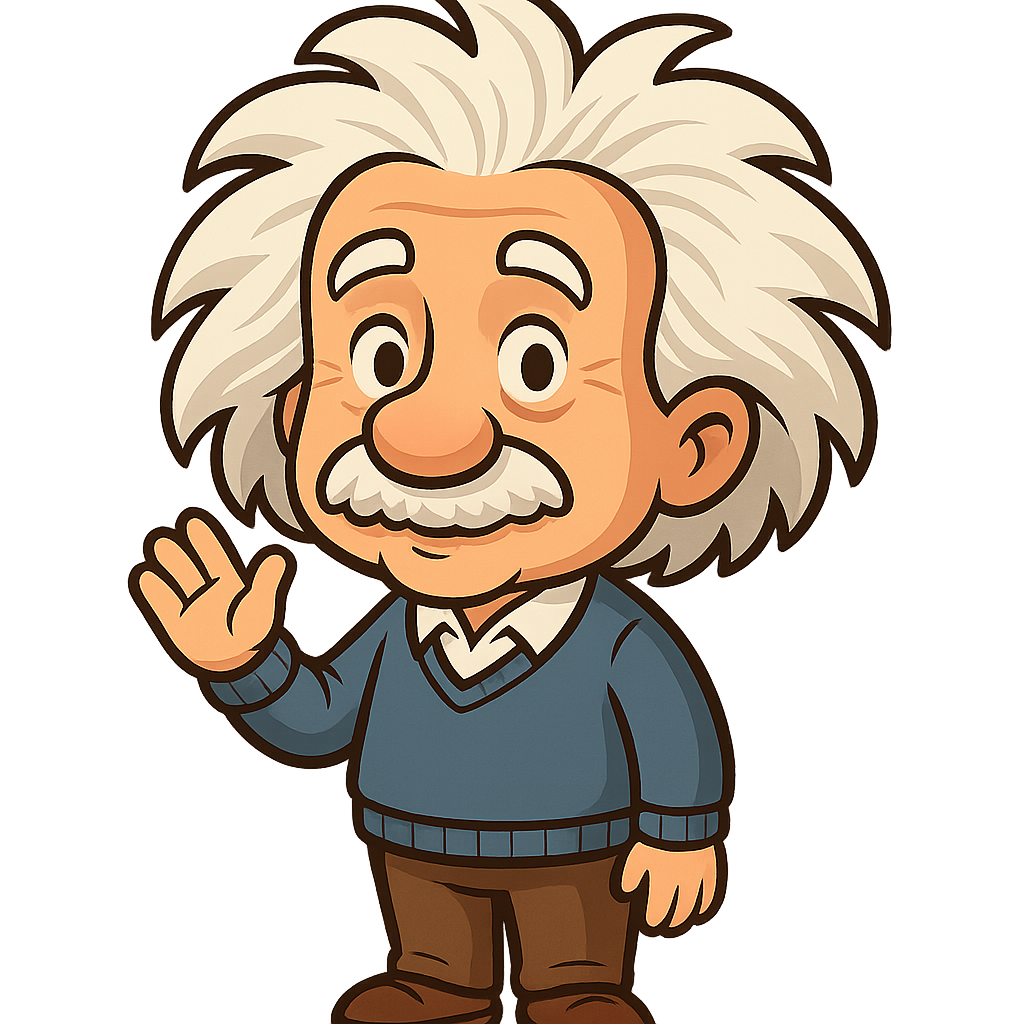
Hello there. My name is Albert Einstein, and you might know me for my wild hair or my famous equation, E=mc². But long before all of that, I was just a boy in Germany with a head full of questions. I was born in the city of Ulm on March 14, 1879. My family soon moved to Munich, and it was there that my life’s great adventure truly began. At school, I was not what you would call a model student. While my classmates were busy memorizing dates and facts, my mind was often drifting, exploring imaginary worlds and wondering about the secrets of the universe. Teachers sometimes thought I was lazy or distracted, but in truth, I was simply more interested in the ‘why’ than the ‘what’.
The most important moment of my childhood happened when I was about five years old and sick in bed. My father, Hermann, wanted to cheer me up, so he showed me a small, simple pocket compass. I watched, mesmerized, as the needle trembled and then pointed steadily north, no matter which way he turned the case. There was no string, no gear, nothing visible moving it. Yet, some invisible force was acting upon it, a mysterious power that filled the empty space around us. I felt a deep sense of wonder, a feeling that there was something hidden behind the appearance of things. That little compass lit a fire in my mind. It taught me that the universe was full of unseen forces and deep mysteries waiting to be understood. From that day on, I knew I didn't just want to learn what was already known; I wanted to discover the fundamental rules that governed everything.
Albert Einstein: A Journey Through Spacetime
Hello there. My name is Albert Einstein, and you might know me for my wild hair or my famous equation, E=mc². But long before all of that, I was just a boy in Germany with a head full of questions. I was born in the city of Ulm on March 14, 1879. My family soon moved to Munich, and it was there that my life’s great adventure truly began. At school, I was not what you would call a model student. While my classmates were busy memorizing dates and facts, my mind was often drifting, exploring imaginary worlds and wondering about the secrets of the universe. Teachers sometimes thought I was lazy or distracted, but in truth, I was simply more interested in the ‘why’ than the ‘what’.
The most important moment of my childhood happened when I was about five years old and sick in bed. My father, Hermann, wanted to cheer me up, so he showed me a small, simple pocket compass. I watched, mesmerized, as the needle trembled and then pointed steadily north, no matter which way he turned the case. There was no string, no gear, nothing visible moving it. Yet, some invisible force was acting upon it, a mysterious power that filled the empty space around us. I felt a deep sense of wonder, a feeling that there was something hidden behind the appearance of things. That little compass lit a fire in my mind. It taught me that the universe was full of unseen forces and deep mysteries waiting to be understood. From that day on, I knew I didn't just want to learn what was already known; I wanted to discover the fundamental rules that governed everything.
As I grew older, my curiosity only intensified. The rigid German school system felt like a cage for my imagination, so at the age of seventeen, in 1896, I enrolled in the Zurich Polytechnic in Switzerland. It was a place of new ideas and new freedoms. It was also where I met my first wife, Mileva Marić, a brilliant physics and mathematics student who shared my passion for unraveling the universe's secrets. After graduating in 1900, however, I struggled. No university wanted to hire me as a professor. For two years, I searched for a teaching post, feeling like a failure. Finally, in 1902, I took a job as a clerk in the Swiss patent office in Bern. It may sound like a dull job, examining other people's inventions all day, but for me, it was a blessing. The work was simple enough that it left my mind free to wander, to conduct what I called ‘thought experiments.’
While sitting at my quiet desk, I would imagine riding on a beam of light or what would happen if a clock could travel at incredible speeds. These daydreams were the seeds of my greatest ideas. Then came the year 1905, a time I now look back on as my "Annus Mirabilis," or Miracle Year. In just a few months, I published four scientific papers that would shake the very foundations of physics. One paper explained that light could behave not just as a wave, but also as a stream of tiny energy packets, an idea that would later win me a Nobel Prize. Another proved the existence of atoms by explaining the jittery, random motion of particles in water. And two others introduced my special theory of relativity, which proposed that time and space were not absolute but could change depending on how fast you were moving. Tucked inside that theory was the most famous equation in the world: E=mc². It revealed that matter and energy were two sides of the same coin, a concept with unimaginable power.
My Miracle Year of 1905 was just the beginning. The special theory of relativity was a huge step, but it was incomplete because it didn't include gravity. For the next ten years, I wrestled with that problem. How did gravity actually work?. Isaac Newton had described it as a mysterious force pulling objects toward each other, but that didn't satisfy my curiosity. I wanted to know why it worked. I spent years filling notebooks with complex mathematics, going down wrong paths, and feeling utterly lost. My mind was consumed with this one great question. I imagined a person falling from a roof; in that moment of freefall, they would feel no weight, no gravity. This simple thought experiment was the key. It led me to realize that gravity was not a force at all. Instead, it was a curvature in the very fabric of the universe, a fabric I called spacetime.
Imagine a giant, stretchy rubber sheet. If you place a heavy bowling ball in the center, the sheet will bend and sag. Now, if you roll a small marble nearby, it won't travel in a straight line; it will curve inward, drawn toward the bowling ball's dip. That, in essence, is my general theory of relativity, which I finally completed in 1915. The Sun, like the bowling ball, warps the spacetime around it, and the planets, like the marbles, are simply following those curves. It was a radical idea, and I needed proof. My theory predicted that starlight passing near the sun should bend by a specific amount. The only way to test this was during a total solar eclipse. In 1919, a British astronomer named Sir Arthur Eddington traveled to Africa to observe an eclipse, and his measurements proved my calculations were correct. The news spread like wildfire. Overnight, I became world-famous. Newspapers everywhere hailed a new understanding of the universe. In 1921, I was awarded the Nobel Prize in Physics, but ironically, it was for my 1905 work on the photoelectric effect. The theory of relativity was still considered too strange and revolutionary for many scientists to fully accept.
Fame was strange, but it gave me a platform to speak about things that mattered beyond science. The world was changing rapidly, and not for the better. In my home country of Germany, a dark political tide was rising. By 1933, with the Nazi party in power, I knew that as a Jewish intellectual, I was no longer safe. I left Germany and never returned, finding a new home in the United States at the Institute for Advanced Study in Princeton, New Jersey. But my heart was heavy. In 1939, I was faced with a terrible dilemma. I learned that German scientists were trying to build an atomic weapon. Fearing they would succeed, I signed a letter to President Franklin D. Roosevelt, urging the United States to begin its own research. It was a decision that haunted me for the rest of my life. When atomic bombs were used at the end of World War II, I was horrified.
I had spent my life trying to understand the beautiful, elegant laws of the universe, only to see that knowledge used for destruction. My final years were dedicated to advocating for peace, world government, and the end of nuclear weapons. On April 18, 1955, my journey came to an end in Princeton. My life was one of constant questioning. I learned that imagination is more important than knowledge, and that the most beautiful thing we can experience is the mysterious. My hope is that you, too, will never stop asking 'why'. Stay curious, question everything, and use the incredible power of your mind not just to understand the world, but to make it a kinder, more peaceful place for everyone.
Wow facts
About
Albert Einstein was a German-born theoretical physicist who developed the theory of relativity, one of the two pillars of modern physics. His work is also known for its influence on the philosophy of science.
Take a Quiz
Question 1 of 5
Can you retell the story of how a simple compass influenced my entire life and scientific journey?
Explore next





Want to do even more?
Go beyond exploring. Unlock tools that turn every story into real learning.

Storypie Plus for families
Full stories, quizzes, and printables. Nights and car rides, sorted.
- Unlimited audio stories
- Create Mode: your child stars in the story
- Offline downloads
- Printable worksheets & coloring pages

Why Storypie for Schools
Students engaged. Prep in seconds. Evenings back to you.
- Worksheets & Quizzes
- Classroom Management
- Formative Assessment
- Custom Curriculum & Lesson Plans
- 27 Languages

Why Storypie for Homeschool
Curriculum done. They'll ask for more. Hours back in your day.
- Worksheet Generator
- First-Person Audio Stories
- Built-in Comprehension Quizzes
- Custom Curriculum & Lesson Plans
- Print & Go Activities