English

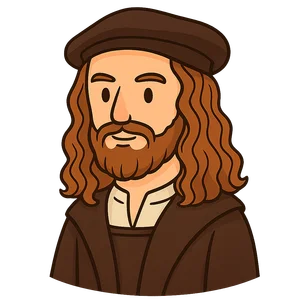
Albrecht Dürer
Albrecht Dürer was a German painter, printmaker, and theorist of the German Renaissance.
Reads at Grades 6–8 Listens at Grades 4–8
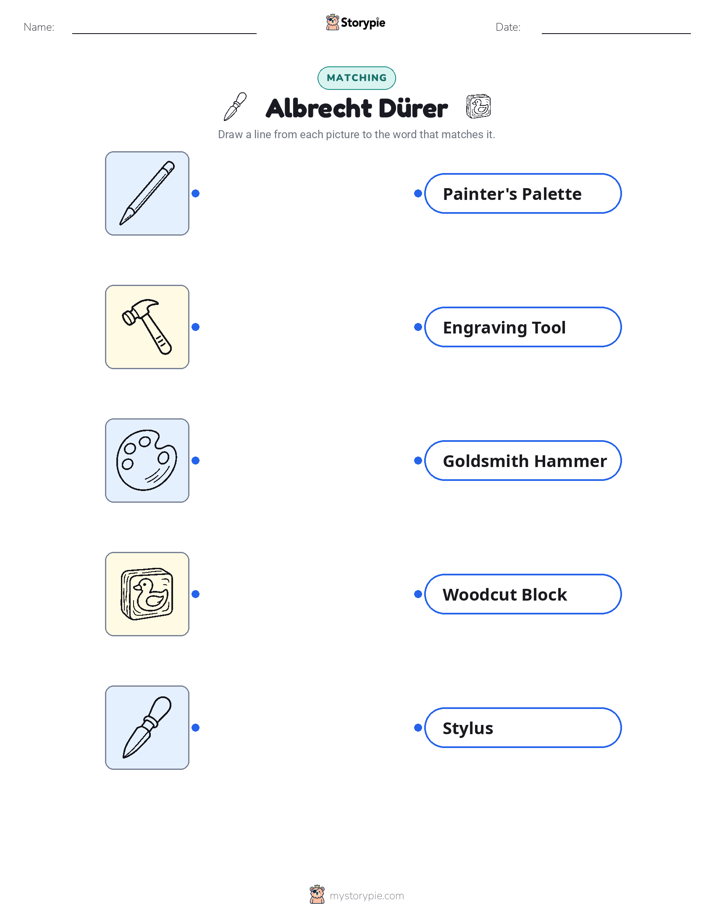
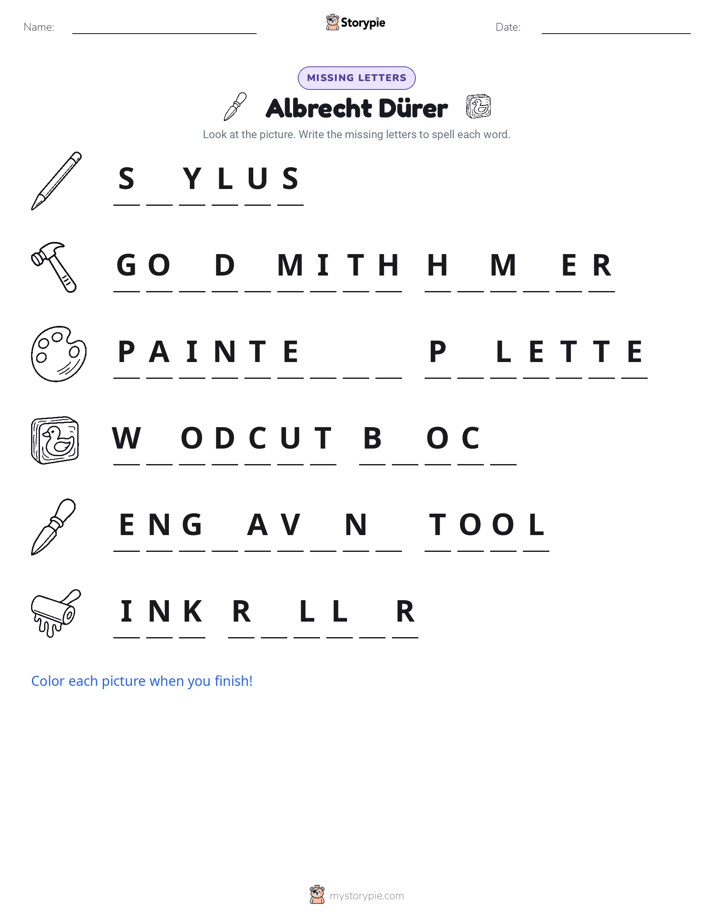
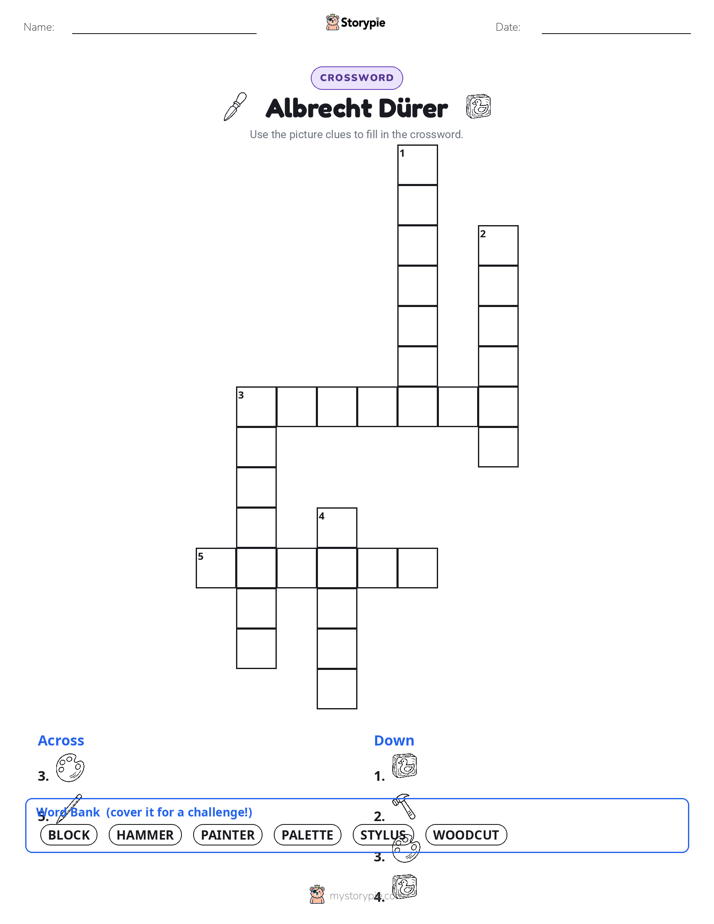
Print & create
Answer keys·No prep·Free with an account
28 worksheets · answer keys · full story · quiz · Ages 10-12 · CEFR B2
Plus adds 244,000+ more stories in 27 languages, audio for every one, and printables for all of them.
Just want Albrecht Dürer?
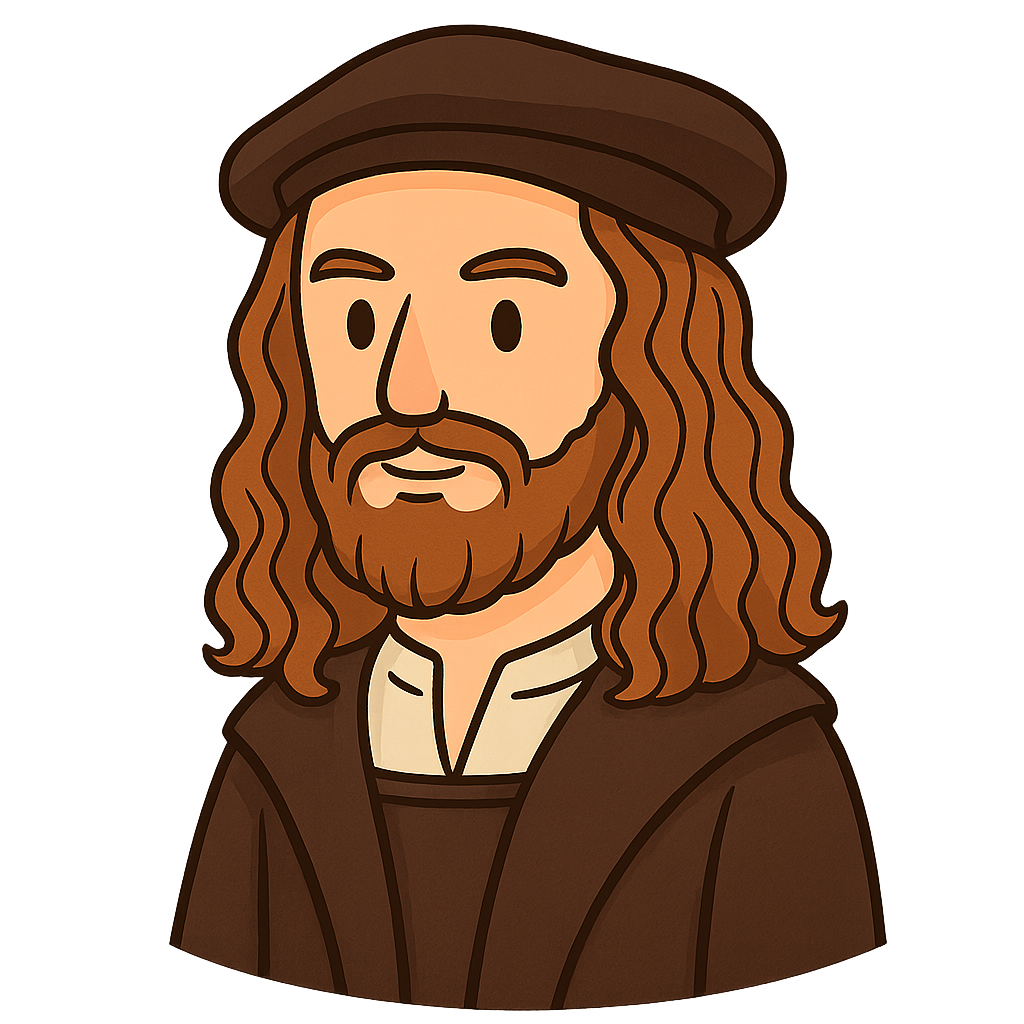
Hello, my name is Albrecht Dürer, and I am an artist who lived long ago. My story begins on May 21st, 1471, in the lively city of Nuremberg, which was then part of the vast Holy Roman Empire. My father was a skilled goldsmith, and I was one of his many children. Growing up in his workshop, I was surrounded by creativity and precision. From a very young age, my greatest passion was for drawing. In 1484, when I was only thirteen years old, I created a detailed self-portrait using a silverpoint stylus, a tool that makes fine, metallic lines. My father had hoped that I would follow in his footsteps and become a goldsmith, a fine and respectable trade. However, my heart was truly set on becoming a painter. Seeing my determination and talent, he supported my dream. In 1486, he arranged for me to become an apprentice in the workshop of a leading local artist named Michael Wolgemut, where my real journey began.
After completing my training, I began what was known as my 'Wanderjahre,' or journeyman years, around 1490. This was a custom for young craftsmen to travel, work in different cities, and learn new skills from other masters. My most important and life-changing journey was to Italy from 1494 to 1495. There, I was completely astonished by the art of the Italian Renaissance. The artists in Italy had mastered new ideas like perspective, which made their paintings look three-dimensional and incredibly realistic. Seeing their work opened my eyes to a new world of artistic possibilities. When I returned to Nuremberg in 1495, I was filled with inspiration and immediately opened my own workshop. I began to focus on the techniques of woodcuts and engravings. These are types of printmaking where you carve an image into wood or metal, apply ink, and press it onto paper. This process allowed me to make many copies of a single artwork. Suddenly, art was no longer just for the very wealthy. My prints could be owned and enjoyed by many people. One of my first major successes was a series of fifteen dramatic woodcuts I completed in 1498 called 'The Apocalypse,' which told a powerful story entirely through images.
Albrecht Dürer
Hello, my name is Albrecht Dürer, and I am an artist who lived long ago. My story begins on May 21st, 1471, in the lively city of Nuremberg, which was then part of the vast Holy Roman Empire. My father was a skilled goldsmith, and I was one of his many children. Growing up in his workshop, I was surrounded by creativity and precision. From a very young age, my greatest passion was for drawing. In 1484, when I was only thirteen years old, I created a detailed self-portrait using a silverpoint stylus, a tool that makes fine, metallic lines. My father had hoped that I would follow in his footsteps and become a goldsmith, a fine and respectable trade. However, my heart was truly set on becoming a painter. Seeing my determination and talent, he supported my dream. In 1486, he arranged for me to become an apprentice in the workshop of a leading local artist named Michael Wolgemut, where my real journey began.
After completing my training, I began what was known as my 'Wanderjahre,' or journeyman years, around 1490. This was a custom for young craftsmen to travel, work in different cities, and learn new skills from other masters. My most important and life-changing journey was to Italy from 1494 to 1495. There, I was completely astonished by the art of the Italian Renaissance. The artists in Italy had mastered new ideas like perspective, which made their paintings look three-dimensional and incredibly realistic. Seeing their work opened my eyes to a new world of artistic possibilities. When I returned to Nuremberg in 1495, I was filled with inspiration and immediately opened my own workshop. I began to focus on the techniques of woodcuts and engravings. These are types of printmaking where you carve an image into wood or metal, apply ink, and press it onto paper. This process allowed me to make many copies of a single artwork. Suddenly, art was no longer just for the very wealthy. My prints could be owned and enjoyed by many people. One of my first major successes was a series of fifteen dramatic woodcuts I completed in 1498 called 'The Apocalypse,' which told a powerful story entirely through images.
My prints traveled far and wide, and soon I became famous all across Europe. People began to recognize my unique style. To make sure everyone knew that a work was mine, I created a special signature—a monogram of my initials, 'AD,' enclosed in a design. You could think of it as one of the very first artist logos in history. My reputation grew so much that when I made a second journey to Italy from 1505 to 1507, I was no longer an unknown student but was treated as a celebrity artist in the great city of Venice. A tremendous honor came to me around 1512, when I began to work for the Holy Roman Emperor himself, Maximilian I. During this period, I created what many people consider my greatest masterpieces in engraving. These three prints are known as my 'Master Engravings,' and they are filled with complex details and mysterious symbols that people still study today. The first was 'Knight, Death and the Devil' in 1513, followed by 'Saint Jerome in his Study' and 'Melencolia I,' both completed in 1514. Each one is like a visual puzzle, inviting viewers to look closely and think deeply about their meaning.
Beyond my workshop, I was endlessly curious about the world around me. I firmly believed that great art must be built upon the careful and honest observation of nature. I saw art and science as partners. I spent countless hours studying plants, animals, and landscapes, trying to capture every detail with my pen and brush. In 1502, I painted a watercolor of a 'Young Hare,' so realistic that you can almost feel its soft fur and sense its nervous energy. The next year, in 1503, I painted 'The Large Piece of Turf,' which shows a simple patch of grass and weeds with such detail that it becomes a beautiful and complex little world. My curiosity sometimes led to amusing results. In 1515, I was asked to create a woodcut of a rhinoceros. The challenge was that I had never actually seen one. Working only from a written description and a rough sketch by another person, I drew an incredible creature covered in thick, armor-like plates. While it was not perfectly accurate, my rhinoceros became one of my most famous and widely copied images for centuries. I also wanted to share my knowledge. I wrote several books to teach other artists about subjects I had studied, like geometry and the proportions of the human body. My 'Four Books on Measurement,' published in 1525, was an important work for helping others learn the principles of art.
I spent my final years in my beloved hometown of Nuremberg, where I continued to paint, draw, and write, always exploring new ideas. I lived to be 56 years old, and my life came to an end on April 6th, 1528. Today, I am remembered as a leading figure of the Northern Renaissance, an artist who built a bridge between the detailed, traditional art of Germany and the revolutionary ideas of perspective and realism from Italy. Through my work in printmaking, I helped make art accessible to more people than ever before, changing how art was seen and shared. My life's work showed that art and science are not separate, but are wonderful partners in the never-ending quest to understand our world.
Wow facts
About
Albrecht Dürer was a German painter, printmaker, and theorist of the German Renaissance. His high-quality woodcuts and engravings established his reputation and influence across Europe when he was still in his twenties.
Take a Quiz
Question 1 of 5
The story mentions the word 'monogram.' Based on the context, what is a monogram?
Explore next





Want to do even more?
Go beyond exploring. Unlock tools that turn every story into real learning.

Storypie Plus for families
Full stories, quizzes, and printables. Nights and car rides, sorted.
- Unlimited audio stories
- Create Mode: your child stars in the story
- Offline downloads
- Printable worksheets & coloring pages

Why Storypie for Schools
Students engaged. Prep in seconds. Evenings back to you.
- Worksheets & Quizzes
- Classroom Management
- Formative Assessment
- Custom Curriculum & Lesson Plans
- 27 Languages

Why Storypie for Homeschool
Curriculum done. They'll ask for more. Hours back in your day.
- Worksheet Generator
- First-Person Audio Stories
- Built-in Comprehension Quizzes
- Custom Curriculum & Lesson Plans
- Print & Go Activities