English

Anders Celsius
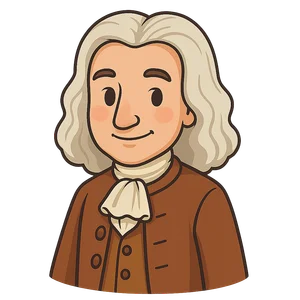
Anders Celsius was a Swedish astronomer, physicist…
Reads at Grades 6–8 Listens at Grades 4–8
Print & create
Answer keys·No prep·Free with an account
28 worksheets · answer keys · full story · quiz · Ages 10-12 · CEFR B2
Plus adds 244,000+ more stories in 27 languages, audio for every one, and printables for all of them.
Just want Anders Celsius?
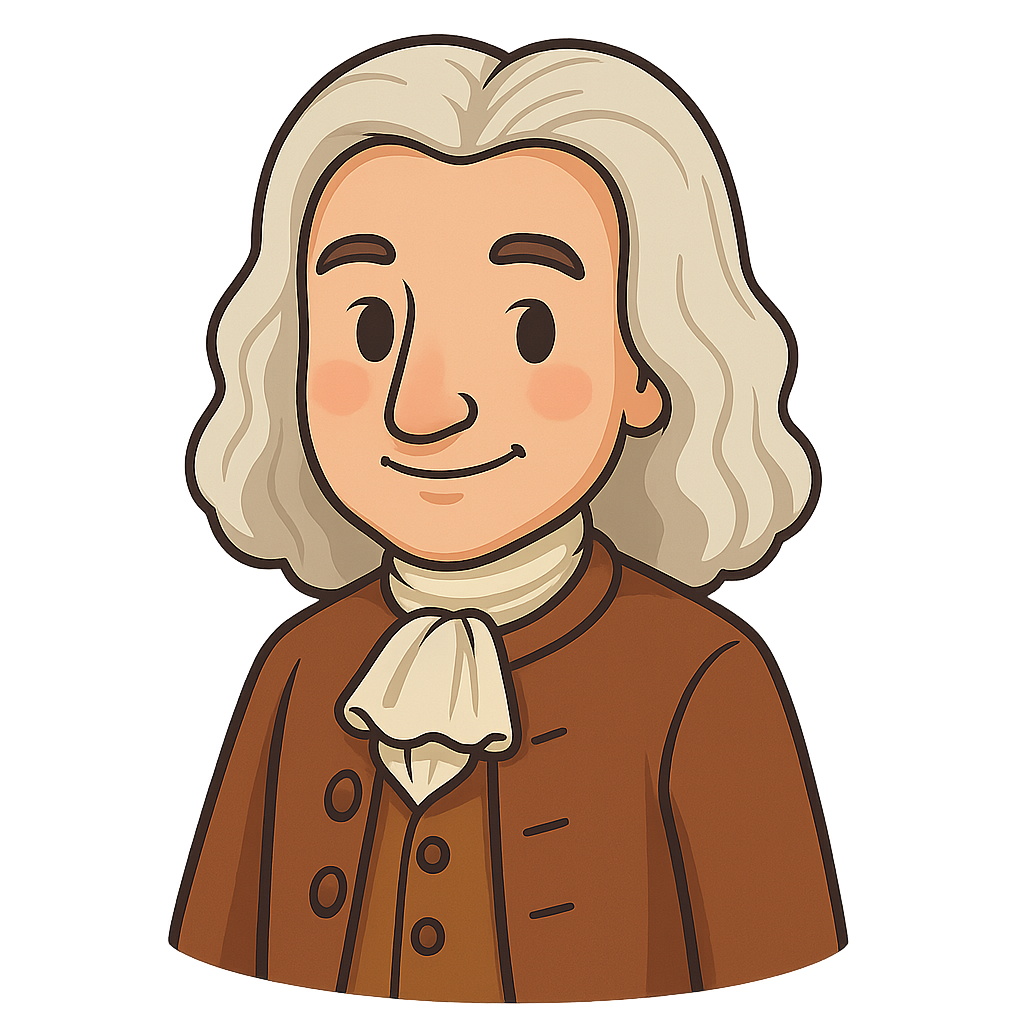
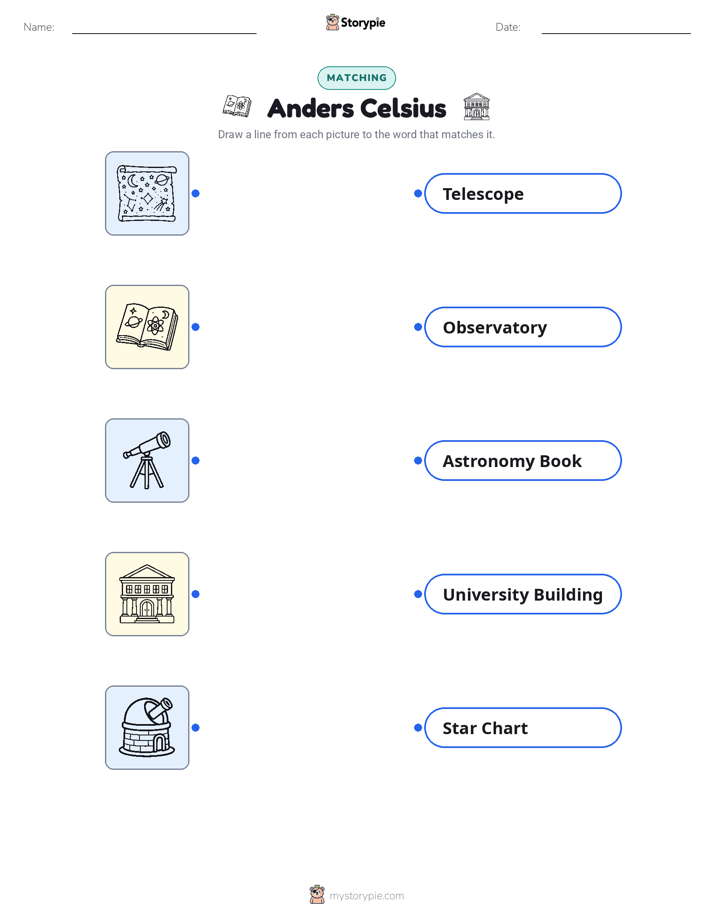
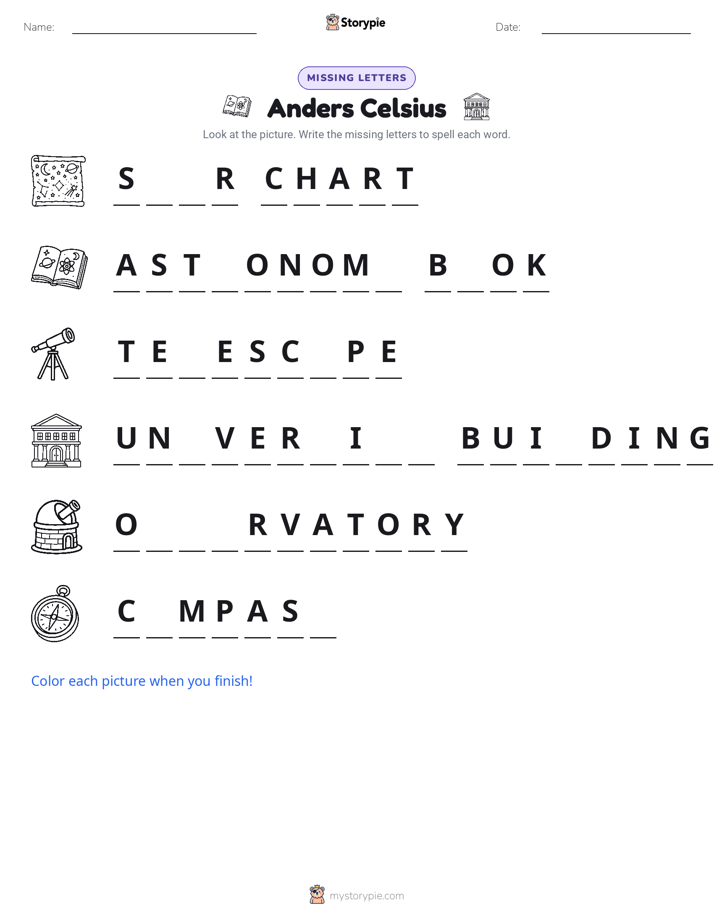
Hello, my name is Anders Celsius, and I am a scientist who found a new way to measure the world around us. I was born on November 27th, 1701, in the city of Uppsala, Sweden. You could say that science was in my blood. My father was a respected professor of astronomy, and my family tree was filled with brilliant minds. Both of my grandfathers were also professors; one was an expert in mathematics, and the other, like my father, was a professor of astronomy. Growing up, my home was filled with books, star charts, and constant scientific discussions. This environment made me incredibly curious about how the universe worked, and from a very young age, I knew I wanted to spend my life searching for answers among the stars and here on Earth.
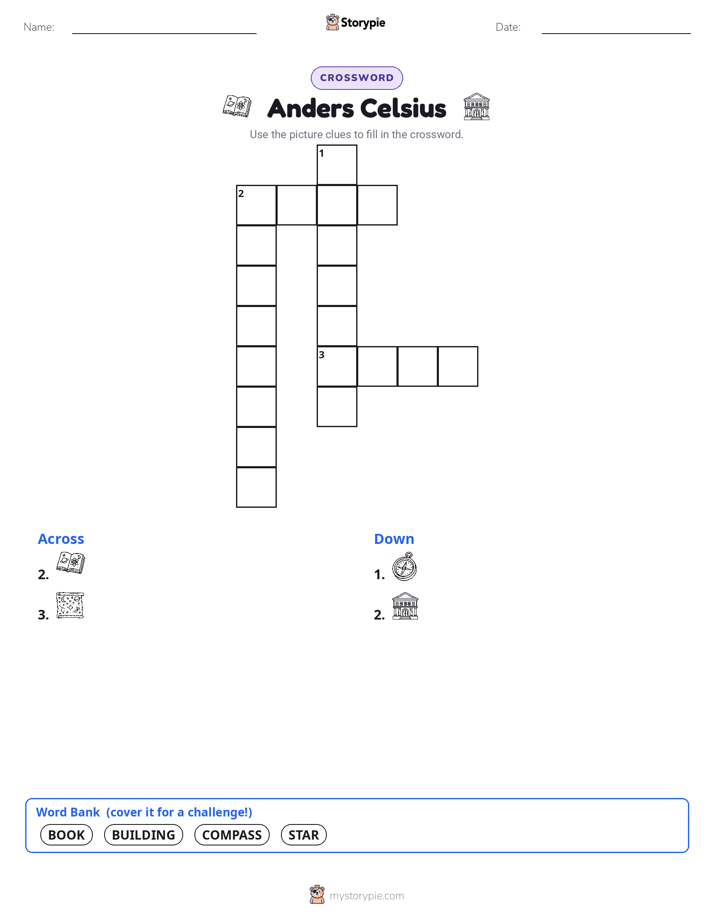
Following my family's tradition, I enrolled at Uppsala University, the very same institution where my father and grandfathers had taught. It was a place I knew well, and I dedicated myself to my studies. My hard work paid off when, in the year 1730, I was appointed a professor of astronomy at the university. It was a moment of great pride to follow in their footsteps. While astronomy was my main passion, my curiosity led me to explore other fields. I became fascinated with our own planet, particularly the Earth's magnetic field. I also spent a great deal of time observing the northern lights, a beautiful natural display also known as the aurora borealis. I carefully documented what I saw and eventually published a collection of over 300 of my observations of this amazing phenomenon.
Anders Celsius: Measuring the World
Hello, my name is Anders Celsius, and I am a scientist who found a new way to measure the world around us. I was born on November 27th, 1701, in the city of Uppsala, Sweden. You could say that science was in my blood. My father was a respected professor of astronomy, and my family tree was filled with brilliant minds. Both of my grandfathers were also professors; one was an expert in mathematics, and the other, like my father, was a professor of astronomy. Growing up, my home was filled with books, star charts, and constant scientific discussions. This environment made me incredibly curious about how the universe worked, and from a very young age, I knew I wanted to spend my life searching for answers among the stars and here on Earth.
Following my family's tradition, I enrolled at Uppsala University, the very same institution where my father and grandfathers had taught. It was a place I knew well, and I dedicated myself to my studies. My hard work paid off when, in the year 1730, I was appointed a professor of astronomy at the university. It was a moment of great pride to follow in their footsteps. While astronomy was my main passion, my curiosity led me to explore other fields. I became fascinated with our own planet, particularly the Earth's magnetic field. I also spent a great deal of time observing the northern lights, a beautiful natural display also known as the aurora borealis. I carefully documented what I saw and eventually published a collection of over 300 of my observations of this amazing phenomenon.
My desire to learn more about the world couldn't be contained within Sweden. Between the years 1732 and 1736, I embarked on what was called a 'grand tour' of Europe. I traveled to the most important observatories in Germany, Italy, and France, meeting with other great scientists and learning from their work. This journey led to the greatest adventure of my life. In 1736, I was invited to join a scientific expedition to Lapland, the coldest, northernmost region of Sweden. The expedition was led by a French scientist named Pierre Louis Maupertuis. Our important mission was to conduct measurements that would help prove a theory by the famous Sir Isaac Newton. He believed that the Earth was not a perfect sphere, but was actually slightly flattened at the North and South Poles. The work was incredibly challenging, as we had to make precise measurements in the freezing cold, but the thought of contributing to such an important discovery kept us going.
I returned to Uppsala full of new knowledge and ideas. I was determined to create a world-class center for astronomy in my home city. I worked hard to convince the university to fund a brand-new, modern observatory, and I was thrilled when it finally opened in 1741. This new facility allowed me to conduct much more advanced experiments in astronomy and meteorology. However, I quickly realized that the thermometers we used were not reliable. Different instruments gave different readings for the same temperature, which made precise scientific work impossible. I knew I needed a better system. So, in 1742, I proposed a new temperature scale. My idea was to base it on two fixed points that are constant everywhere on Earth: the freezing point and the boiling point of water. In my original scale, I set 100 degrees as the point where water freezes and 0 degrees as the point where it boils.
My life was one of constant scientific exploration, but my time was cut short when I became ill with tuberculosis. I lived to be 42 years old. After I was gone, other scientists, including my fellow Swede Carl Linnaeus, recognized the genius of my temperature scale. They found it very useful but decided it would be more logical to flip the numbers. They changed the scale so that 0 degrees represented the freezing point of water and 100 degrees represented the boiling point. This is the version of the scale that became famous. Today, the temperature scale that carries my name is used by billions of people all over the world. Every time someone checks the weather, follows a recipe, or conducts a scientific experiment, my passion for precise and reliable measurement lives on.
Wow facts
About
Anders Celsius was a Swedish astronomer, physicist, and mathematician who founded the Uppsala Astronomical Observatory and is most famous for proposing a temperature scale in 1742 with 0° for the boiling point of water and 100° for the freezing point.
Take a Quiz
Question 1 of 5
What was the main purpose of the 1736 expedition to Lapland that Anders Celsius joined?
Explore next




Want to do even more?
Go beyond exploring. Unlock tools that turn every story into real learning.

Storypie Plus for families
Full stories, quizzes, and printables. Nights and car rides, sorted.
- Unlimited audio stories
- Create Mode: your child stars in the story
- Offline downloads
- Printable worksheets & coloring pages

Why Storypie for Schools
Students engaged. Prep in seconds. Evenings back to you.
- Worksheets & Quizzes
- Classroom Management
- Formative Assessment
- Custom Curriculum & Lesson Plans
- 27 Languages

Why Storypie for Homeschool
Curriculum done. They'll ask for more. Hours back in your day.
- Worksheet Generator
- First-Person Audio Stories
- Built-in Comprehension Quizzes
- Custom Curriculum & Lesson Plans
- Print & Go Activities