English

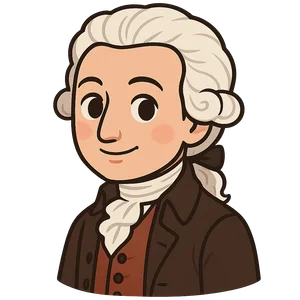
Antoine Lavoisier
Antoine Lavoisier was a French chemist who is considered the "Father of Modern Chemistry." He named oxygen…
Reads at Grades 6–8 Listens at Grades 4–8
Antoine Lavoisier: The Father of Modern Chemistry
Hello, my name is Antoine-Laurent Lavoisier, and I want to share the story of my life and my love for science. I was born in Paris, France, on August 26th, 1743, into a wealthy family that believed deeply in the power of education. The world around me was buzzing with new ideas, and I was encouraged to learn as much as I could. From 1754 to 1761, I attended the Collège Mazarin, a famous school where my fascination with the natural world truly began. I was captivated by chemistry, astronomy, and botany. However, to please my family, I went on to study law. Even as I pursued my legal studies, my mind was always drawn back to science. In my spare time, I would set up a laboratory and conduct experiments, driven by an endless curiosity to understand how things worked.
After my studies, I began a career in public service. In the late 1760s, I worked on a geological survey of France, which allowed me to travel and observe the land. Then, in 1768, I took a position with the Ferme générale, a company that collected taxes for the king. This work provided me with the financial means to build a state-of-the-art laboratory. It was during this time that I met the brilliant Marie-Anne Pierrette Paulze. We were married on December 16th, 1771, and she became not just my wife, but my most important scientific partner. Marie-Anne was gifted in languages and art. She was absolutely crucial to our work, translating important scientific papers from English, drawing precise illustrations of our experiments, and keeping the detailed laboratory notebooks that were essential for our discoveries. We were a team in every sense of the word.
In the 1770s, the scientific world believed in an idea called 'phlogiston.' It was thought to be a fire-like substance that was released when things burned. I was not convinced this was true. To test it, I began a series of very careful experiments. I used extremely precise scales to weigh objects before and after burning them inside sealed glass jars. I discovered that instead of losing weight, burning materials actually gained weight. This could only mean they were combining with something from the air. In 1777, after many experiments, I identified this part of the air as a unique element, and I named it 'oxygen.' My work didn't stop there. In 1783, I conducted another famous experiment that demonstrated water was not an element itself, as everyone had believed for centuries. Instead, I showed it was a compound made of two gases: oxygen and another gas I named 'hydrogen.'
My discoveries led to my most famous contribution to science: the Law of Conservation of Mass. I explained it with a simple but powerful statement: 'Nothing is lost, nothing is created, everything is transformed.' This meant that in any chemical reaction, the total weight of the substances at the start is always equal to the total weight of the substances at the end. To share these new ideas with the world, I published a book in 1789 called 'Traité Élémentaire de Chimie,' or 'Elementary Treatise on Chemistry.' It laid out a whole new, logical system for understanding chemistry and naming chemical substances. During this time, I also worked with a team of other scientists to help develop the metric system, creating a universal and logical way of measuring things that is still used around the world today.
The year my book was published, 1789, also marked the beginning of the French Revolution. It started with great hopes for liberty and justice, but it soon became a dangerous and chaotic time known as the Reign of Terror. Because I was born into a noble family and had worked for the Ferme générale as a tax collector, I became a target of suspicion. The new revolutionary leaders viewed my past work for the king with distrust. In November 1793, I was arrested along with my colleagues from the tax company, and my life of scientific discovery was suddenly brought to a halt.
My life came to an end on May 8th, 1794. I lived to be 50 years old. Although my life was cut short, the ideas I worked so hard to uncover did not disappear. The methods Marie-Anne and I used—insisting on careful measurement, logical reasoning, and repeatable experiments—became the foundation for modern chemistry. I am honored to be remembered as the 'father of modern chemistry,' and the chemical language we use today, like H₂O for water, is part of the system we helped build. My hope is that my story inspires others to always ask questions and to seek truth through careful observation.
Wow facts
About
Antoine Lavoisier was a French chemist who is considered the "Father of Modern Chemistry." He named oxygen and hydrogen, helped construct the metric system, and formulated the law of conservation of mass.
Take a Quiz
Question 1 of 5
Based on the story, what was Antoine Lavoisier's most significant contribution to science?
Explore next



Want to do even more?
Go beyond exploring. Unlock tools that turn every story into real learning.

Storypie Plus for families
Full stories, quizzes, and printables. Nights and car rides, sorted.
- Unlimited audio stories
- Create Mode: your child stars in the story
- Offline downloads
- Printable worksheets & coloring pages

Why Storypie for Schools
Students engaged. Prep in seconds. Evenings back to you.
- Worksheets & Quizzes
- Classroom Management
- Formative Assessment
- Custom Curriculum & Lesson Plans
- 27 Languages

Why Storypie for Homeschool
Curriculum done. They'll ask for more. Hours back in your day.
- Worksheet Generator
- First-Person Audio Stories
- Built-in Comprehension Quizzes
- Custom Curriculum & Lesson Plans
- Print & Go Activities