English


C. V. Raman
C.
Reads at Grades 6–8 Listens at Grades 4–8
Print & create
Answer keys·No prep·Free with an account
28 worksheets · answer keys · full story · quiz · Ages 10-12 · CEFR B2
Plus adds 244,000+ more stories in 27 languages, audio for every one, and printables for all of them.
Just want C. V. Raman?
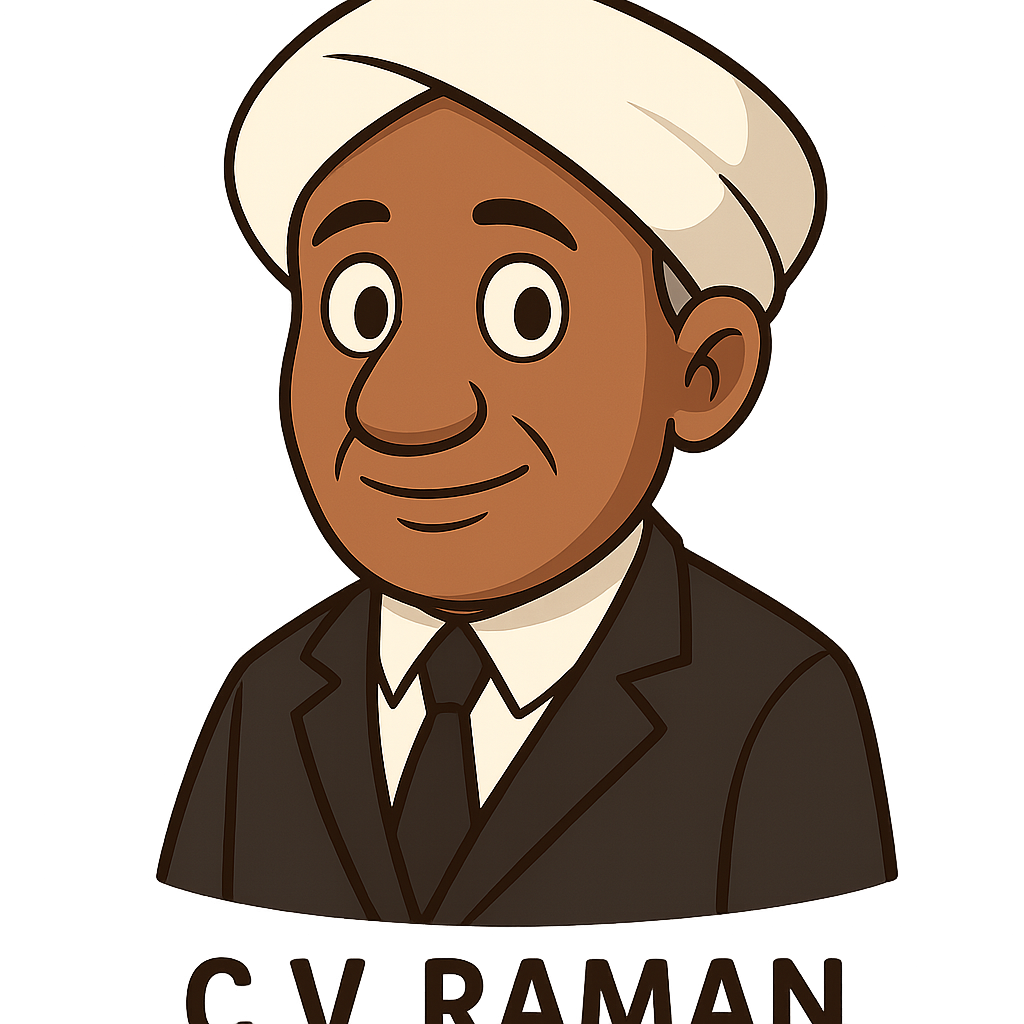
Hello! My name is Chandrasekhara Venkata Raman, but you can call me C. V. Raman. My story begins in a town called Tiruchirappalli in southern India, where I was born on November 7th, 1888. My father was a college professor of physics and mathematics, and our home was filled with books and scientific instruments that sparked my curiosity from a very young age. I was fascinated by everything, especially the science of sound and light. My desire to learn was so strong that I completed high school by the time I was only 11 years old. I entered Presidency College in Madras in 1902, eager to dive deeper into the world of science. I loved my studies and excelled, earning my bachelor's degree in 1904 and my master's degree in physics in 1907, winning the top awards in my class.
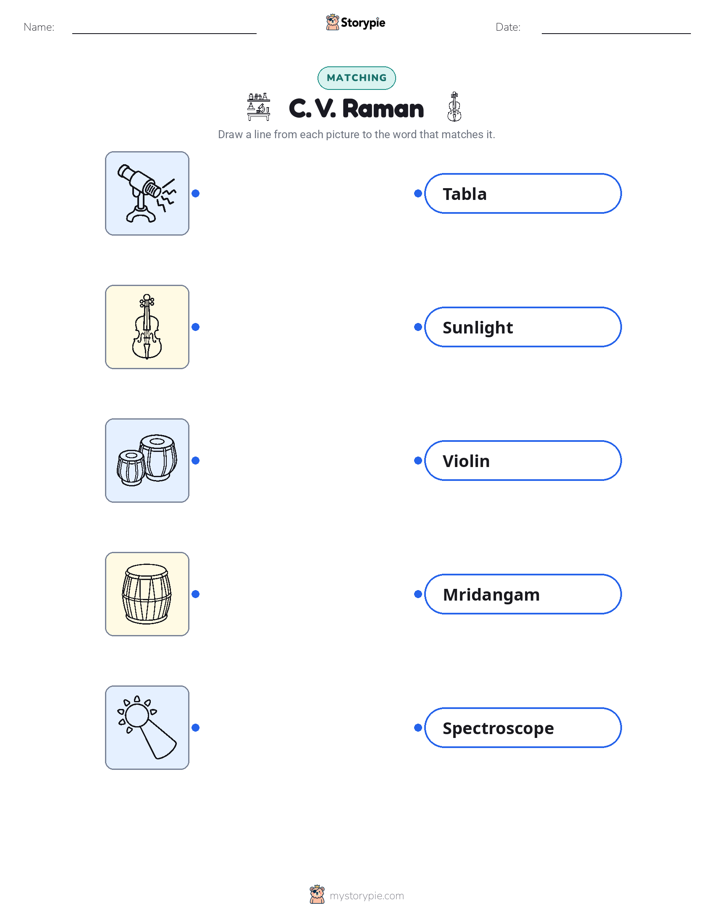
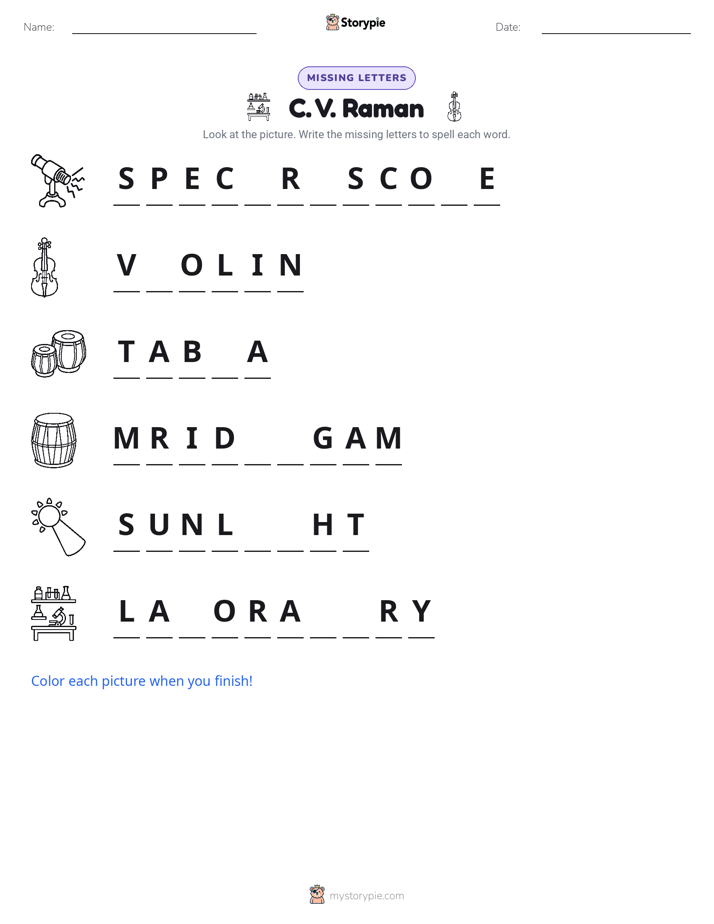
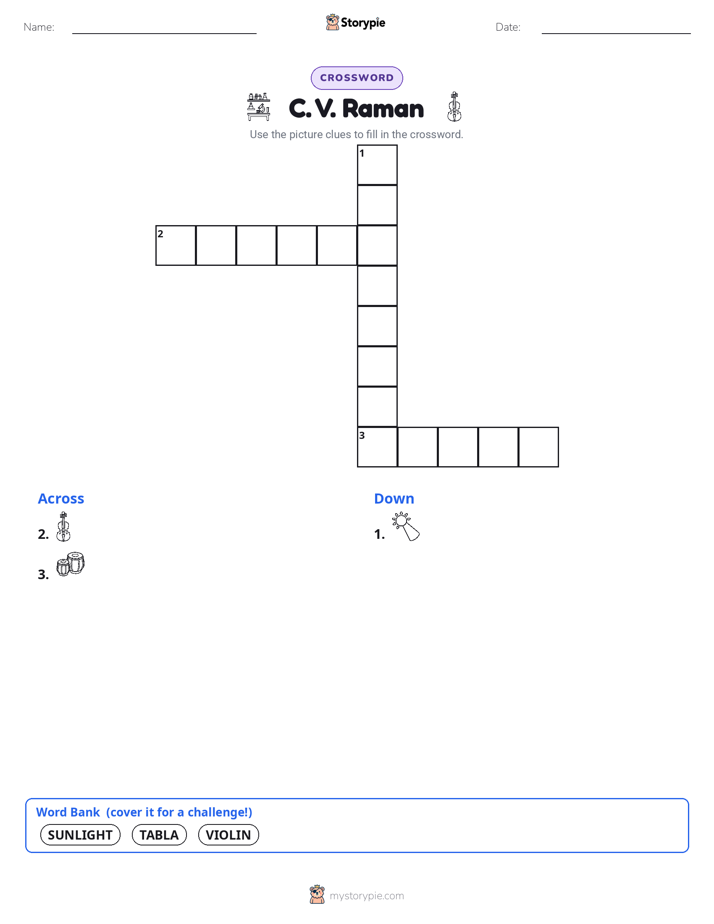
Even though I loved science more than anything, it was very difficult to become a professional scientist in India during that time. So, in 1907, I took a very difficult exam and began working for the government's finance department in Calcutta. It was a respectable job with good pay, but my heart wasn't in accounting; it was in the laboratory. I refused to let my dream fade. Every single day after finishing my office work, I would hurry to a place called the Indian Association for the Cultivation of Science. There, I would stay late into the night, conducting my own experiments and research. My early work focused on acoustics, the science of sound, and I studied how musical instruments like violins and traditional Indian drums like the tabla and mridangam created their beautiful and complex sounds.
C. V. Raman: A Life of Light
Hello! My name is Chandrasekhara Venkata Raman, but you can call me C. V. Raman. My story begins in a town called Tiruchirappalli in southern India, where I was born on November 7th, 1888. My father was a college professor of physics and mathematics, and our home was filled with books and scientific instruments that sparked my curiosity from a very young age. I was fascinated by everything, especially the science of sound and light. My desire to learn was so strong that I completed high school by the time I was only 11 years old. I entered Presidency College in Madras in 1902, eager to dive deeper into the world of science. I loved my studies and excelled, earning my bachelor's degree in 1904 and my master's degree in physics in 1907, winning the top awards in my class.
Even though I loved science more than anything, it was very difficult to become a professional scientist in India during that time. So, in 1907, I took a very difficult exam and began working for the government's finance department in Calcutta. It was a respectable job with good pay, but my heart wasn't in accounting; it was in the laboratory. I refused to let my dream fade. Every single day after finishing my office work, I would hurry to a place called the Indian Association for the Cultivation of Science. There, I would stay late into the night, conducting my own experiments and research. My early work focused on acoustics, the science of sound, and I studied how musical instruments like violins and traditional Indian drums like the tabla and mridangam created their beautiful and complex sounds.
After ten years of living a double life—a government officer by day and a secret scientist by night—I finally received the opportunity I had always dreamed of. In 1917, the University of Calcutta offered me a position as a full-time professor of physics. I happily left my high-paying government job to follow my true passion. My world expanded even more a few years later, in 1921, when I traveled to Europe for a scientific conference. On the long ship voyage home, I spent countless hours looking at the Mediterranean Sea. I was mesmerized by its brilliant blue color. The common explanation at the time, proposed by a scientist named Lord Rayleigh, was that the sea's color was simply a reflection of the blue sky. But I had a different idea. I believed the water molecules themselves were scattering the sunlight, creating that incredible blue hue. When I returned to India, I was determined to prove it.
Back in my laboratory in Calcutta, my students and I began a series of detailed experiments to understand how light behaves when it passes through different substances. My most brilliant student was K. S. Krishnan, and together we worked day and night, driven by our curiosity. We used a simple but clever method: we directed a beam of focused sunlight into various liquids and then used an instrument called a spectroscope to see what happened to the light that was scattered. For years, we searched for a tiny, almost imperceptible change in the light. Then, on February 28th, 1928, our persistence paid off. We saw it. We discovered that when light passes through a material, a tiny fraction of that light emerges with a different color, or wavelength. This meant the light particles, which we call photons, were exchanging energy with the molecules of the substance. This discovery was a new kind of light scattering, and it soon became known all over the world as the 'Raman Effect'.
Our discovery of the Raman Effect was a huge breakthrough in physics. It provided powerful new proof for the quantum theory of light and gave scientists a brand new way to study the internal structure of molecules without disturbing them. The world of science took notice of the important work we were doing in India. In 1930, I received the most incredible news of my life: I had been awarded the Nobel Prize in Physics for my discovery. This was a moment of immense pride, not just for me, but for my entire country. I was the very first person from Asia to win a Nobel Prize in any of the sciences. It proved to the world that great science could be done anywhere, by anyone with a curious mind and a dedicated spirit.
I spent the rest of my life dedicated to science and to building up scientific research in my home country of India. I helped establish the prestigious Indian Institute of Science in Bangalore and later founded my own institute, the Raman Research Institute, in 1948. I lived to be 82 years old, passing away on November 21st, 1970. Today, the Raman Effect is a vital tool used in thousands of laboratories around the world for everything from identifying unknown chemicals in forensics to detecting diseases in medicine. To honor my discovery, India celebrates National Science Day every year on February 28th, the day we first observed the effect. My hope is that it continues to inspire a new generation to look at the world with wonder, just as I did.
Wow facts
About
C. V. Raman was an Indian physicist known for his groundbreaking work on light scattering, which led to the discovery of the Raman Effect. He was the first Asian to win the Nobel Prize in Physics in 1930.
Take a Quiz
Question 1 of 5
What was the main problem C. V. Raman faced in his early career, and how did he solve it?
Explore next






Want to do even more?
Go beyond exploring. Unlock tools that turn every story into real learning.

Storypie Plus for families
Full stories, quizzes, and printables. Nights and car rides, sorted.
- Unlimited audio stories
- Create Mode: your child stars in the story
- Offline downloads
- Printable worksheets & coloring pages

Why Storypie for Schools
Students engaged. Prep in seconds. Evenings back to you.
- Worksheets & Quizzes
- Classroom Management
- Formative Assessment
- Custom Curriculum & Lesson Plans
- 27 Languages

Why Storypie for Homeschool
Curriculum done. They'll ask for more. Hours back in your day.
- Worksheet Generator
- First-Person Audio Stories
- Built-in Comprehension Quizzes
- Custom Curriculum & Lesson Plans
- Print & Go Activities