English

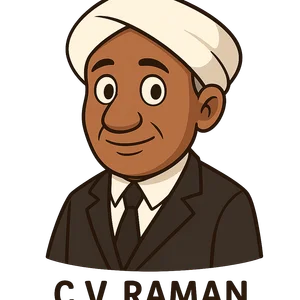
C. V. Raman
C.
Reads at Grades 3–5 Listens at Grades 1–5
Print & create
Answer keys·No prep·Free with an account
28 worksheets · answer keys · full story · quiz · Ages 8-10 · CEFR B1
Plus adds 244,000+ more stories in 27 languages, audio for every one, and printables for all of them.
Just want C. V. Raman?
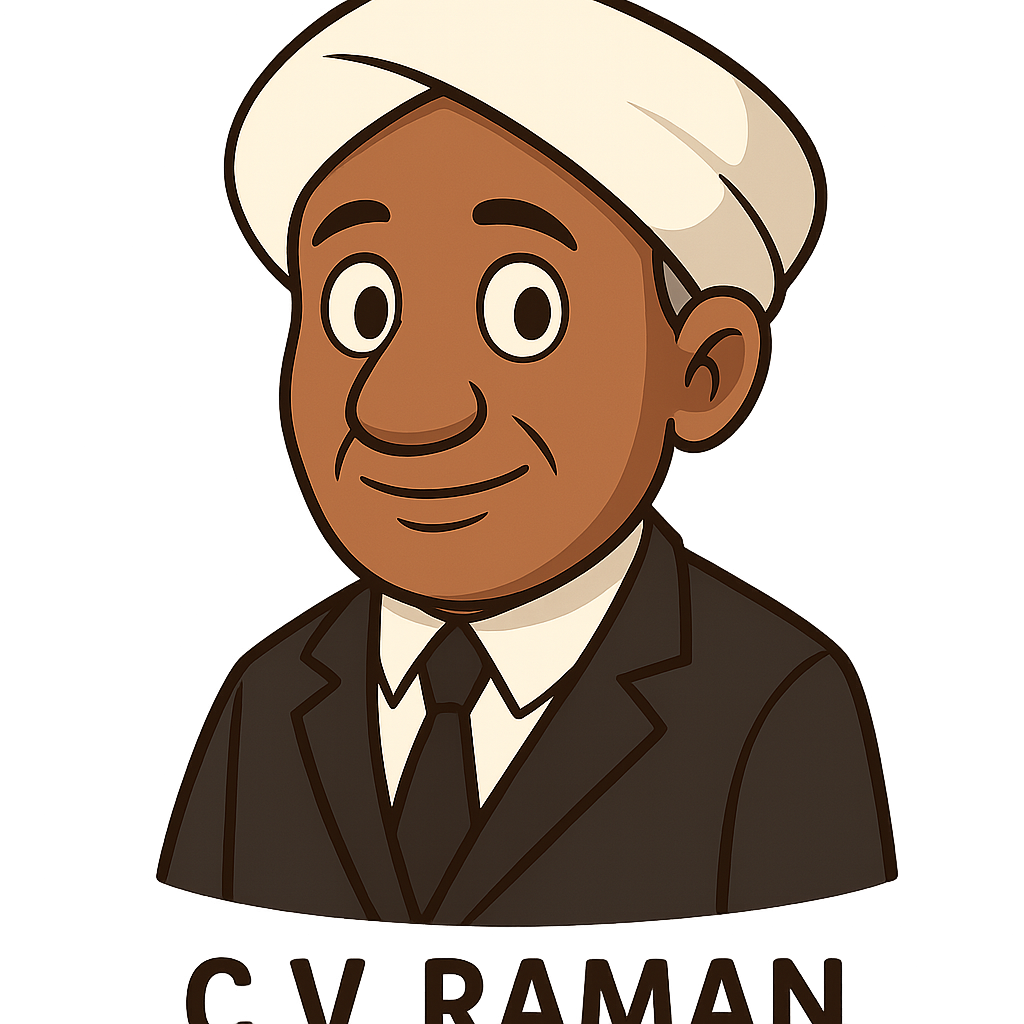
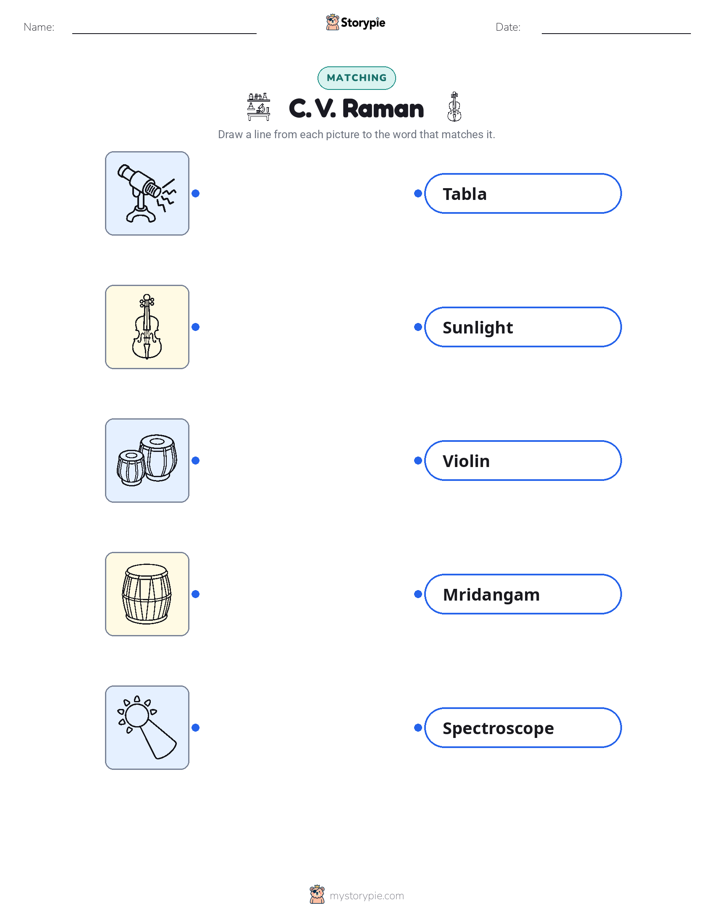
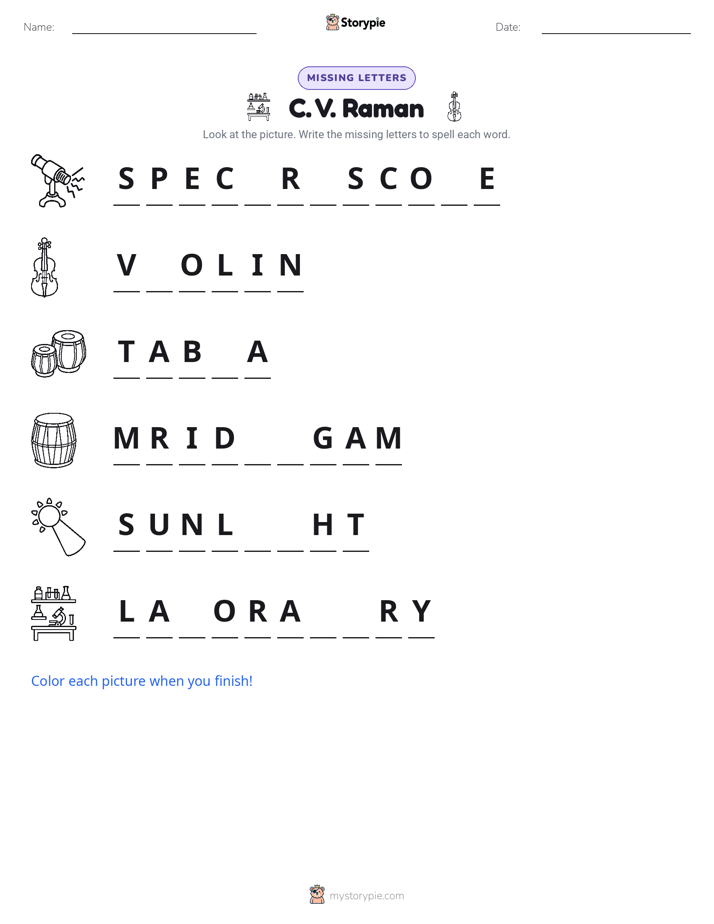
Hello, my name is Chandrasekhara Venkata Raman, but you can call me C. V. Raman. My story begins in a small town in India called Tiruchirappalli, where I was born on November 7th, 1888. My childhood home was a wonderful place, filled with learning and discovery. My father was a teacher of mathematics and physics, and he filled our house with books and scientific instruments. He sparked a great curiosity in me from a very young age. I loved learning about how the world worked, and I was also very fond of music, especially the sounds of violins and Indian drums. I was so eager to learn that I finished my studies very quickly. By 1907, when I was only nineteen years old, I had already earned my master's degree in physics. I couldn't wait to spend my life exploring the secrets of science.
Even though my heart belonged to science, I needed a way to support my family. So, in 1907, I took a job working for the government in the finance department. It was a good job that paid well, but it wasn't my true passion. I felt like I was living a double life. During the day, I worked with numbers and money. But at night, my real work began. I would go to a laboratory in Calcutta called the Indian Association for the Cultivation of Science, or IACS. There, I spent all my free time, often late into the night, doing experiments with light and sound. For ten years, I kept up this busy schedule. Finally, in 1917, I made a big decision. I decided to leave my comfortable government job to become a full-time professor of physics at the University of Calcutta. It was a risk, but I knew I had to follow my dream of being a scientist.
C. V. Raman: The Man Who Questioned the Blue Sea
Hello, my name is Chandrasekhara Venkata Raman, but you can call me C. V. Raman. My story begins in a small town in India called Tiruchirappalli, where I was born on November 7th, 1888. My childhood home was a wonderful place, filled with learning and discovery. My father was a teacher of mathematics and physics, and he filled our house with books and scientific instruments. He sparked a great curiosity in me from a very young age. I loved learning about how the world worked, and I was also very fond of music, especially the sounds of violins and Indian drums. I was so eager to learn that I finished my studies very quickly. By 1907, when I was only nineteen years old, I had already earned my master's degree in physics. I couldn't wait to spend my life exploring the secrets of science.
Even though my heart belonged to science, I needed a way to support my family. So, in 1907, I took a job working for the government in the finance department. It was a good job that paid well, but it wasn't my true passion. I felt like I was living a double life. During the day, I worked with numbers and money. But at night, my real work began. I would go to a laboratory in Calcutta called the Indian Association for the Cultivation of Science, or IACS. There, I spent all my free time, often late into the night, doing experiments with light and sound. For ten years, I kept up this busy schedule. Finally, in 1917, I made a big decision. I decided to leave my comfortable government job to become a full-time professor of physics at the University of Calcutta. It was a risk, but I knew I had to follow my dream of being a scientist.
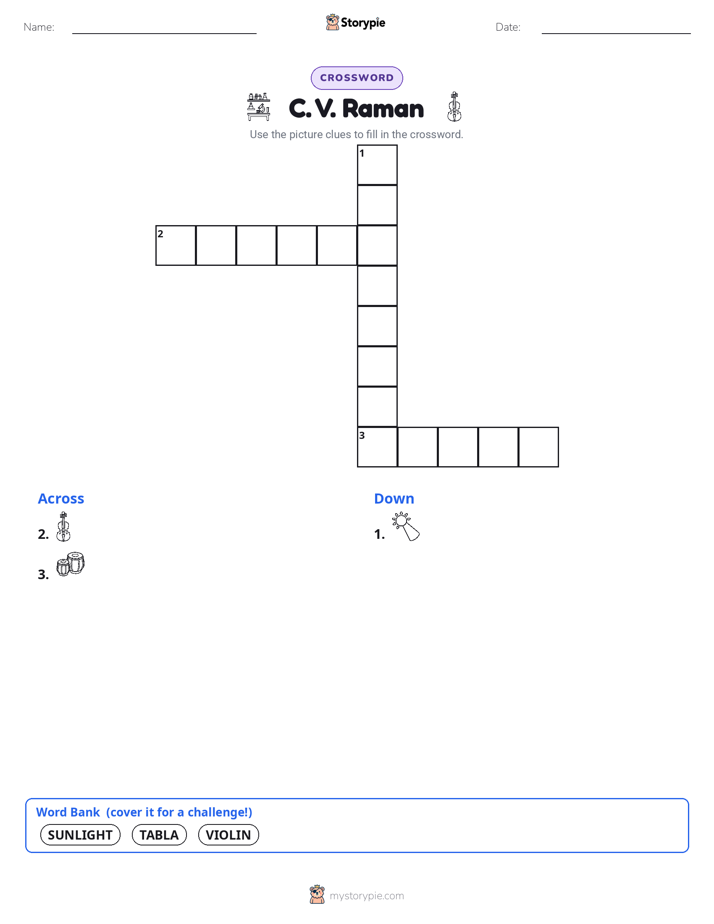
One of the most important moments in my life started with a simple question. In 1921, I was traveling on a ship across the beautiful, deep blue Mediterranean Sea. Everyone believed the sea was blue because it reflected the color of the sky. But I wasn't so sure. I had a hypothesis, which is a scientific guess, that the water molecules themselves were scattering the sunlight, giving the sea its brilliant color. When I returned to India, my students and I began working hard to test this idea. We spent years in the laboratory, shining beams of light through different liquids. Then, on February 28th, 1928, we saw something amazing. We discovered that when light passed through a liquid, a small part of it changed color. This proved that the light was interacting with the molecules of the liquid. This discovery was a breakthrough and became known all over the world as the 'Raman Effect'.
My discovery of the Raman Effect caused a great deal of excitement in the science community. Scientists from all over the world were thrilled by this new way to understand molecules. In 1930, I was awarded the Nobel Prize in Physics for my work. It was an incredibly proud moment for me. I was the first person from India, and even the first from all of Asia, to win a Nobel Prize in any science. This honor was not just for me; it was for my country. I had a deep desire to see India become a world leader in scientific research. To help make that happen, I founded the Raman Research Institute in Bangalore in 1948, creating a place where future generations of Indian scientists could make their own amazing discoveries.
I lived a long and full life dedicated to science and teaching, and I was 82 years old when my journey ended. The discovery I made so long ago, the Raman Effect, is still incredibly important today. Scientists use it in many different fields. It helps doctors understand diseases, allows art experts to study old paintings without damaging them, and even helps space probes analyze rocks on other planets. My story shows that it is important to always be curious and to ask questions about the world around you. Even a simple question, like 'Why is the sea blue?', can lead to an incredible adventure of discovery.
Wow facts
About
C. V. Raman was an Indian physicist known for his groundbreaking work on light scattering, which led to the discovery of the Raman Effect. He was the first Asian to win the Nobel Prize in Physics in 1930.
Take a Quiz
Question 1 of 5
In the story, what does the phrase 'double life' mean?
Explore next






Want to do even more?
Go beyond exploring. Unlock tools that turn every story into real learning.

Storypie Plus for families
Full stories, quizzes, and printables. Nights and car rides, sorted.
- Unlimited audio stories
- Create Mode: your child stars in the story
- Offline downloads
- Printable worksheets & coloring pages

Why Storypie for Schools
Students engaged. Prep in seconds. Evenings back to you.
- Worksheets & Quizzes
- Classroom Management
- Formative Assessment
- Custom Curriculum & Lesson Plans
- 27 Languages

Why Storypie for Homeschool
Curriculum done. They'll ask for more. Hours back in your day.
- Worksheet Generator
- First-Person Audio Stories
- Built-in Comprehension Quizzes
- Custom Curriculum & Lesson Plans
- Print & Go Activities