English


Edgar Degas
Edgar Degas was a French artist associated with the Impressionist movement…
Reads at Grades 6–8 Listens at Grades 4–8
Print & create
Answer keys·No prep·Free with an account
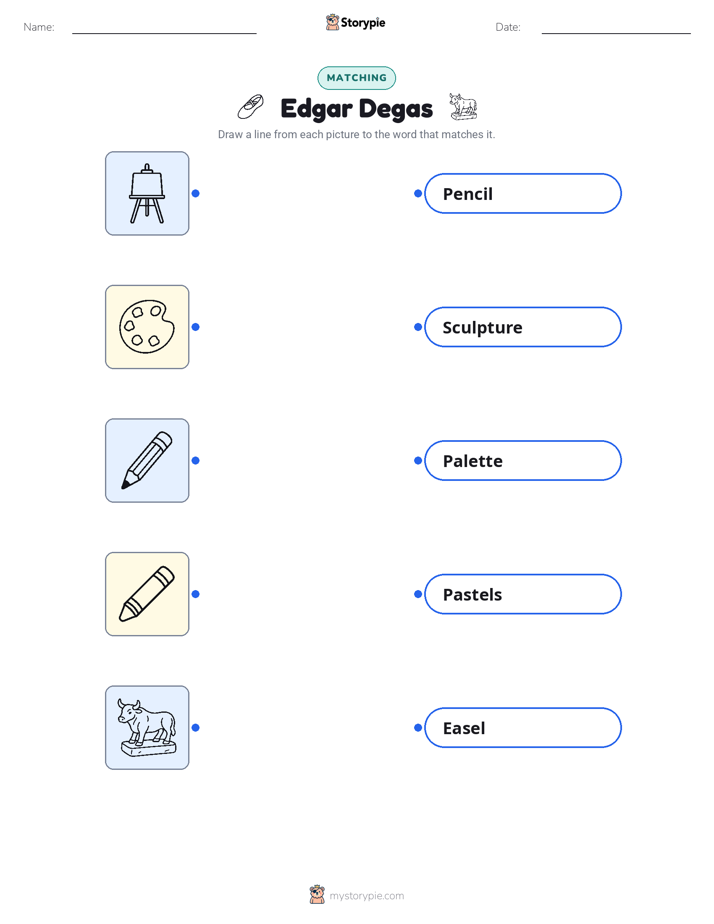
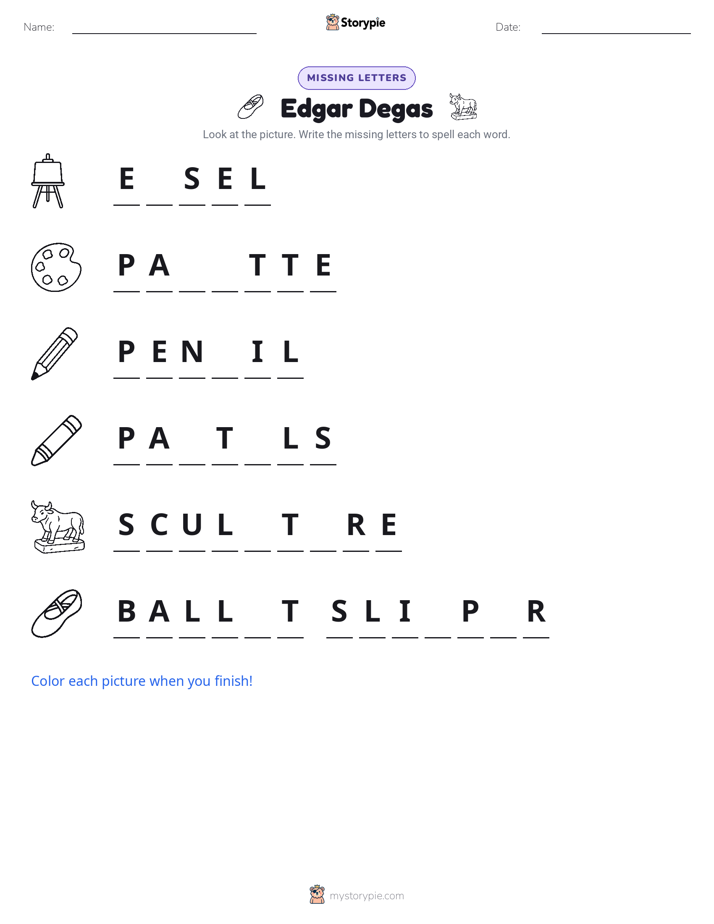
28 worksheets · answer keys · full story · quiz · Ages 10-12 · CEFR B2
Plus adds 164,000+ more stories in 27 languages, audio for every one, and printables for all of them.
Just want Edgar Degas?

Hello! My name is Edgar Degas, though I was born Hilaire-Germain-Edgar De Gas on July 19th, 1834. I grew up in Paris, France, a city buzzing with art and culture that felt like the center of the world. My father was a banker, and my mother had a deep love for opera, which meant our home was always filled with music and an appreciation for beautiful things. From a very young age, I found that I loved to draw more than anything else. I would spend countless hours in my room, sketching everything I saw with intense focus. My father had ambitions for me to become a lawyer and follow a more traditional path, but he also recognized my undeniable passion for art. He kindly allowed me to turn one of the rooms in our home into my very first studio, a space where my artistic journey could truly begin.
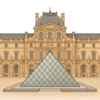
To please my family, I enrolled in law school in 1853, but my heart was never in it. The rigid world of legal texts couldn't compare to the freedom I felt with a pencil in my hand. After a short time, I knew I had to follow my true calling and become an artist. My real education began when I spent my days at the famous Louvre Museum, carefully copying the paintings of the great masters to learn their techniques. In 1855, I achieved a major goal when I was accepted into the most important art school in France, the École des Beaux-Arts. A year later, in 1856, I embarked on a long trip to Italy that would forever change my perspective. For three years, I traveled through cities rich with history, like Rome, Naples, and Florence, studying the incredible art of the Renaissance. While I learned so much about drawing and composition, I also had a powerful realization: I wanted to paint the world around me, not just grand stories from the distant past.
Edgar Degas
Hello! My name is Edgar Degas, though I was born Hilaire-Germain-Edgar De Gas on July 19th, 1834. I grew up in Paris, France, a city buzzing with art and culture that felt like the center of the world. My father was a banker, and my mother had a deep love for opera, which meant our home was always filled with music and an appreciation for beautiful things. From a very young age, I found that I loved to draw more than anything else. I would spend countless hours in my room, sketching everything I saw with intense focus. My father had ambitions for me to become a lawyer and follow a more traditional path, but he also recognized my undeniable passion for art. He kindly allowed me to turn one of the rooms in our home into my very first studio, a space where my artistic journey could truly begin.
To please my family, I enrolled in law school in 1853, but my heart was never in it. The rigid world of legal texts couldn't compare to the freedom I felt with a pencil in my hand. After a short time, I knew I had to follow my true calling and become an artist. My real education began when I spent my days at the famous Louvre Museum, carefully copying the paintings of the great masters to learn their techniques. In 1855, I achieved a major goal when I was accepted into the most important art school in France, the École des Beaux-Arts. A year later, in 1856, I embarked on a long trip to Italy that would forever change my perspective. For three years, I traveled through cities rich with history, like Rome, Naples, and Florence, studying the incredible art of the Renaissance. While I learned so much about drawing and composition, I also had a powerful realization: I wanted to paint the world around me, not just grand stories from the distant past.
When I returned to Paris in 1859, I began to see my own city with fresh eyes. I started to look for my subjects in the vibrant scenes of modern life. I was completely fascinated by the energy of the city—the bustling cafés where people gathered, the thrill of the horse races with their powerful animals and jockeys, and the gas-lit stages of the theaters and opera houses. My goal was to paint people as they really were, captured in unguarded, private moments, almost as a photograph could freeze an instant in time. Instead of creating posed, perfect portraits that were common at the time, I chose to paint people yawning, stretching, or completely lost in their own thoughts. This was a very different and radical way of painting, and not everyone understood or appreciated it. But I was determined to show the truth and unconventional beauty that I saw in those ordinary, everyday moments.
Back in Paris, I became friends with a group of forward-thinking artists, including Édouard Manet and Claude Monet, who also felt constrained by the old, strict rules of art. We shared a desire to break free from the official government-run art show, known as the Salon, which often rejected new and different styles. Together, we decided to organize our own independent art show. Our very first exhibition took place in 1874, and it was after this show that critics gave our group a name: the Impressionists. Although I helped organize eight of these exhibitions and showed my work alongside my friends, I never truly liked the label. My friends, like Monet, loved painting outdoors to capture the fleeting effects of sunlight. I, however, preferred the controlled environment of my studio, where I could compose pictures from memory and the thousands of sketches I drew. I always thought of myself as a 'Realist' or an 'Independent' artist, focused on capturing the reality of modern life.
Of all the subjects I explored, I am most famous for my paintings and sculptures of ballet dancers. I spent countless hours at the Paris Opéra, not just watching the polished final performances, but also gaining access to sketch backstage during exhausting rehearsals and rigorous classes. I wasn't interested in the fantasy of the ballet; I wanted to show the reality behind it—the immense hard work, the strict discipline, and the sheer exhaustion of the young dancers. I painted them adjusting their shoes, stretching at the barre, and waiting nervously in the wings. I also loved painting horse races for a similar reason, as both subjects allowed me to study the complexities of bodies in motion. To capture these fleeting moments, I often used pastels, which were perfect for me because they let me draw and paint at the same time with brilliant, immediate color. In 1881, I took a bold step and exhibited a sculpture, 'The Little Fourteen-Year-Old Dancer,' which was made of colored wax and dressed in a real fabric tutu and ballet slippers. It looked so lifelike that it shocked the public and critics alike!
As I grew older, a great challenge entered my life. My eyesight, which was so crucial for my work, began to fail me, a process that started around the 1880s. This was incredibly difficult for a painter who relied on his eyes for every detail. It became harder and harder for me to work with the fine, precise brushstrokes required for oil painting. As a result, I began to work more and more with pastels, whose bold, bright sticks were easier for me to handle and see. I also turned more to sculpture, an art form where I could feel the shapes and forms with my hands, relying on my sense of touch. Though this condition caused me to become more private and I spent more time alone in my later years, I never stopped my work. For me, creating art was as essential as breathing—it was something I simply had to do to feel alive.
I lived a long and full life dedicated entirely to my art, and I lived to be 83 years old before passing away in my beloved Paris on September 27th, 1917. I was never very interested in fame or selling a lot of paintings during my lifetime; my true goal was simply to capture the world as I saw it, with all its constant movement and quiet, overlooked moments. Today, my paintings and sculptures are displayed in major museums all over the world. I hope that when people see my work, they feel as if they've been given a special peek into a moment in time, and that they discover the unique beauty and grace that can be found in the ordinary, everyday lives of people.
Wow facts
About
Edgar Degas was a French artist associated with the Impressionist movement, though he preferred to be called a realist. He was famous for his paintings, sculptures, and drawings, and he is especially identified with the subject of dance.
Take a Quiz
Question 1 of 5
In your own words, describe Edgar Degas's journey from studying law to becoming an independent artist.
Explore next





Want to do even more?
Go beyond exploring. Unlock tools that turn every story into real learning.

Storypie Plus for families
Full stories, quizzes, and printables. Nights and car rides, sorted.
- Unlimited audio stories
- Create Mode: your child stars in the story
- Offline downloads
- Printable worksheets & coloring pages

Why Storypie for Schools
Students engaged. Prep in seconds. Evenings back to you.
- Worksheets & Quizzes
- Classroom Management
- Formative Assessment
- Custom Curriculum & Lesson Plans
- 27 Languages

Why Storypie for Homeschool
Curriculum done. They'll ask for more. Hours back in your day.
- Worksheet Generator
- First-Person Audio Stories
- Built-in Comprehension Quizzes
- Custom Curriculum & Lesson Plans
- Print & Go Activities