English

Ernest Rutherford
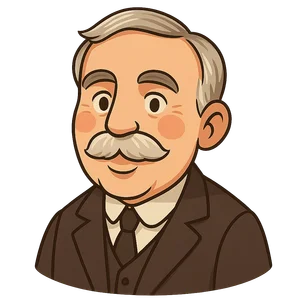
Ernest Rutherford was a New Zealand-born physicist who became known as the 'father of nuclear physics' for…
Reads at Grades 6–8 Listens at Grades 4–8
Print & create
Answer keys·No prep·Free with an account
28 worksheets · answer keys · full story · quiz · Ages 10-12 · CEFR B2
Plus adds 208,000+ more stories in 27 languages, audio for every one, and printables for all of them.
Just want Ernest Rutherford?
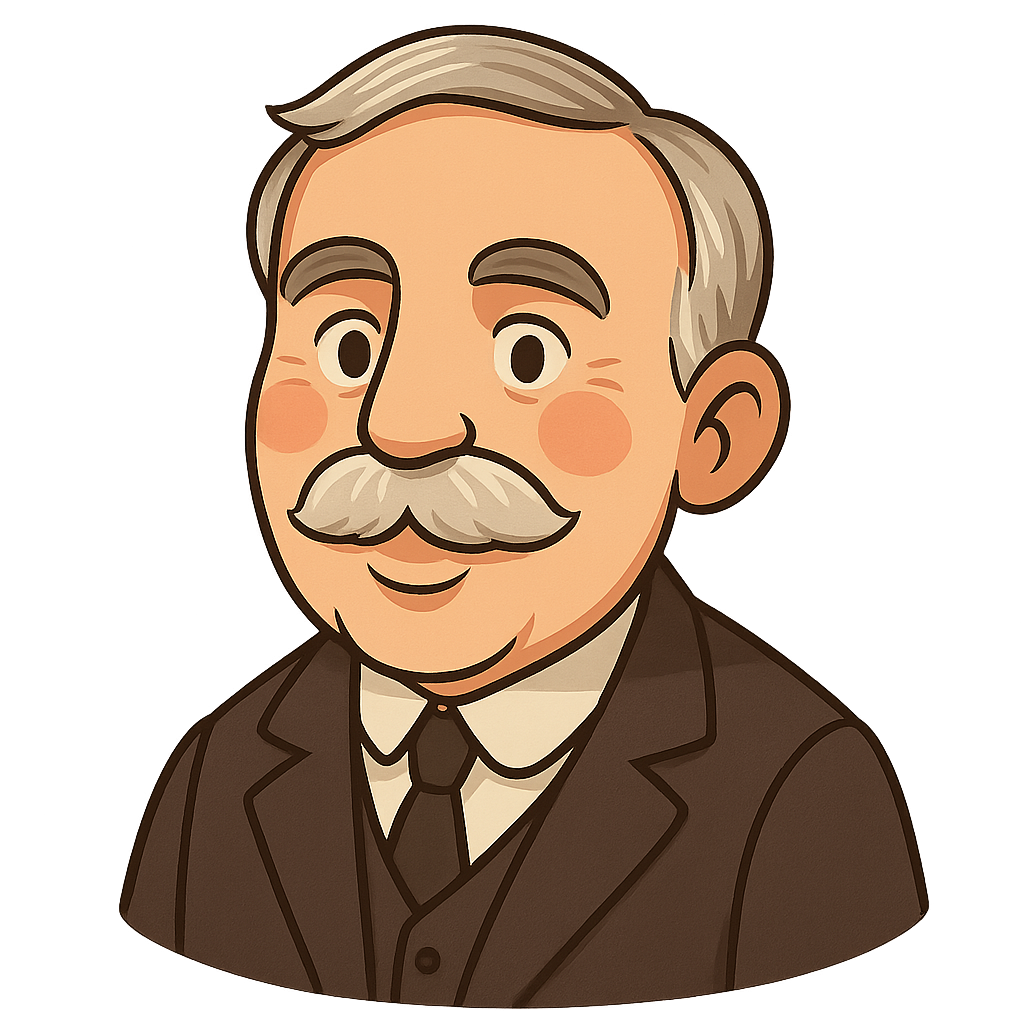
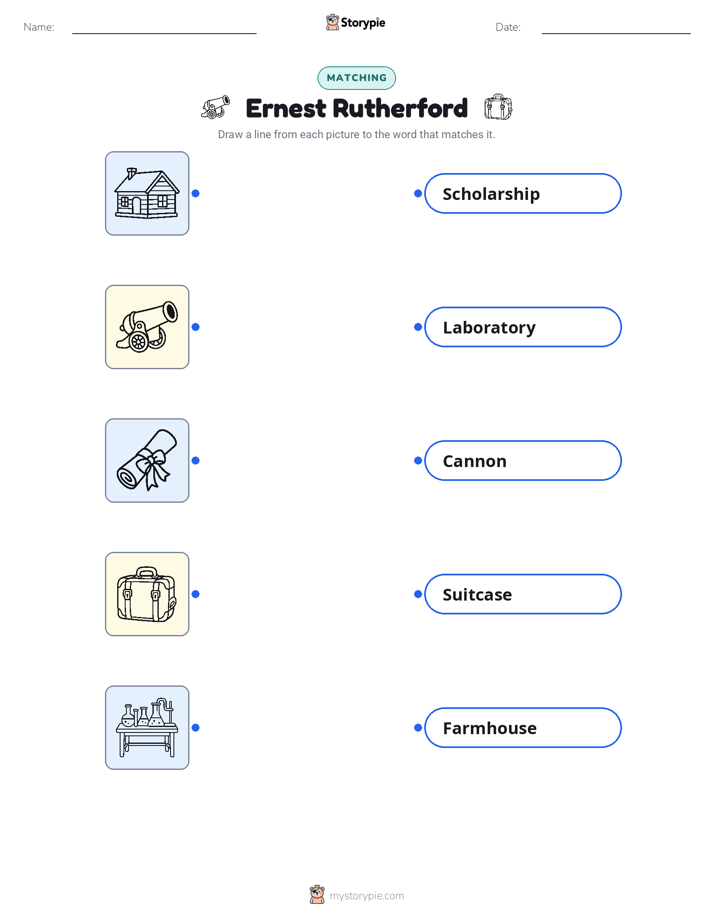
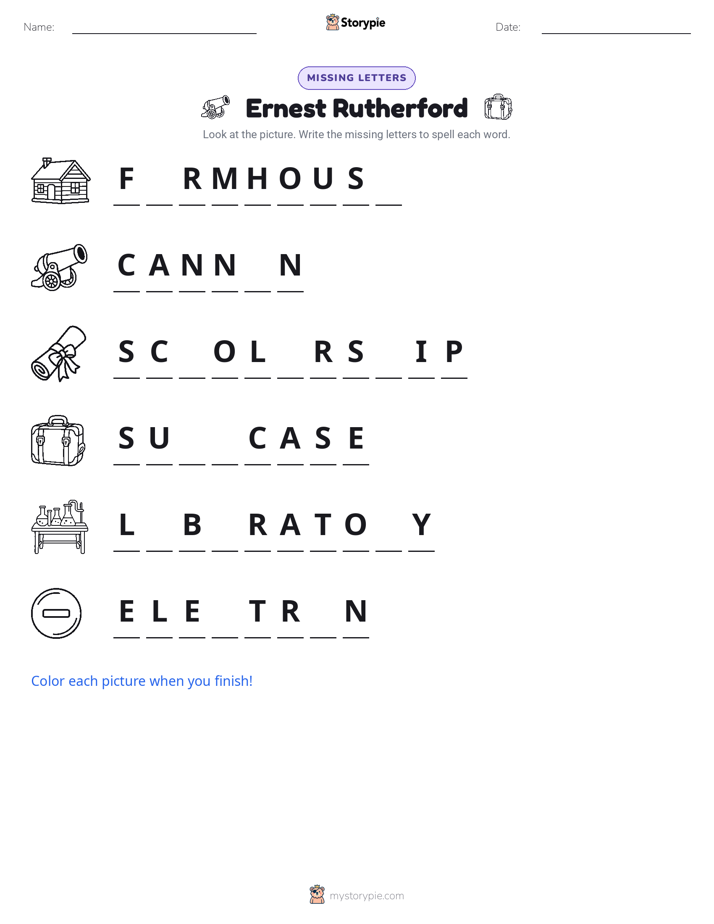
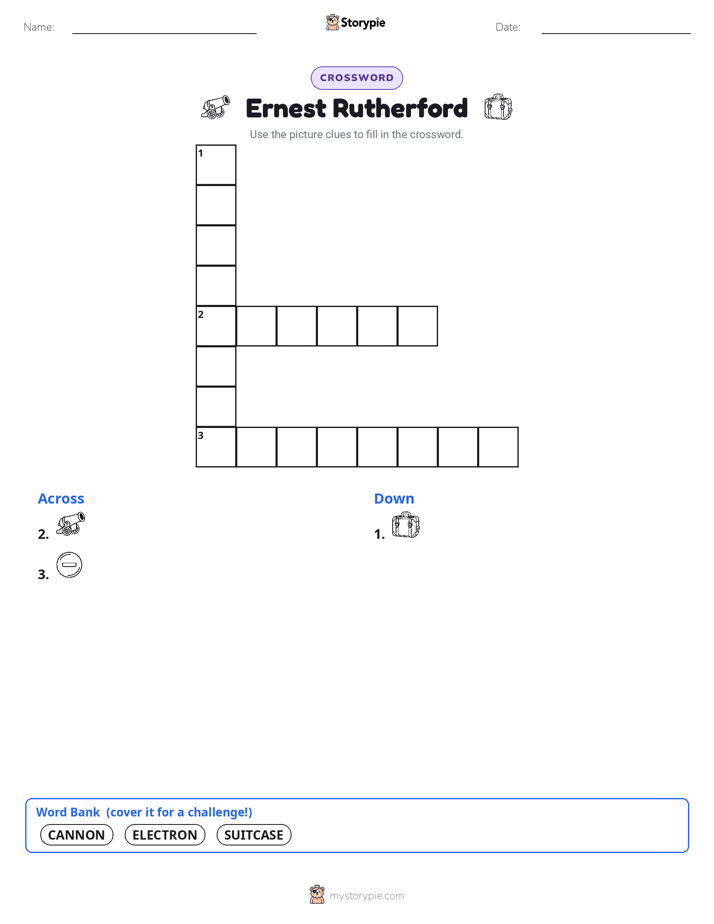
Hello! My name is Ernest Rutherford, and you might know me as the father of nuclear physics. My story begins not in a grand laboratory, but on a humble farm in Brightwater, New Zealand, where I was born on August 30th, 1871. As one of twelve children, life was busy, and we all had chores to do. But my mind was always buzzing with questions about how things worked. My parents consistently encouraged us to pursue a good education. I spent my free time building things and conducting small experiments. One time, I even tried to make a small cannon that, much to my surprise, exploded! It was that powerful curiosity and my constant need to ask 'why?' that launched my lifelong adventure into the unseen world of atoms.
My dedication to my studies eventually earned me a scholarship to Canterbury College. Later, a truly life-changing opportunity came in 1895 when I won the prestigious 1851 Exhibition Scholarship. This award was my ticket to the other side of the world. I packed my bags and journeyed all the way to England to study at the renowned Cavendish Laboratory at the University of Cambridge. My professor was the brilliant J.J. Thomson, a man who had just discovered the electron. The laboratory was buzzing with energy and new ideas; it was the most exciting place a young scientist could imagine being. I found myself surrounded by some of the greatest scientific minds of the era, and I was eager to make my own mark.
In 1898, I accepted a position as a professor at McGill University in Montreal, Canada. It was there that I became fascinated by a mysterious phenomenon that had recently been discovered: radioactivity. I dedicated myself to studying the strange rays emitted by elements like uranium. In 1899, I identified two different types of these rays, which I named 'alpha' and 'beta.' Working alongside my colleague Frederick Soddy, I made an even more astonishing discovery. We realized that radioactivity was the process of atoms of one element decaying and transforming into atoms of a completely different element. At the time, everyone believed atoms were indivisible and unchangeable, so this idea was revolutionary. For this groundbreaking work on the transmutation of elements, I was awarded the Nobel Prize in Chemistry in 1908. I must admit, I found it quite amusing, as I had always considered myself a physicist, not a chemist!
Ernest Rutherford: Journey into the Atom
Hello! My name is Ernest Rutherford, and you might know me as the father of nuclear physics. My story begins not in a grand laboratory, but on a humble farm in Brightwater, New Zealand, where I was born on August 30th, 1871. As one of twelve children, life was busy, and we all had chores to do. But my mind was always buzzing with questions about how things worked. My parents consistently encouraged us to pursue a good education. I spent my free time building things and conducting small experiments. One time, I even tried to make a small cannon that, much to my surprise, exploded! It was that powerful curiosity and my constant need to ask 'why?' that launched my lifelong adventure into the unseen world of atoms.
My dedication to my studies eventually earned me a scholarship to Canterbury College. Later, a truly life-changing opportunity came in 1895 when I won the prestigious 1851 Exhibition Scholarship. This award was my ticket to the other side of the world. I packed my bags and journeyed all the way to England to study at the renowned Cavendish Laboratory at the University of Cambridge. My professor was the brilliant J.J. Thomson, a man who had just discovered the electron. The laboratory was buzzing with energy and new ideas; it was the most exciting place a young scientist could imagine being. I found myself surrounded by some of the greatest scientific minds of the era, and I was eager to make my own mark.
In 1898, I accepted a position as a professor at McGill University in Montreal, Canada. It was there that I became fascinated by a mysterious phenomenon that had recently been discovered: radioactivity. I dedicated myself to studying the strange rays emitted by elements like uranium. In 1899, I identified two different types of these rays, which I named 'alpha' and 'beta.' Working alongside my colleague Frederick Soddy, I made an even more astonishing discovery. We realized that radioactivity was the process of atoms of one element decaying and transforming into atoms of a completely different element. At the time, everyone believed atoms were indivisible and unchangeable, so this idea was revolutionary. For this groundbreaking work on the transmutation of elements, I was awarded the Nobel Prize in Chemistry in 1908. I must admit, I found it quite amusing, as I had always considered myself a physicist, not a chemist!
I returned to England in 1907 to work at the University of Manchester, and it was here that my team and I conducted the experiment for which I am most famous. Our goal was to understand what was inside an atom. The popular theory at the time, proposed by my old mentor J.J. Thomson, was the 'plum pudding' model, which suggested that an atom was a sphere of positive charge with negative electrons embedded within it. To test this, around 1909, my assistants Hans Geiger and Ernest Marsden aimed a beam of tiny, fast-moving alpha particles at an incredibly thin sheet of gold foil. We expected the particles to pass straight through. While most of them did, a tiny fraction—about 1 in 8,000—bounced back dramatically. I later described my astonishment: 'It was almost as incredible as if you fired a 15-inch shell at a piece of tissue paper and it came back and hit you.' This shocking result led me to a radical conclusion. In 1911, I published my new model of the atom: it was mostly empty space, with a tiny, dense, positively-charged center which I called the nucleus.
My discovery of the nucleus opened up an entirely new field of science. In 1917, while the world was in the middle of the First World War, I made another critical breakthrough. I was conducting experiments firing alpha particles into nitrogen gas when I noticed that hydrogen nuclei were being knocked out of the nitrogen atoms. I had successfully transformed one element into another in a controlled, artificial way. I was the first person to split the atom. This achievement was a monumental step in understanding the power held within the nucleus. Two years later, in 1919, I was given the incredible honor of succeeding J.J. Thomson as the director of the Cavendish Laboratory, the very place where my journey into the heart of the atom had truly begun.
I lived a full and exciting life of discovery and lived to be 66 years old. My work completely changed how humanity sees the world. Before my discoveries, the atom was a complete mystery, but I revealed that it had a complex structure that could be explored and even altered. My ideas paved the way for countless modern technologies, from nuclear power to new medical treatments. I was also a dedicated teacher, and it was a great source of pride for me that many of my students went on to win Nobel Prizes of their own. I hope my story shows you that with relentless curiosity and determination, you can uncover the biggest secrets of the universe, even those hidden inside its tiniest particles.
Wow facts
About
Ernest Rutherford was a New Zealand-born physicist who became known as the 'father of nuclear physics' for his discovery of the atomic nucleus and for being the first person to split the atom.
Take a Quiz
Question 1 of 5
What was the most significant conclusion from Rutherford's gold foil experiment?
Explore next



Want to do even more?
Go beyond exploring. Unlock tools that turn every story into real learning.

Storypie Plus for families
Full stories, quizzes, and printables. Nights and car rides, sorted.
- Unlimited audio stories
- Create Mode: your child stars in the story
- Offline downloads
- Printable worksheets & coloring pages

Why Storypie for Schools
Students engaged. Prep in seconds. Evenings back to you.
- Worksheets & Quizzes
- Classroom Management
- Formative Assessment
- Custom Curriculum & Lesson Plans
- 27 Languages

Why Storypie for Homeschool
Curriculum done. They'll ask for more. Hours back in your day.
- Worksheet Generator
- First-Person Audio Stories
- Built-in Comprehension Quizzes
- Custom Curriculum & Lesson Plans
- Print & Go Activities