English


Fibonacci
An Italian mathematician from the Republic of Pisa…
Reads at Grades 6–8 Listens at Grades 4–8
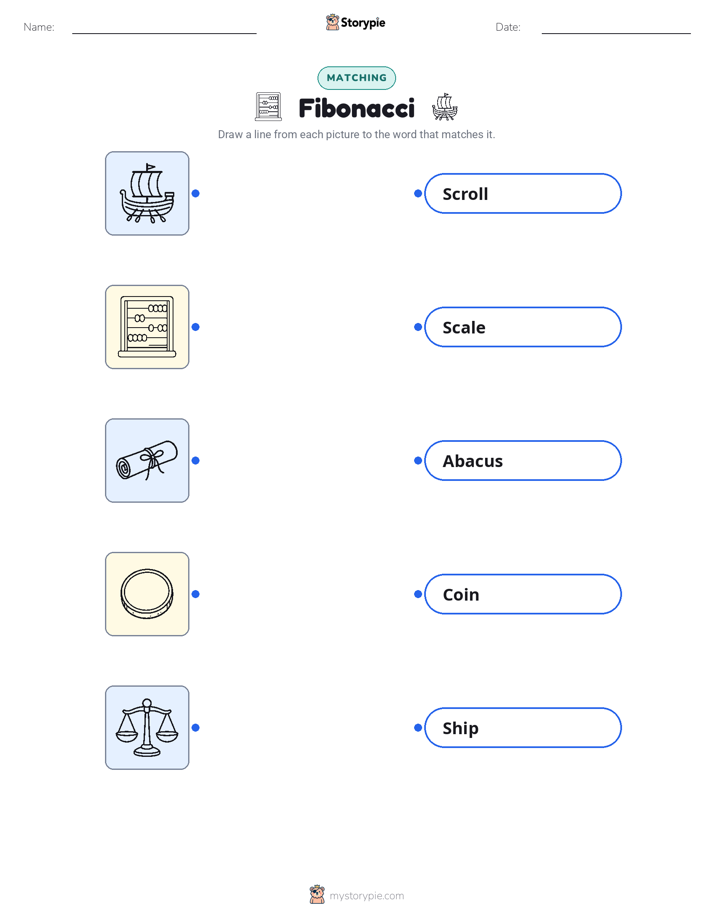
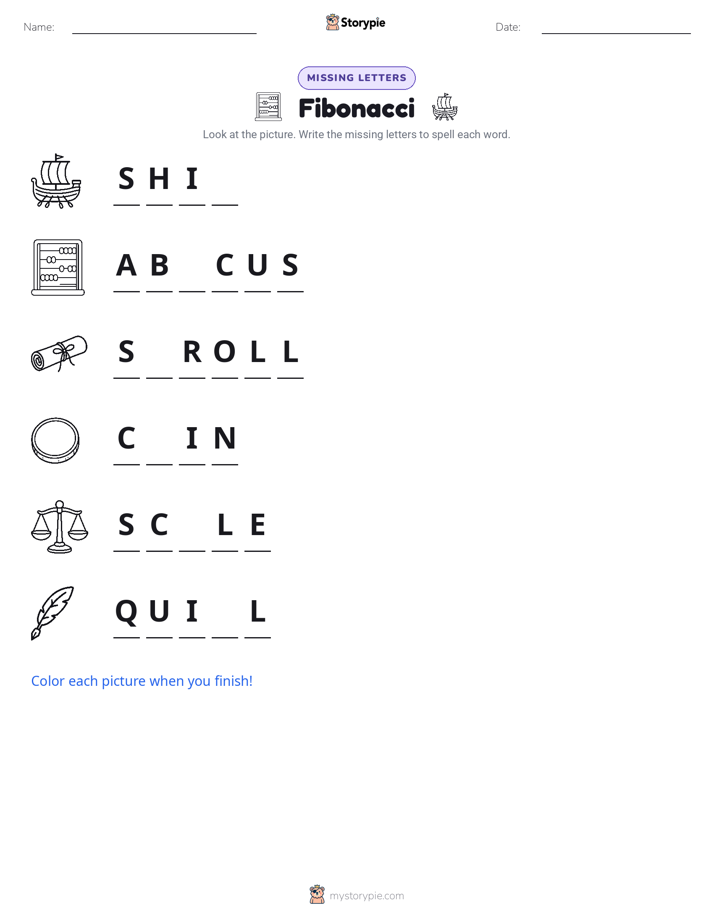
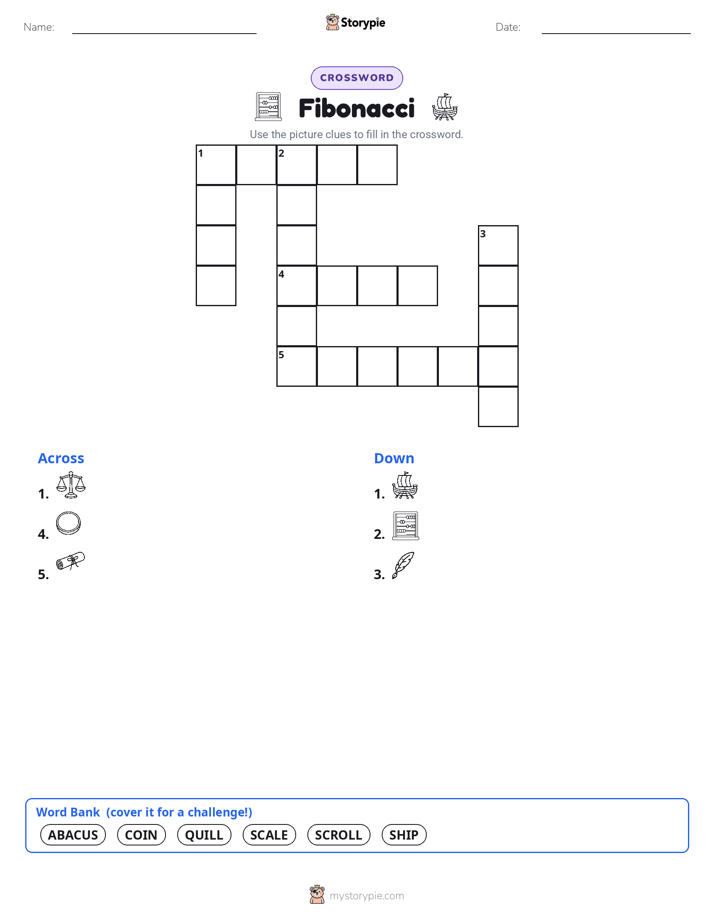
Print & create
Answer keys·No prep·Free with an account
28 worksheets · answer keys · full story · quiz · Ages 10-12 · CEFR B2
Plus adds 164,000+ more stories in 27 languages, audio for every one, and printables for all of them.
Just want Fibonacci?

Hello! You can call me Fibonacci, but my real name is Leonardo of Pisa. I was born around the year 1170 in Pisa, a bustling city in the land we now call Italy. My world was one of ships, trade, and numbers. My father was a merchant, a man of business, and when I was still a boy, his work took him to a trading post in Bugia, a vibrant port city in North Africa. I accompanied him on this journey, leaving my home in Pisa behind. I had no idea at the time, but this move would not just change my life; it would eventually change how the entire world thought about numbers. In the markets and offices of Bugia, I was about to discover a secret that Europe had yet to learn.
In Europe, the world I came from, we counted and calculated using Roman numerals. You may have seen them on clocks or buildings—letters like I, V, and X. For simple counting, they worked well enough, but for the complex calculations a merchant needed to do, they were terribly clumsy. Imagine trying to multiply CXXIII by XLVII. It was a nightmare. But in North Africa, I was introduced to a completely different way of thinking. The merchants there used the Hindu-Arabic numeral system. It was beautifully simple, with just nine symbols and one more that was truly revolutionary: the zero. This placeholder made everything from addition to division incredibly straightforward. I became fascinated. I traveled all around the Mediterranean world, to Egypt, Syria, and Greece, and everywhere I went, I studied how local merchants used this elegant system. I saw firsthand how much more efficient it was for calculating profits, converting currencies, and measuring goods. I knew, with absolute certainty, that I had to bring this powerful knowledge back home to Europe.
Fibonacci: The Man of Numbers
Hello! You can call me Fibonacci, but my real name is Leonardo of Pisa. I was born around the year 1170 in Pisa, a bustling city in the land we now call Italy. My world was one of ships, trade, and numbers. My father was a merchant, a man of business, and when I was still a boy, his work took him to a trading post in Bugia, a vibrant port city in North Africa. I accompanied him on this journey, leaving my home in Pisa behind. I had no idea at the time, but this move would not just change my life; it would eventually change how the entire world thought about numbers. In the markets and offices of Bugia, I was about to discover a secret that Europe had yet to learn.
In Europe, the world I came from, we counted and calculated using Roman numerals. You may have seen them on clocks or buildings—letters like I, V, and X. For simple counting, they worked well enough, but for the complex calculations a merchant needed to do, they were terribly clumsy. Imagine trying to multiply CXXIII by XLVII. It was a nightmare. But in North Africa, I was introduced to a completely different way of thinking. The merchants there used the Hindu-Arabic numeral system. It was beautifully simple, with just nine symbols and one more that was truly revolutionary: the zero. This placeholder made everything from addition to division incredibly straightforward. I became fascinated. I traveled all around the Mediterranean world, to Egypt, Syria, and Greece, and everywhere I went, I studied how local merchants used this elegant system. I saw firsthand how much more efficient it was for calculating profits, converting currencies, and measuring goods. I knew, with absolute certainty, that I had to bring this powerful knowledge back home to Europe.
After my travels, I returned to my home city of Pisa filled with purpose. I knew it wasn't enough for me to simply use these new numbers in my own work; I had to share them with everyone. I dedicated years to writing a comprehensive book that would explain everything I had learned. In 1202, my great work was finally published. I called it Liber Abaci, which in Latin means 'The Book of Calculation'. This book was my attempt to bridge two worlds. In its pages, I carefully explained how to use the nine Hindu-Arabic numerals and, most importantly, the concept of zero. I didn't just present the theory; I filled the book with practical problems that merchants, bookkeepers, and surveyors would encounter in their daily lives. I showed them, step-by-step, how to solve problems of profit and loss, interest, and measurement far more easily than they ever could with Roman numerals. My hope was that this book would open their eyes to a new, more efficient world of mathematics.
To make the lessons in Liber Abaci more engaging, I included a variety of puzzles and thought experiments. I wanted to show that mathematics could be not only useful but also fun. One of these puzzles has become more famous than I ever could have imagined. It posed a simple question: if you start with one pair of rabbits, and every month they produce a new pair, which then also starts producing pairs, how many pairs of rabbits would you have after one year? The solution to this problem revealed a fascinating sequence of numbers. It starts 1, 1, 2, 3, 5, 8, 13, and continues on, with each new number being the sum of the two that came before it. Hundreds of years later, people named this pattern the Fibonacci sequence, in my honor. What is truly amazing is that this sequence appears again and again in the natural world. You can find it in the arrangement of petals on a flower, the spiral chambers of a seashell, the branching of trees, and even the shape of galaxies. It is a beautiful, hidden code that connects mathematics to life itself.
My work did not go unnoticed. As Liber Abaci circulated, my reputation as a mathematician grew, eventually reaching the ears of one of the most powerful and learned men of my time: the Holy Roman Emperor, Frederick II. The emperor was a great patron of science and mathematics and was deeply curious about the ideas I had introduced. Around the year 1225, he visited Pisa and invited me to his court for a mathematical tournament. It was both an honor and a tremendous challenge. The emperor’s own scholars, some of the finest minds in his kingdom, presented me with a series of incredibly difficult problems. They tested my knowledge on everything from algebra to geometry. But I was confident in the methods I had described in my book. Using the power of the Hindu-Arabic system, I was able to solve the problems they put before me. It was a proud moment, as it demonstrated to the emperor and his court the immense practical power of these new mathematical ideas.
The city of Pisa recognized my contributions, and in 1240, I was honored with a salary for my service to the community as a mathematical advisor. I lived a long and full life, to be about 80 years old, passing away around the year 1250. Though my time on Earth ended, my work continued to spread and transform Europe. The Hindu-Arabic numeral system I championed is the very same one you learn in school and use every single day. And my special sequence continues to inspire scientists and artists, showing us the elegant mathematical patterns that connect the smallest flower to the largest galaxy. It is a reminder that the world is full of beautiful, hidden order, just waiting to be discovered.
Wow facts
About
An Italian mathematician from the Republic of Pisa, credited with popularizing the Hindu-Arabic numeral system in Europe through his 1202 book, Liber Abaci. He is also known for the Fibonacci sequence.
Take a Quiz
Question 1 of 5
What was the main goal of Fibonacci's book, *Liber Abaci*, which he published in 1202?
Explore next



Want to do even more?
Go beyond exploring. Unlock tools that turn every story into real learning.

Storypie Plus for families
Full stories, quizzes, and printables. Nights and car rides, sorted.
- Unlimited audio stories
- Create Mode: your child stars in the story
- Offline downloads
- Printable worksheets & coloring pages

Why Storypie for Schools
Students engaged. Prep in seconds. Evenings back to you.
- Worksheets & Quizzes
- Classroom Management
- Formative Assessment
- Custom Curriculum & Lesson Plans
- 27 Languages

Why Storypie for Homeschool
Curriculum done. They'll ask for more. Hours back in your day.
- Worksheet Generator
- First-Person Audio Stories
- Built-in Comprehension Quizzes
- Custom Curriculum & Lesson Plans
- Print & Go Activities