English


Fibonacci
Fibonacci was an Italian mathematician from the Republic of Pisa…
Reads at Grades 3–5 Listens at Grades 1–5
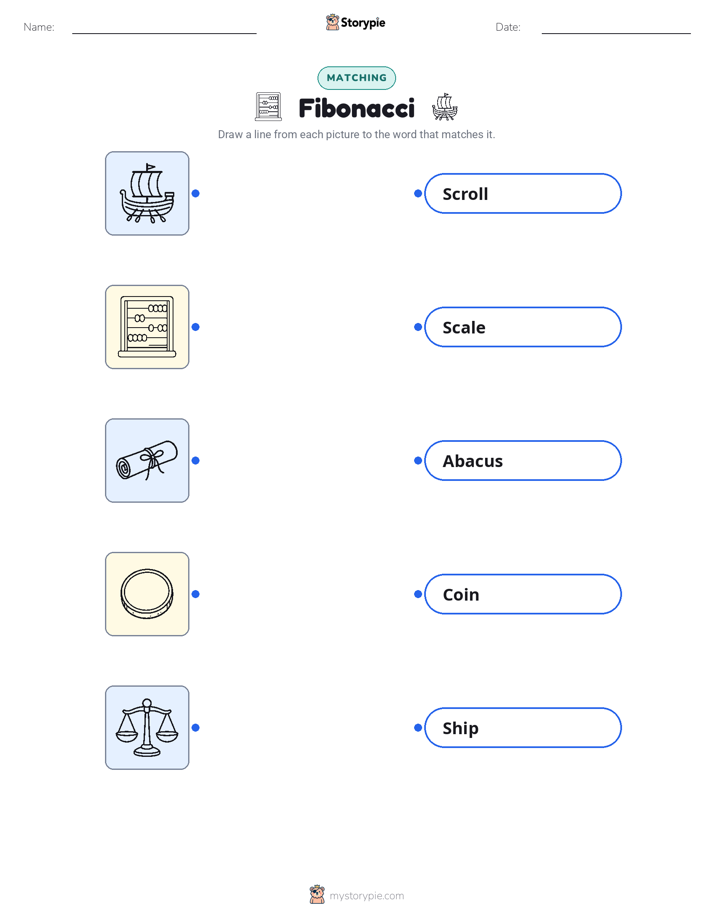
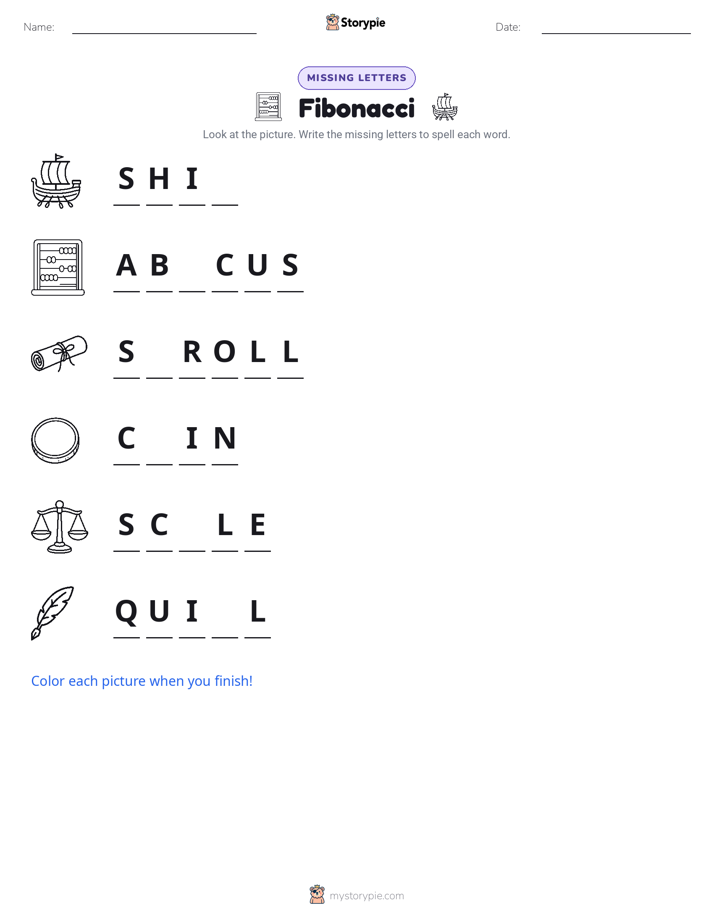
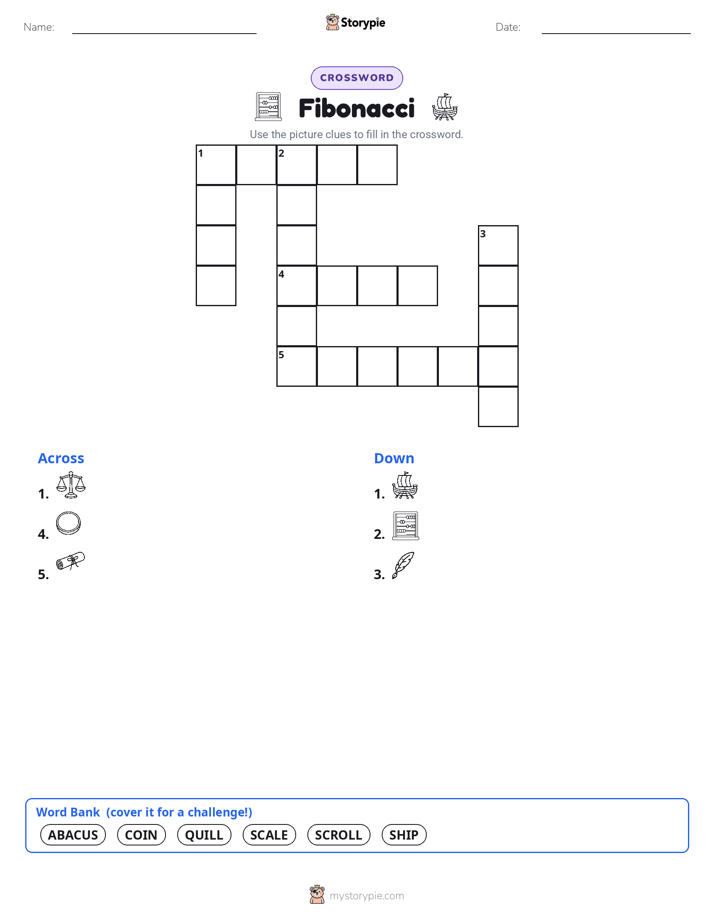
Print & create
Answer keys·No prep·Free with an account
28 worksheets · answer keys · full story · quiz · Ages 8-10 · CEFR B1
Plus adds 164,000+ more stories in 27 languages, audio for every one, and printables for all of them.
Just want Fibonacci?

Hello. My name is Leonardo of Pisa, but many years after my life, people started calling me by my nickname, Fibonacci. I was born around the year 1170 in the city of Pisa, in what is now modern-day Italy. Pisa was a very exciting place to grow up. It was a bustling port city, which means it was full of ships arriving from and sailing to faraway lands. The air was filled with the scents of spices and the sounds of traders from all over the world making deals. My father, Guglielmo, was a merchant, which meant he bought and sold goods for a living. His job was the reason for the biggest adventure of my young life. Around the year 1192, my father’s business took us on a long sea voyage to North Africa. I was curious about this new place, but I never could have guessed how much I would learn there. That trip was the beginning of my journey into the amazing world of numbers, a journey that would change how all of Europe thought about math.
In Europe during my time, everyone used Roman numerals. You might have seen them on old clocks or in books—letters like I, V, and X that stood for numbers. They were fine for writing down a date or a chapter number, but for doing actual mathematics, they were very clumsy. Can you imagine trying to multiply CXXIII by XLVII? It was a nightmare. The calculations were long, confusing, and it was very easy to make a mistake. For my father, Guglielmo, and other merchants, this made business difficult. Adding up costs or dividing profits took a lot of time and effort. But when I was in North Africa, I discovered a much better way. I learned about the Hindu-Arabic numeral system, the same one you use today: 0, 1, 2, 3, 4, 5, 6, 7, 8, and 9. It was a brilliant invention. The most powerful part was the number zero. This symbol for 'nothing' was a genius idea because it allowed for place value. This means that the position of a digit tells you its value. For example, in the number 252, the first 2 means two hundred, while the last 2 means just two. This system made math so much easier and faster. I knew I had to share this incredible discovery.
Fibonacci: The Man Who Loved Numbers
Hello. My name is Leonardo of Pisa, but many years after my life, people started calling me by my nickname, Fibonacci. I was born around the year 1170 in the city of Pisa, in what is now modern-day Italy. Pisa was a very exciting place to grow up. It was a bustling port city, which means it was full of ships arriving from and sailing to faraway lands. The air was filled with the scents of spices and the sounds of traders from all over the world making deals. My father, Guglielmo, was a merchant, which meant he bought and sold goods for a living. His job was the reason for the biggest adventure of my young life. Around the year 1192, my father’s business took us on a long sea voyage to North Africa. I was curious about this new place, but I never could have guessed how much I would learn there. That trip was the beginning of my journey into the amazing world of numbers, a journey that would change how all of Europe thought about math.
In Europe during my time, everyone used Roman numerals. You might have seen them on old clocks or in books—letters like I, V, and X that stood for numbers. They were fine for writing down a date or a chapter number, but for doing actual mathematics, they were very clumsy. Can you imagine trying to multiply CXXIII by XLVII? It was a nightmare. The calculations were long, confusing, and it was very easy to make a mistake. For my father, Guglielmo, and other merchants, this made business difficult. Adding up costs or dividing profits took a lot of time and effort. But when I was in North Africa, I discovered a much better way. I learned about the Hindu-Arabic numeral system, the same one you use today: 0, 1, 2, 3, 4, 5, 6, 7, 8, and 9. It was a brilliant invention. The most powerful part was the number zero. This symbol for 'nothing' was a genius idea because it allowed for place value. This means that the position of a digit tells you its value. For example, in the number 252, the first 2 means two hundred, while the last 2 means just two. This system made math so much easier and faster. I knew I had to share this incredible discovery.
After I returned to Italy, I couldn't stop thinking about how much easier life would be for merchants, bookkeepers, and mathematicians if they knew about this new system. Using Roman numerals was like trying to build a house with crooked tools. The Hindu-Arabic numerals were a set of perfect, powerful tools. I decided that I had to share this knowledge with as many people as I could. The best way to do that, I thought, was to write a book. It was a huge project that took me years of hard work. I gathered all the knowledge I had learned from my travels and organized it carefully. Finally, in the year 1202, I published my book, which I called Liber Abaci. In the Latin language, that means 'The Book of Calculation.' It wasn't just a book about numbers; it was a practical guide. I filled it with real-world problems that merchants would face every day, like how to calculate profit or convert different types of money. And hidden inside its pages, I included a little puzzle about rabbits, just for fun. I had no idea that this simple puzzle would become one of the most famous things I ever wrote.
The rabbit puzzle in my book was about how many pairs of rabbits would be born in one year if you started with just one pair. The answer to this puzzle created a very special sequence of numbers. It starts with 0 and 1. Then, to find the next number, you simply add the two numbers that came before it. So, 0 plus 1 is 1. Then 1 plus 1 is 2. Then 1 plus 2 is 3. The sequence continues: 0, 1, 1, 2, 3, 5, 8, 13, and it goes on forever. At the time, it was just an interesting mathematical pattern. But what I came to find so wondrous is that this pattern isn't just found in books. It is everywhere in the world around us. People later named it the Fibonacci sequence, after me. You can see it in nature. If you count the petals on many flowers, you'll find a number from my sequence. You can see it in the spirals of a pinecone or a pineapple, and even in the beautiful, perfect curve of a seashell.
My work and my book, Liber Abaci, helped slowly change the way people thought about mathematics all across Europe. The new numbers I introduced made everything from trade and bookkeeping to science and engineering much easier and more accurate for everyone. I lived a long and full life and passed away around the year 1250. Even though my life ended, my ideas continued to spread. Today, the number sequence that was named after me is still studied by mathematicians and scientists all over the world. It connects the logical world of math with the beautiful world of nature. So, the next time you see the spiral of seeds in a sunflower or the elegant curve of a seashell, remember my story, because you might just be seeing a little piece of it.
Wow facts
About
Fibonacci was an Italian mathematician from the Republic of Pisa, considered to be 'the most talented Western mathematician of the Middle Ages.' He is best known for popularizing the Hindu-Arabic numeral system in Europe through his 1202 book *Liber Abaci* and for introducing the Fibonacci sequence to Western mathematics.
Take a Quiz
Question 1 of 5
Why did Fibonacci decide to write his book, *Liber Abaci*?
Explore next


Want to do even more?
Go beyond exploring. Unlock tools that turn every story into real learning.

Storypie Plus for families
Full stories, quizzes, and printables. Nights and car rides, sorted.
- Unlimited audio stories
- Create Mode: your child stars in the story
- Offline downloads
- Printable worksheets & coloring pages

Why Storypie for Schools
Students engaged. Prep in seconds. Evenings back to you.
- Worksheets & Quizzes
- Classroom Management
- Formative Assessment
- Custom Curriculum & Lesson Plans
- 27 Languages

Why Storypie for Homeschool
Curriculum done. They'll ask for more. Hours back in your day.
- Worksheet Generator
- First-Person Audio Stories
- Built-in Comprehension Quizzes
- Custom Curriculum & Lesson Plans
- Print & Go Activities