English


Fibonacci
Fibonacci was an Italian mathematician from the Republic of Pisa…
Reads at Grades K-2 Listens at K–3
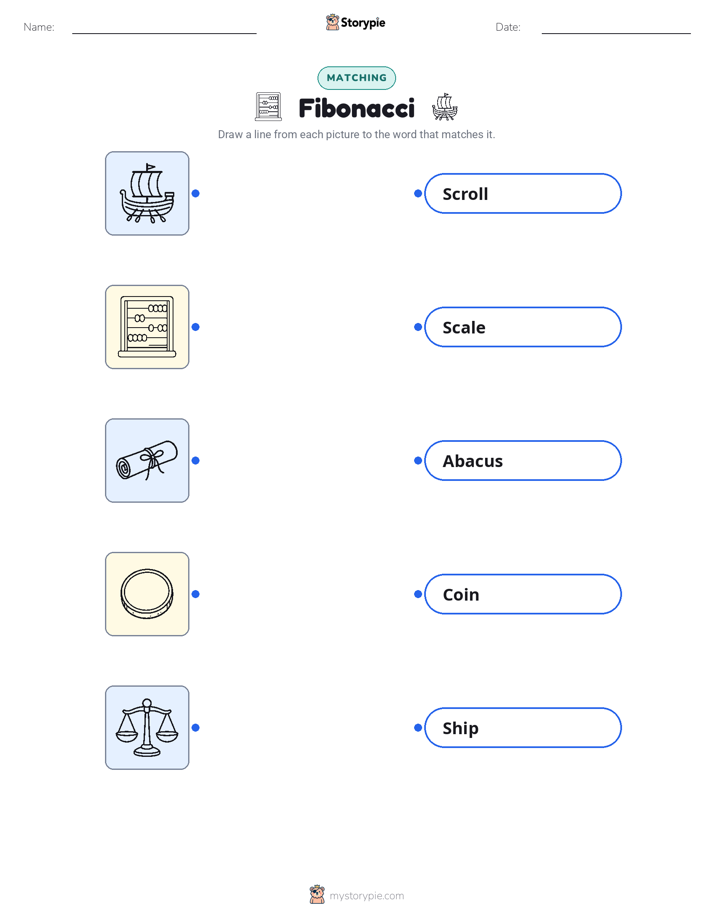
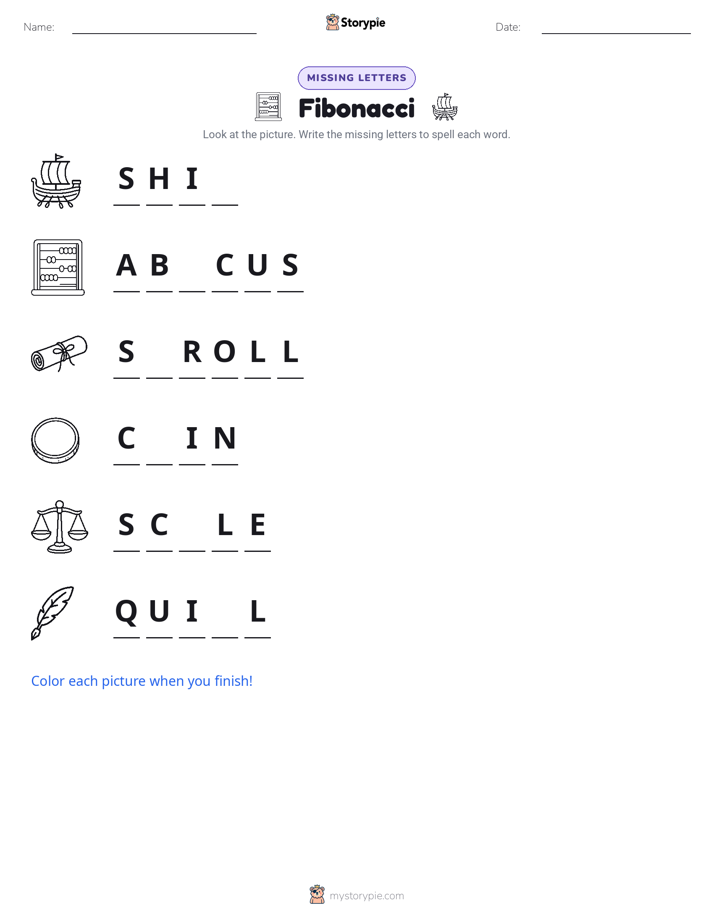
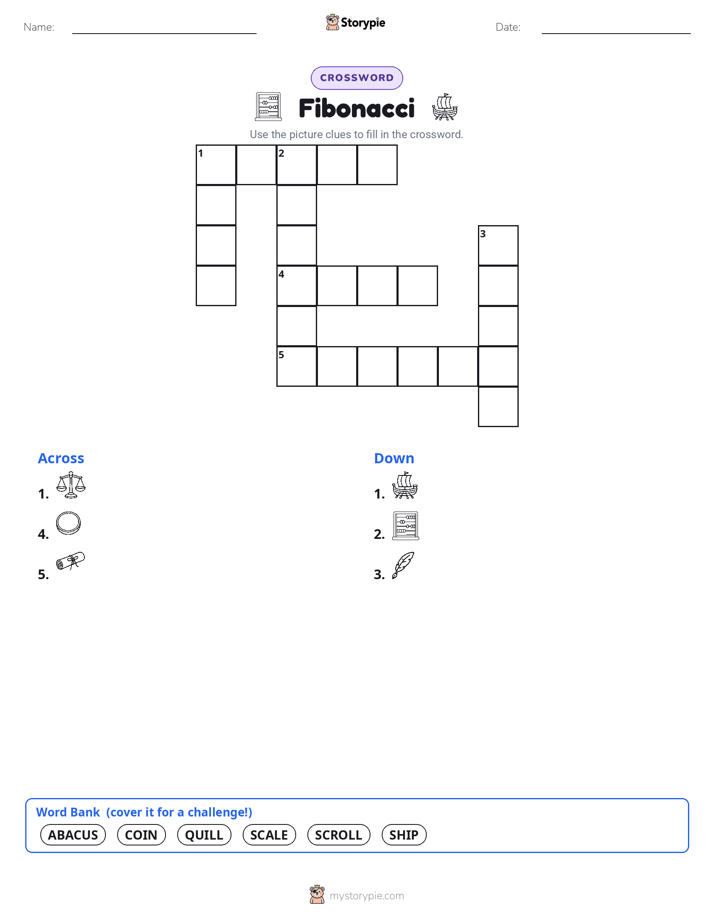
Print & create
Answer keys·No prep·Free with an account
28 worksheets · answer keys · full story · quiz · Ages 6-8 · CEFR A2
Plus adds 164,000+ more stories in 27 languages, audio for every one, and printables for all of them.
Just want Fibonacci?

Hello! My name is Leonardo of Pisa, but many people today know me by my nickname, Fibonacci. I was born in a beautiful city called Pisa, in Italy, around the year 1170. My father, Guglielmo, was a merchant, which is a person who buys and sells things. Because of his job, our family got to travel to many different countries. I loved seeing new places and learning new things, especially about numbers. It was these travels that helped me make a very important discovery that I shared with the world.
On one very important trip, my father took me to North Africa. While I was there, I learned about a wonderful way of writing numbers that was different from what we used back home in Europe. It was called the Hindu-Arabic system. You use it every day. It’s the numbers 0, 1, 2, 3, 4, 5, 6, 7, 8, and 9. Before this, people in Europe used Roman numerals, which were letters like I, V, and X. Can you imagine trying to add CXXIII and XLVII? It was very tricky. I saw right away that the Hindu-Arabic numbers were so much simpler and easier for adding and subtracting. I was so excited, and I knew I had to share this amazing discovery.
When I got back home to Italy, I wanted to teach everyone this better way to do math. So, in the year 1202, I wrote my most famous book, which I called *Liber Abaci*. In a language called Latin, that means 'The Book of Calculation.' I filled the book with examples to show merchants and mathematicians how much easier their work could be using the new numbers. To make the book extra fun, I put in a special math puzzle. It was a question about a family of rabbits and how quickly they could have babies over a year. It was a fun way to practice using the new numbers.
Fibonacci
Hello! My name is Leonardo of Pisa, but many people today know me by my nickname, Fibonacci. I was born in a beautiful city called Pisa, in Italy, around the year 1170. My father, Guglielmo, was a merchant, which is a person who buys and sells things. Because of his job, our family got to travel to many different countries. I loved seeing new places and learning new things, especially about numbers. It was these travels that helped me make a very important discovery that I shared with the world.
On one very important trip, my father took me to North Africa. While I was there, I learned about a wonderful way of writing numbers that was different from what we used back home in Europe. It was called the Hindu-Arabic system. You use it every day. It’s the numbers 0, 1, 2, 3, 4, 5, 6, 7, 8, and 9. Before this, people in Europe used Roman numerals, which were letters like I, V, and X. Can you imagine trying to add CXXIII and XLVII? It was very tricky. I saw right away that the Hindu-Arabic numbers were so much simpler and easier for adding and subtracting. I was so excited, and I knew I had to share this amazing discovery.
When I got back home to Italy, I wanted to teach everyone this better way to do math. So, in the year 1202, I wrote my most famous book, which I called Liber Abaci. In a language called Latin, that means 'The Book of Calculation.' I filled the book with examples to show merchants and mathematicians how much easier their work could be using the new numbers. To make the book extra fun, I put in a special math puzzle. It was a question about a family of rabbits and how quickly they could have babies over a year. It was a fun way to practice using the new numbers.
It turned out that the answer to my rabbit puzzle was not just one number, but a special pattern of numbers. The pattern goes like this: 1, 1, 2, 3, 5, 8, and it keeps on going. Do you see how it works? You just add the last two numbers together to get the next one. So, 1 plus 1 equals 2. Then, 1 plus 2 equals 3. After that, 2 plus 3 equals 5. Years later, people named this special pattern the Fibonacci sequence, after me. The most amazing part is that this pattern is hidden all over in nature, in the petals of a flower or the spiral of a seashell.
I lived a long and full life, and I was about 80 years old when my time on Earth was through. Today, people remember me for two big things. First, for bringing the easy-to-use Hindu-Arabic number system to Europe, which we all still use today. And second, for that special number sequence that shows up in flowers, shells, and pinecones, revealing the beautiful math hidden all around us in our world.
Wow facts
About
Fibonacci was an Italian mathematician from the Republic of Pisa, considered to be 'the most talented Western mathematician of the Middle Ages.' He is best known for popularizing the Hindu-Arabic numeral system in Europe through his 1202 book *Liber Abaci* and for introducing the Fibonacci sequence to Western mathematics.
Take a Quiz
Question 1 of 4
What was Fibonacci's real name?
Explore next



Want to do even more?
Go beyond exploring. Unlock tools that turn every story into real learning.

Storypie Plus for families
Full stories, quizzes, and printables. Nights and car rides, sorted.
- Unlimited audio stories
- Create Mode: your child stars in the story
- Offline downloads
- Printable worksheets & coloring pages

Why Storypie for Schools
Students engaged. Prep in seconds. Evenings back to you.
- Worksheets & Quizzes
- Classroom Management
- Formative Assessment
- Custom Curriculum & Lesson Plans
- 27 Languages

Why Storypie for Homeschool
Curriculum done. They'll ask for more. Hours back in your day.
- Worksheet Generator
- First-Person Audio Stories
- Built-in Comprehension Quizzes
- Custom Curriculum & Lesson Plans
- Print & Go Activities