English


François Viète
François Viète was a French mathematician whose work on algebra was an important step towards modern symbolic…
Reads at Grades 6–8 Listens at Grades 4–8
Print & create
Answer keys·No prep·Free with an account
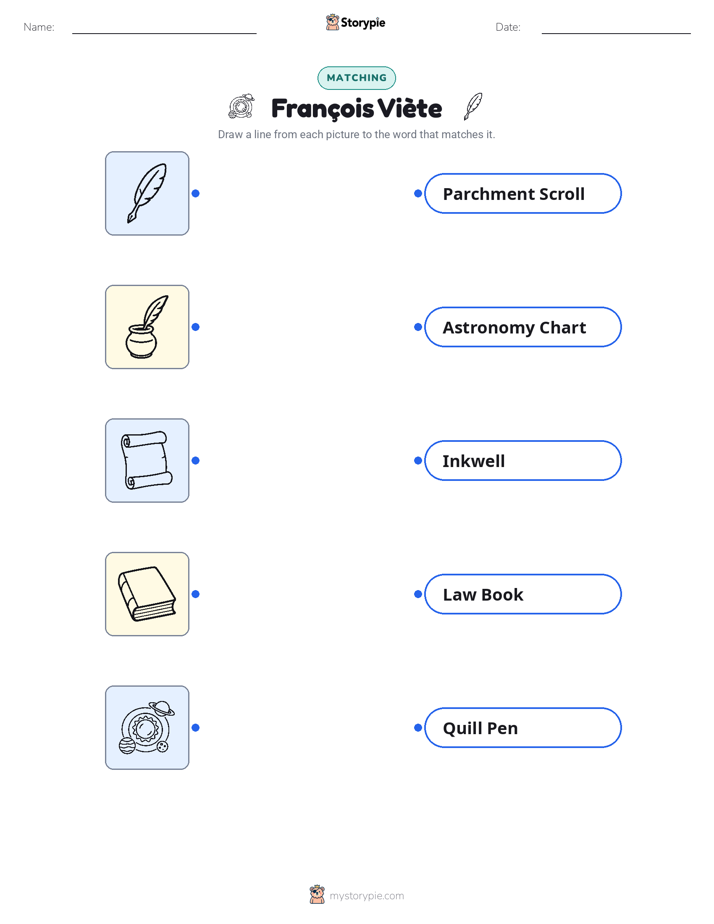
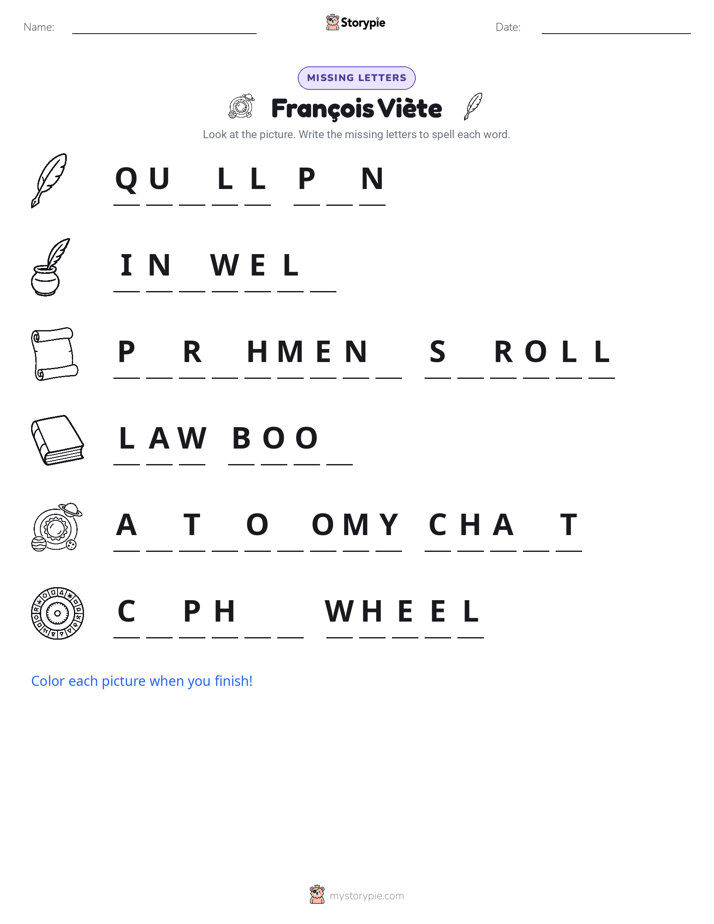
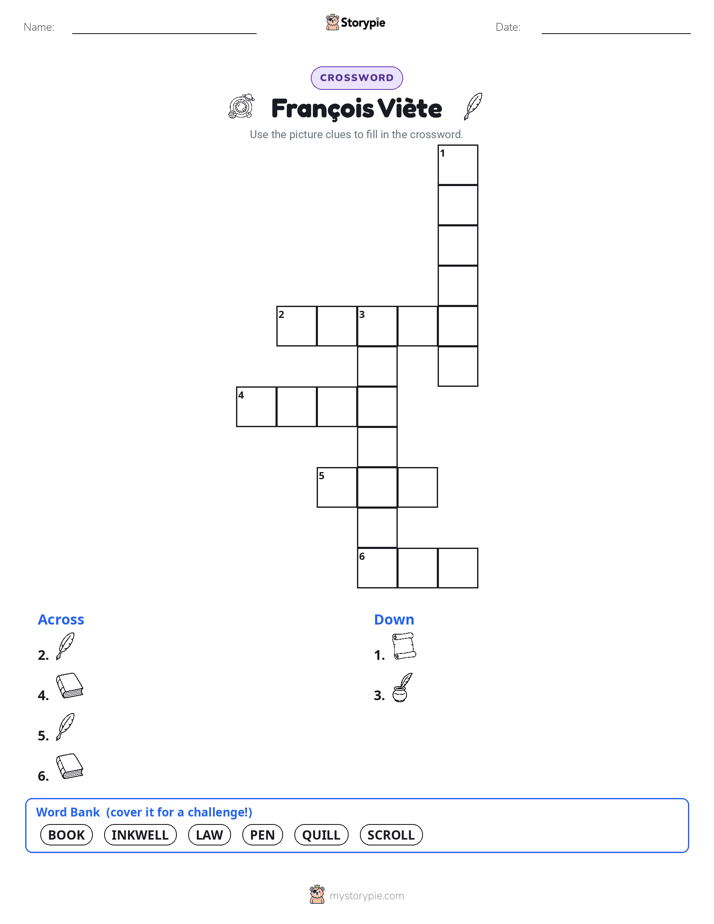
28 worksheets · answer keys · full story · quiz · Ages 10-12 · CEFR B2
Plus adds 244,000+ more stories in 27 languages, audio for every one, and printables for all of them.
Just want François Viète?
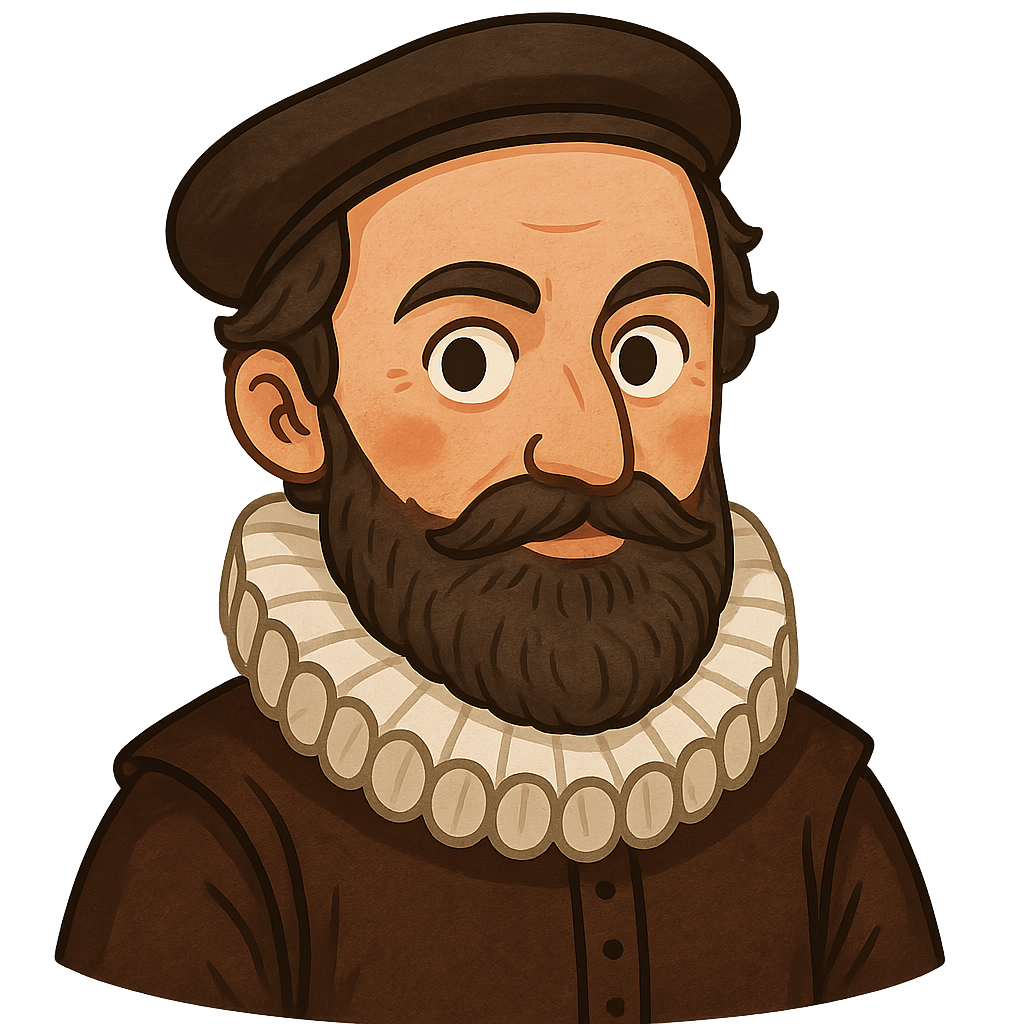
Hello! My name is François Viète, and I would like to tell you my story. I was born in the year 1540 in a town called Fontenay-le-Comte in France, a place of rolling hills and quiet rivers. From a young age, I was fascinated by the world around me, but my family encouraged me to pursue a stable and respected career. I followed their advice and studied law, becoming a lawyer around the year 1560. I found the work of helping people and arguing for justice to be very satisfying. I enjoyed the structure and logic that law required, where one point had to follow clearly from another to build a convincing case. However, even as I dedicated my days to legal matters, my mind was often consumed by my true passion: numbers and the stars. In my spare time, I would lose myself in books about mathematics and astronomy. I loved solving complex puzzles and looking for patterns in the movements of the planets. I soon realized that the very same logic I applied in the courtroom was essential for solving mathematical problems. It was all about finding order and reason in a world that could sometimes feel chaotic.
My reputation as a sharp and logical lawyer grew, and my work brought me into the service of some of the most powerful people in France. Eventually, my journey led me to the royal court, where I was invited to work for the King of France himself. It was a great honor to serve as a privy councillor, first for King Henry III and later for his successor, King Henry IV. My time in the court was set against a backdrop of great turmoil in my country. This period, known as the French Wars of Religion, was a time of conflict and uncertainty. My legal advice was important, but the kings soon discovered that my other skills were just as valuable. They knew of my deep love for mathematics and my talent for solving complex puzzles. Because of this, they entrusted me with a very important and highly secret responsibility: I was to become a codebreaker for the crown. In a time of war, understanding the enemy's plans was a matter of life and death, and my mind for numbers was now a tool for the kingdom.
François Viète: The Father of Modern Algebra
Hello! My name is François Viète, and I would like to tell you my story. I was born in the year 1540 in a town called Fontenay-le-Comte in France, a place of rolling hills and quiet rivers. From a young age, I was fascinated by the world around me, but my family encouraged me to pursue a stable and respected career. I followed their advice and studied law, becoming a lawyer around the year 1560. I found the work of helping people and arguing for justice to be very satisfying. I enjoyed the structure and logic that law required, where one point had to follow clearly from another to build a convincing case. However, even as I dedicated my days to legal matters, my mind was often consumed by my true passion: numbers and the stars. In my spare time, I would lose myself in books about mathematics and astronomy. I loved solving complex puzzles and looking for patterns in the movements of the planets. I soon realized that the very same logic I applied in the courtroom was essential for solving mathematical problems. It was all about finding order and reason in a world that could sometimes feel chaotic.
My reputation as a sharp and logical lawyer grew, and my work brought me into the service of some of the most powerful people in France. Eventually, my journey led me to the royal court, where I was invited to work for the King of France himself. It was a great honor to serve as a privy councillor, first for King Henry III and later for his successor, King Henry IV. My time in the court was set against a backdrop of great turmoil in my country. This period, known as the French Wars of Religion, was a time of conflict and uncertainty. My legal advice was important, but the kings soon discovered that my other skills were just as valuable. They knew of my deep love for mathematics and my talent for solving complex puzzles. Because of this, they entrusted me with a very important and highly secret responsibility: I was to become a codebreaker for the crown. In a time of war, understanding the enemy's plans was a matter of life and death, and my mind for numbers was now a tool for the kingdom.
One of the greatest challenges I faced came during the war with Spain. The Spanish court sent secret messages to its commanders and allies using an incredibly complex cipher. This was no simple code; it was a sophisticated system with more than 500 different symbols, each one designed to confuse anyone who might intercept the letters. The Spanish were so confident in their cipher that it was widely considered to be unbreakable. Between the years 1589 and 1590, King Henry IV presented me with this monumental puzzle. He asked me to apply my skills to decipher the Spanish messages. I accepted the task and spent countless days and nights poring over the coded documents. I filled pages with notes, testing theories, and searching for the hidden patterns I knew must be there. Finally, after intense effort, I found the key. I had cracked the code. This breakthrough was a major turning point, as it allowed the French to read Spain's secret plans and anticipate their moves. The Spanish were so astounded that their unbreakable code had been solved that they accused me of using magic. But I assured everyone it was not sorcery—it was the pure and simple power of mathematics.
While I was proud of my service to the king and my country, I believe my most lasting contribution was in the world of algebra. Before my work, mathematics was a very different field. To solve an algebraic problem, mathematicians had to write everything out in long, descriptive sentences. For example, instead of writing '3x² + 5x = 10,' they would have to write something like 'Three times the square of a quantity, added to five times the quantity, is equal to ten.' It was very clumsy and inefficient. I knew there had to be a better way. In my book, In artem analyticem isagoge, which was published in 1591, I introduced a revolutionary idea. I proposed that we use letters to represent numbers systematically. I suggested using vowels for unknown quantities—the numbers we are trying to find—and consonants for known quantities, or the numbers given in the problem. This simple change transformed algebra. It created a symbolic language that allowed us to write general formulas that could solve not just one specific problem, but entire categories of problems. This innovation laid the groundwork for modern algebra, and it is why many people call me the 'father of modern algebra.'
I continued my work in both mathematics and my service to the crown for the rest of my life, always seeking new patterns to discover and new problems to solve. My journey came to an end in Paris on December 13th, 1603. I lived to be about 63 years old. Though my life is over, the ideas I introduced are still fundamental to the study of mathematics today. Every time a student uses a letter like 'x' or 'y' to solve an equation, they are using the new language for algebra that I helped to create. My story shows that a passion for puzzles and logic can do more than just solve a riddle; it can help solve some of the world's biggest challenges, from breaking secret codes to unlocking the universal mysteries of mathematics.
Wow facts
About
François Viète was a French mathematician whose work on algebra was an important step towards modern symbolic algebra. He is known for introducing the use of letters to represent both variables and constants in equations.
Take a Quiz
Question 1 of 5
What was the main problem François Viète was asked to solve for King Henry IV, and what was the result?
Explore next






Want to do even more?
Go beyond exploring. Unlock tools that turn every story into real learning.

Storypie Plus for families
Full stories, quizzes, and printables. Nights and car rides, sorted.
- Unlimited audio stories
- Create Mode: your child stars in the story
- Offline downloads
- Printable worksheets & coloring pages

Why Storypie for Schools
Students engaged. Prep in seconds. Evenings back to you.
- Worksheets & Quizzes
- Classroom Management
- Formative Assessment
- Custom Curriculum & Lesson Plans
- 27 Languages

Why Storypie for Homeschool
Curriculum done. They'll ask for more. Hours back in your day.
- Worksheet Generator
- First-Person Audio Stories
- Built-in Comprehension Quizzes
- Custom Curriculum & Lesson Plans
- Print & Go Activities