English

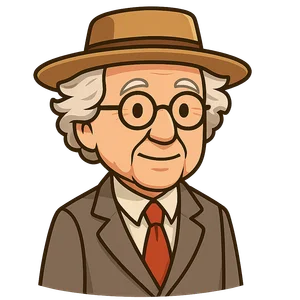
Frank Lloyd Wright
Frank Lloyd Wright was a pioneering American architect, designer, writer…
Reads at Grades 3–5 Listens at Grades 1–5
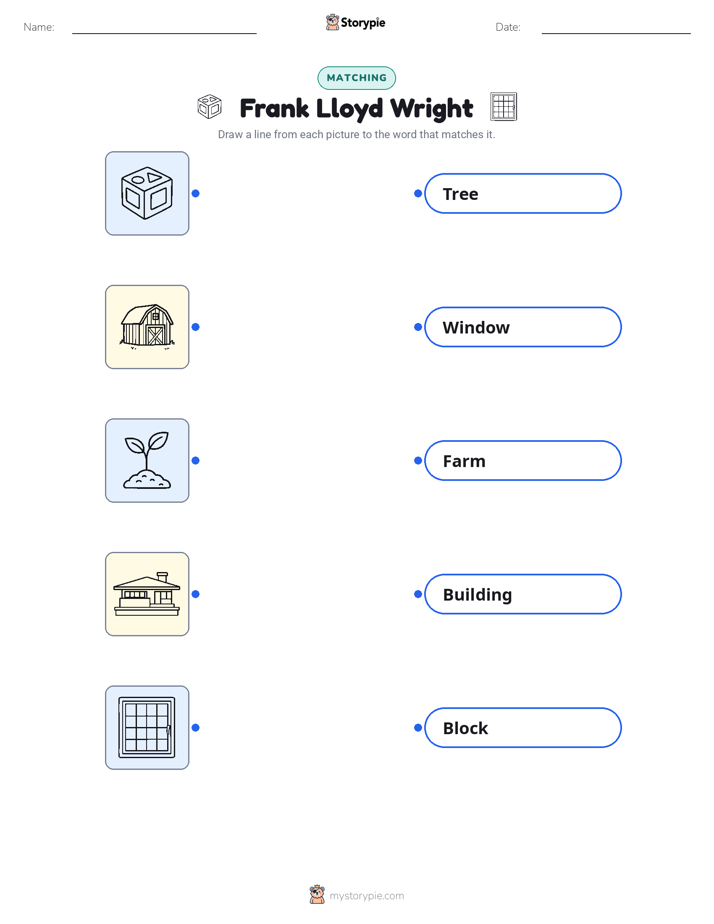
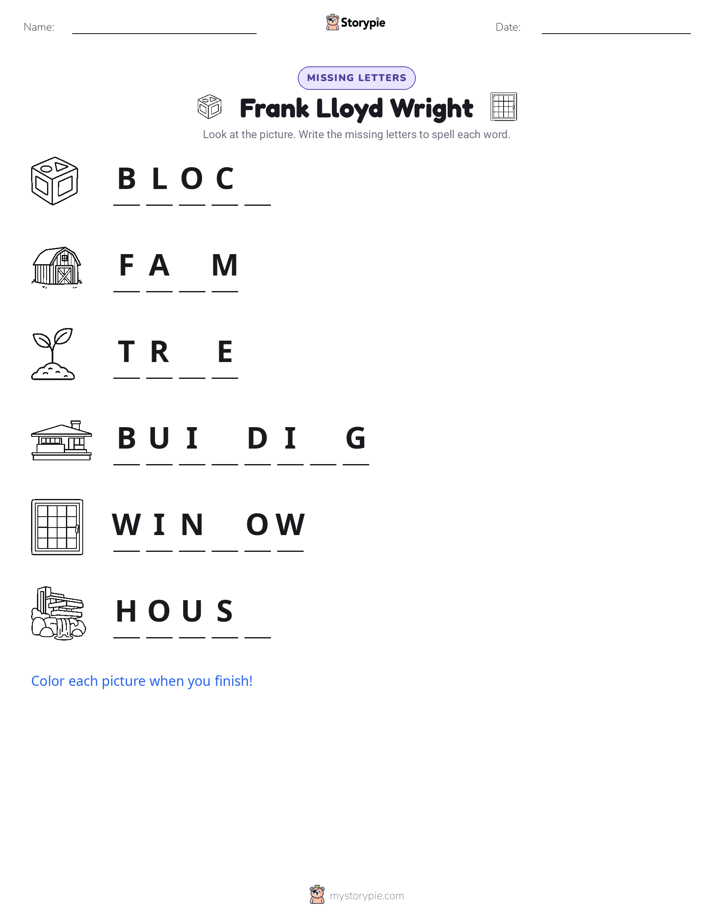
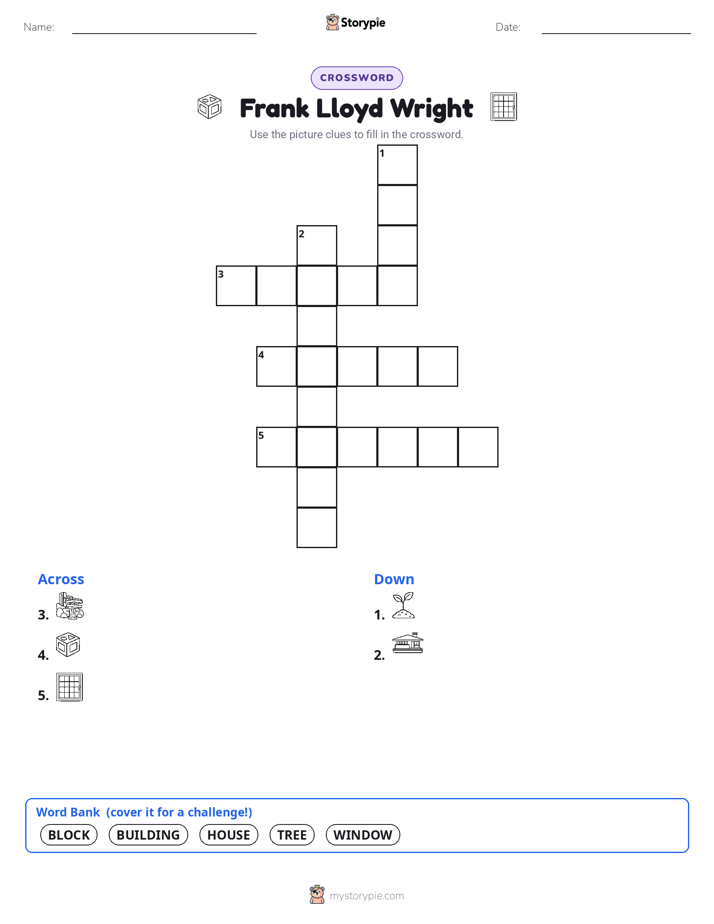
Print & create
Answer keys·No prep·Free with an account
28 worksheets · answer keys · full story · quiz · Ages 8-10 · CEFR B1
Plus adds 244,000+ more stories in 27 languages, audio for every one, and printables for all of them.
Just want Frank Lloyd Wright?
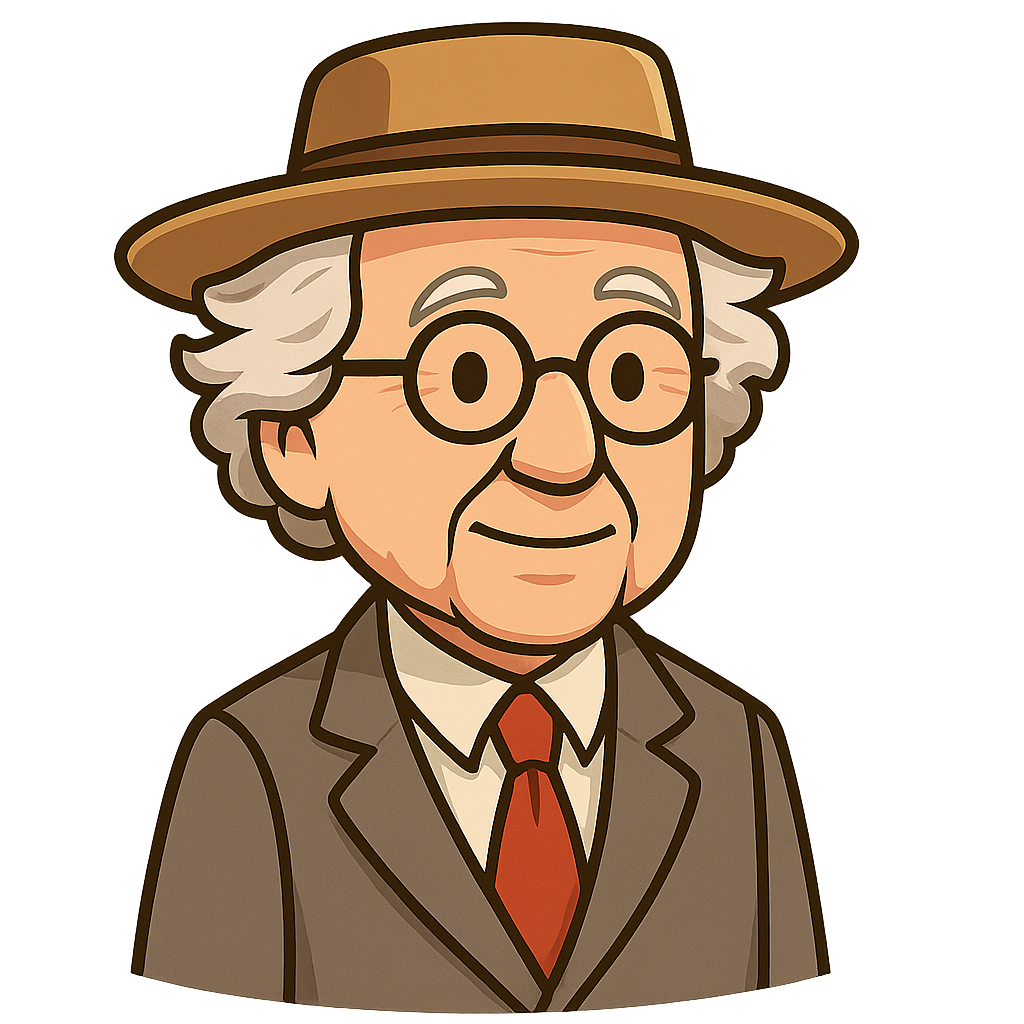
Hello! My name is Frank Lloyd Wright, and I became an architect, someone who designs buildings. My story begins on a farm in Wisconsin, where I was born on June 8th, 1867. My mother, Anna, was a teacher and she believed I was destined to build beautiful things. When I was a boy, she gave me a special set of wooden blocks called Froebel Gifts. I spent hours and hours arranging the smooth, geometric blocks—cubes, spheres, and cylinders—into all sorts of towers and towns. I didn't know it then, but those simple toys were teaching my young mind about shapes, patterns, and how things fit together. They sparked a love for design that would last my entire life.
When I grew up, I knew I had to learn more about how real buildings were made. After studying engineering for a short time at the University of Wisconsin, I moved to the big, busy city of Chicago in 1887. It was an exciting time, with new skyscrapers reaching for the clouds! I got a job with a famous architect named Louis Sullivan. He was my mentor, and he taught me a very important idea: 'form follows function.' That means the design of a building should be based on its purpose. I worked for him for six years, learning everything I could about drawing plans and creating strong, useful structures. But deep down, I had my own ideas I was eager to try.
In 1893, I started my own architecture firm. I looked at the houses around me and thought they looked like stuffy, dark boxes. They didn't seem to belong in the wide-open American Midwest where I grew up. So, I created a new style called the 'Prairie School.' My Prairie houses had low, horizontal roofs that echoed the flat prairie land. They had long rows of windows to let in lots of natural light and open floor plans inside so families could move around freely. One of my most famous Prairie houses is the Robie House in Chicago, which I designed in 1908. My goal was to make a truly American style of architecture, connected to the land.
Frank Lloyd Wright: Building with Nature
Hello! My name is Frank Lloyd Wright, and I became an architect, someone who designs buildings. My story begins on a farm in Wisconsin, where I was born on June 8th, 1867. My mother, Anna, was a teacher and she believed I was destined to build beautiful things. When I was a boy, she gave me a special set of wooden blocks called Froebel Gifts. I spent hours and hours arranging the smooth, geometric blocks—cubes, spheres, and cylinders—into all sorts of towers and towns. I didn't know it then, but those simple toys were teaching my young mind about shapes, patterns, and how things fit together. They sparked a love for design that would last my entire life.
When I grew up, I knew I had to learn more about how real buildings were made. After studying engineering for a short time at the University of Wisconsin, I moved to the big, busy city of Chicago in 1887. It was an exciting time, with new skyscrapers reaching for the clouds! I got a job with a famous architect named Louis Sullivan. He was my mentor, and he taught me a very important idea: 'form follows function.' That means the design of a building should be based on its purpose. I worked for him for six years, learning everything I could about drawing plans and creating strong, useful structures. But deep down, I had my own ideas I was eager to try.
In 1893, I started my own architecture firm. I looked at the houses around me and thought they looked like stuffy, dark boxes. They didn't seem to belong in the wide-open American Midwest where I grew up. So, I created a new style called the 'Prairie School.' My Prairie houses had low, horizontal roofs that echoed the flat prairie land. They had long rows of windows to let in lots of natural light and open floor plans inside so families could move around freely. One of my most famous Prairie houses is the Robie House in Chicago, which I designed in 1908. My goal was to make a truly American style of architecture, connected to the land.
My biggest idea was what I called 'organic architecture.' I believed that a building should seem like it grew right out of the landscape, like a tree or a flower. It should be in harmony with its natural surroundings, using materials like local stone and wood. In 1935, I got the chance to design my most famous example of this idea: a house called Fallingwater in Pennsylvania. The family who hired me wanted a house with a view of their favorite waterfall. So, instead of putting the house next to the waterfall, I built it right on top of it! The sound of the water flows through the house, and stone from the property makes up its walls. It’s a perfect blend of human design and the beauty of nature. My own homes, which I named Taliesin in Wisconsin and Taliesin West in Arizona, were also designed to be part of the hills and desert around them.
I didn't just design houses. I designed hotels, offices, churches, and even museums. In the early 1920s, I designed the Imperial Hotel in Tokyo, Japan. I made its foundation so clever that in 1923, it was one of the only large buildings left standing after a huge earthquake shook the city. One of my last and most famous buildings is the Solomon R. Guggenheim Museum in New York City. Instead of floors, it has a long, continuous ramp that spirals up toward a glass ceiling, like the inside of a seashell. I wanted people to experience art in a whole new way. It opened in 1959, just after I was gone, but it showed my dream of creating buildings that were works of art themselves.
I designed over 1,000 buildings in my career, and more than 500 of them were built. I lived a very long and full life, creating and dreaming until I was 91 years old. Today, people remember me as one of America's greatest architects. My buildings, like Fallingwater and the Guggenheim, are visited by people from all over the world. I hope my work inspires you to look at the world differently and to see that the things we build can be beautiful, useful, and in perfect harmony with nature.
Wow facts
About
Frank Lloyd Wright was a pioneering American architect, designer, writer, and educator who is widely considered one of the greatest architects of the 20th century. He is best known for his philosophy of organic architecture and for designing iconic buildings like Fallingwater and the Solomon R. Guggenheim Museum.
Take a Quiz
Question 1 of 5
According to the story, what famous house did I build right on top of a waterfall?
Explore next






Want to do even more?
Go beyond exploring. Unlock tools that turn every story into real learning.

Storypie Plus for families
Full stories, quizzes, and printables. Nights and car rides, sorted.
- Unlimited audio stories
- Create Mode: your child stars in the story
- Offline downloads
- Printable worksheets & coloring pages

Why Storypie for Schools
Students engaged. Prep in seconds. Evenings back to you.
- Worksheets & Quizzes
- Classroom Management
- Formative Assessment
- Custom Curriculum & Lesson Plans
- 27 Languages

Why Storypie for Homeschool
Curriculum done. They'll ask for more. Hours back in your day.
- Worksheet Generator
- First-Person Audio Stories
- Built-in Comprehension Quizzes
- Custom Curriculum & Lesson Plans
- Print & Go Activities