English

Franz Liszt
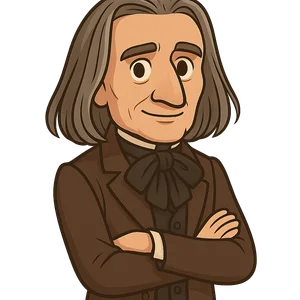
Franz Liszt was a Hungarian composer, virtuoso pianist, conductor, and teacher of the Romantic era…
Reads at Grades 6–8 Listens at Grades 4–8
Print & create
Answer keys·No prep·Free with an account
28 worksheets · answer keys · full story · quiz · Ages 10-12 · CEFR B2
Plus adds 208,000+ more stories in 27 languages, audio for every one, and printables for all of them.
Just want Franz Liszt?
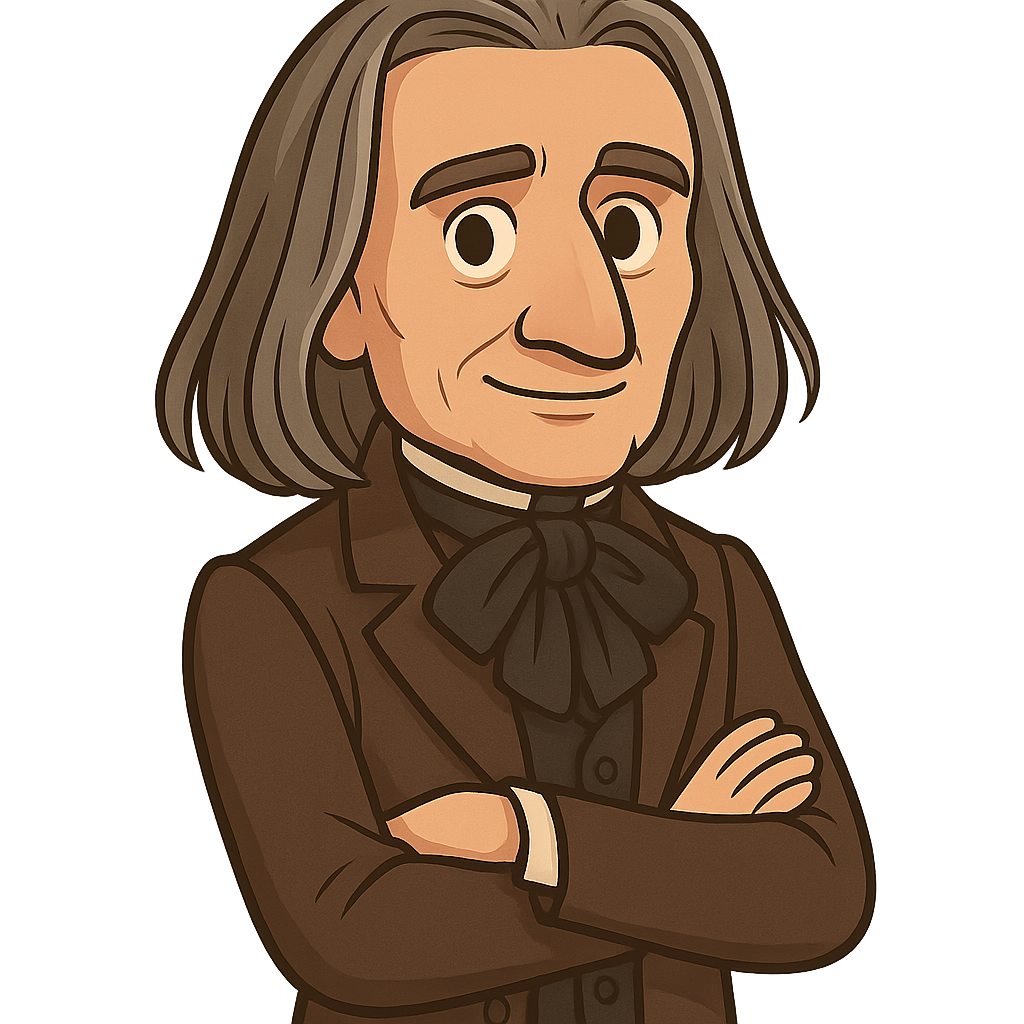
Hello, my name is Franz Liszt, and I am a composer and pianist who helped change the world of music. My story begins on October 22nd, 1811, in the small town of Raiding in the Kingdom of Hungary. My world was filled with music from the very start. My father, Adam Liszt, was a musician himself, working for the wealthy and powerful Esterházy family. He noticed my fascination with the piano and began giving me lessons when I was just six years old. I took to the instrument immediately, and it felt like the piano keys were an extension of my own voice. By the age of nine, I was ready for my first public performance. In 1820, I played a concert that amazed the audience. A group of wealthy patrons were so impressed that they offered to sponsor my education. Thanks to their generosity, my family moved to Vienna, a grand city of music, where I could study with the very best teachers. One of my instructors was Carl Czerny, who had once been a student of the great Ludwig van Beethoven. It was an incredible honor and the beginning of a life dedicated to music.
In 1823, my family moved to Paris, and it was there that my career truly took flight. I became a sensation, known as a touring virtuoso. This meant I traveled all across Europe, from city to city, performing for large and enthusiastic audiences. The 1830s and 1840s were an especially exciting time. My concerts became so popular that a new word was invented to describe the incredible excitement of the crowds: 'Lisztomania.' People would scream and cheer as if I were a modern rock star. I tried to make my performances unforgettable. I was one of the first performers to play entire concerts from memory, without any sheet music in front of me. I also invented the solo piano recital, where a single pianist would perform for the entire evening, which was a brand new idea at the time. During these years of constant travel, I had the great fortune of meeting other famous artists and musicians, and these friendships inspired my own work and pushed me to explore new creative paths.
Franz Liszt: A Life in Music
Hello, my name is Franz Liszt, and I am a composer and pianist who helped change the world of music. My story begins on October 22nd, 1811, in the small town of Raiding in the Kingdom of Hungary. My world was filled with music from the very start. My father, Adam Liszt, was a musician himself, working for the wealthy and powerful Esterházy family. He noticed my fascination with the piano and began giving me lessons when I was just six years old. I took to the instrument immediately, and it felt like the piano keys were an extension of my own voice. By the age of nine, I was ready for my first public performance. In 1820, I played a concert that amazed the audience. A group of wealthy patrons were so impressed that they offered to sponsor my education. Thanks to their generosity, my family moved to Vienna, a grand city of music, where I could study with the very best teachers. One of my instructors was Carl Czerny, who had once been a student of the great Ludwig van Beethoven. It was an incredible honor and the beginning of a life dedicated to music.
In 1823, my family moved to Paris, and it was there that my career truly took flight. I became a sensation, known as a touring virtuoso. This meant I traveled all across Europe, from city to city, performing for large and enthusiastic audiences. The 1830s and 1840s were an especially exciting time. My concerts became so popular that a new word was invented to describe the incredible excitement of the crowds: 'Lisztomania.' People would scream and cheer as if I were a modern rock star. I tried to make my performances unforgettable. I was one of the first performers to play entire concerts from memory, without any sheet music in front of me. I also invented the solo piano recital, where a single pianist would perform for the entire evening, which was a brand new idea at the time. During these years of constant travel, I had the great fortune of meeting other famous artists and musicians, and these friendships inspired my own work and pushed me to explore new creative paths.
After many years on the road, I felt a need to change my focus. The constant touring was thrilling, but I wanted to dedicate more of my time to composing and helping other musicians. In 1848, I made a significant change in my life by accepting a position as the Music Director in the city of Weimar, Germany. This new role allowed me to settle down and explore different parts of my musical identity. Instead of just performing, I was now conducting orchestras and composing my own large-scale works. It was during this period that I created a new form of music called the 'symphonic poem.' These were orchestral pieces that told a story, painted a picture, or explored a philosophical idea through sound. My time in Weimar wasn't just about my own work. I used my position to support other composers whose music I believed in, including my friend Richard Wagner. I conducted performances of his new and sometimes controversial music, helping to introduce his powerful works to the public.
As I grew older, my interests expanded beyond the concert hall. In 1861, I moved to Rome, a city rich with history and spiritual significance. I had always had a deep interest in religion, and my time there allowed me to explore my faith more deeply. In 1865, I took minor orders in the Catholic Church and was given the title 'Abbé' Liszt. This did not mean I abandoned music; on the contrary, my faith inspired me to compose a great deal of sacred music, including masses and oratorios. Perhaps one of the most important parts of my later life was my dedication to teaching. I wanted to pass on what I had learned to the next generation of pianists. I gave free lessons to hundreds of talented students who traveled from all over the world to study with me. Helping these young artists find their own musical voices brought me immense joy, and it was a practice I continued for the rest of my life.
Looking back, my life was a journey through many different worlds—from the energetic concert stages filled with adoring crowds to the quiet halls of a Roman monastery. I lived to be 74 years old and passed away in Bayreuth, Germany, on July 31st, 1886. I hope I am remembered not just for my dazzling piano playing, but for my contributions as a composer and a teacher. My greatest wish is that my music continues to inspire people to feel deeply and that my work is seen as an effort to push the boundaries of what music could be, helping to shape its future for generations to come.
Wow facts
About
Franz Liszt was a Hungarian composer, virtuoso pianist, conductor, and teacher of the Romantic era, renowned for his incredible performance skills, innovative compositions, and the intense fan frenzy he inspired, known as 'Lisztomania.'
Take a Quiz
Question 1 of 5
What does the term 'Lisztomania' refer to in the story?
Explore next



Want to do even more?
Go beyond exploring. Unlock tools that turn every story into real learning.

Storypie Plus for families
Full stories, quizzes, and printables. Nights and car rides, sorted.
- Unlimited audio stories
- Create Mode: your child stars in the story
- Offline downloads
- Printable worksheets & coloring pages

Why Storypie for Schools
Students engaged. Prep in seconds. Evenings back to you.
- Worksheets & Quizzes
- Classroom Management
- Formative Assessment
- Custom Curriculum & Lesson Plans
- 27 Languages

Why Storypie for Homeschool
Curriculum done. They'll ask for more. Hours back in your day.
- Worksheet Generator
- First-Person Audio Stories
- Built-in Comprehension Quizzes
- Custom Curriculum & Lesson Plans
- Print & Go Activities